VN
VN
 EN
EN
10/07/2026, 02:38
Business economics
Credit institutions forecast continued improvement in liquidity
Credit institutions (CIs) forecast that the liquidity situation will continue to improve in the third quarter of 2026 and for the whole year of 2026.
According to a survey conducted by the Department of Forecasting and Statistics under the State Bank of Vietnam (SBV), the overall risk level of customer groups was assessed by CIs to have continued to "increase" in the second quarter of 2026, but is expected to rise at a slower pace in the third quarter of 2026.
Capital Shifts and Loan Demand
Assessing the overall outlook for 2026, credit institutions predict that the general risk profile across customer groups will increase compared to 2025. The two more vulnerable segments identified are "Joint-stock companies, LLCs, and private enterprises" and "Small and medium-sized enterprises (SMEs)."
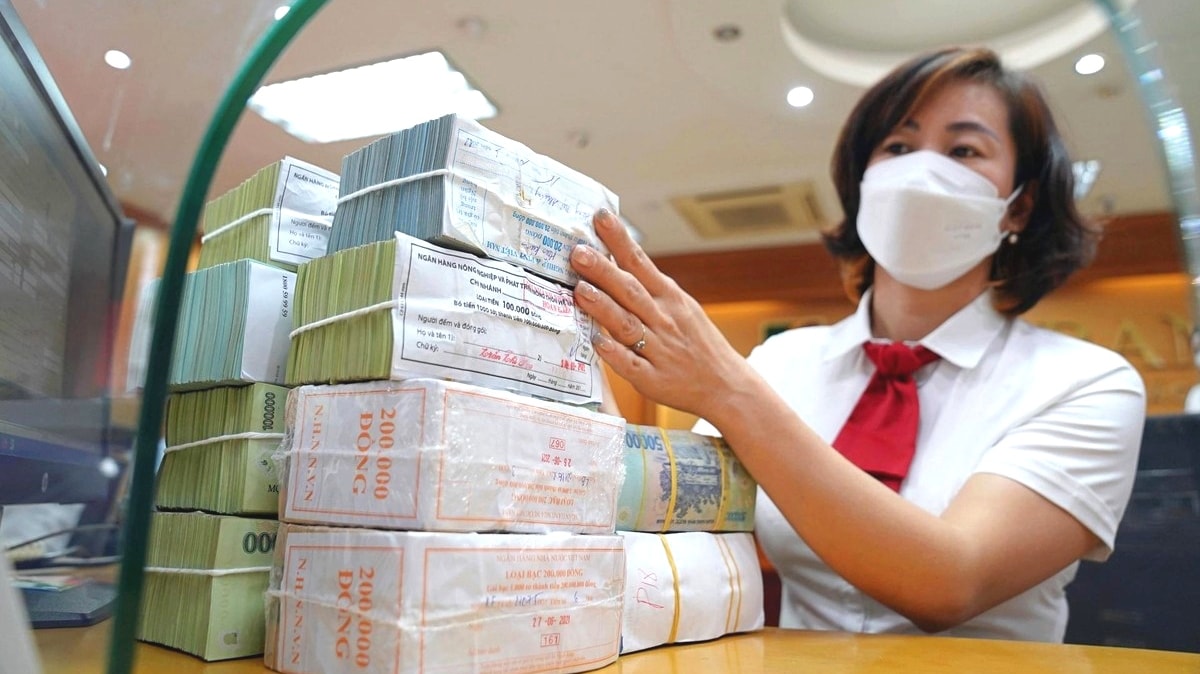
Credit institutions forecast that the liquidity situation will continue to improve in Q3/2026, the full year of 2026, and 2027. (Illustrative photo)
Given this assessment, CIs noted that they have slightly adjusted upwards the average prices of their products and services, including marginal interest rates and service fees, in 2026 to compensate for risks.
CIs reported that customer demand for banking services (including deposits, payment services, and loans) in Q2/2026 "improved" more strongly than in Q1/2026.
Among these, the demand for loans was seen as having the most significant "improvement," while deposit and payment demands continued to improve but at a lower rate than the previous quarter.
An important economic signal is the shift in capital flows, as the loan demand from institutional customers (enterprises) has surpassed that of individual customers to become the primary driver of growth.
For Q3/2026 and the entirety of 2026, CIs expect customer demand for banking services to continue to "improve" even more robustly than previously anticipated in the prior survey cycle. Loan demand is expected to continue outperforming deposit and payment demands.
Liquidity Set to Keep Improving
According to the credit institutions' observations, the liquidity of the banking system in Q2/2026 remained in a "good" state, though there were signs of slight narrowing.
CIs project that the liquidity situation will continue to get better in Q3/2026, throughout 2026, and into 2027.
In this survey round, CIs adjusted their capital mobilization growth expectations down by 1.6 percentage points (pp) to 14.3%, and their credit growth expectations down by 1.5 pp to 14.5% for the full year of 2026 compared to the previous survey. At the same time, they expect an average growth rate of 4.2% in Q3/2026 for both capital mobilization and outstanding credit.
Short-term capital mobilization is still projected to grow faster than long-term mobilization. However, medium and long-term credit is forecasted to outpace short-term credit, reflecting a shift in credit structure toward fixed asset and infrastructure investment projects—aligned with the Government's orientation toward sustainable growth support.
The survey results also show that the non-performing loan (NPL) ratio of the entire system maintained a slight downward trend. Although the pace of reduction slowed down in Q2/2026, it is expected to improve again in Q3/2026.
Optimistic Business Outlook for the Full Year
The overall business situation and pre-tax profits of the banking system in Q2/2026 were noted by CIs to have continued improving compared to the previous quarter. While maintaining relative stability, these figures still fell short of expectations from the prior survey.

Credit loan demand and financial resources of enterprises are forecast to increase sharply in the final months of the year. CIs expect the ratio of positive objective factors to rise to 72.3% for the whole year of 2026. (Illustrative photo)
Business operations are expected to continue expanding in Q3/2026, and the outlook for the entire year remains optimistic.
On that basis, 84.1% of CIs expect their 2026 pre-tax profits to see positive growth compared to 2025. Conversely, 10.6% of CIs express concern over negative profit growth, while 5.3% expect profits to remain unchanged.
Internal factors continue to play a proactive role in supporting business performance, with 69.9% to 76.8% of CIs evaluating and expecting internal drivers to help improve business conditions in Q2/2026 and throughout the year. The level of optimism has also ticked up compared to the last survey period.
Additionally, the impact of objective (external) factors continues to be viewed more positively. Currently, 67% of CIs state that external factors have "improved" their business conditions. For the full year of 2026, the proportion of CIs expecting positive impacts from objective factors rises to 72.3%.
Regarding the banking labor market, the survey reveals that by the end of Q2/2026, the shortage of labor among CIs dropped significantly compared to the end of Q1/2026 (23.9% of CIs reported a labor shortage, down from 27.2% in the previous quarter).
During Q2/2026, CIs maintained a net hiring trend, with 43.9% stating they hired additional staff, while 26.4% downsized. Looking ahead to Q3/2026 and the full year, about 50% to 52.7% of CIs plan to recruit more employees to meet operational demands.
Author: LE MY - TRUONG DANG
RELATED TOPICS
RECOMMENDED TOPICS