VN
VN
 EN
EN
10/07/2026, 02:38
Business economics
Rising logistics costs: What businesses need to do to regain competitiveness
Logistics costs have increased sharply in the context of rising transport costs, inconsistent connection infrastructure and fluctuating global supply chains, creating unprecedented pressure on domestic businesses.
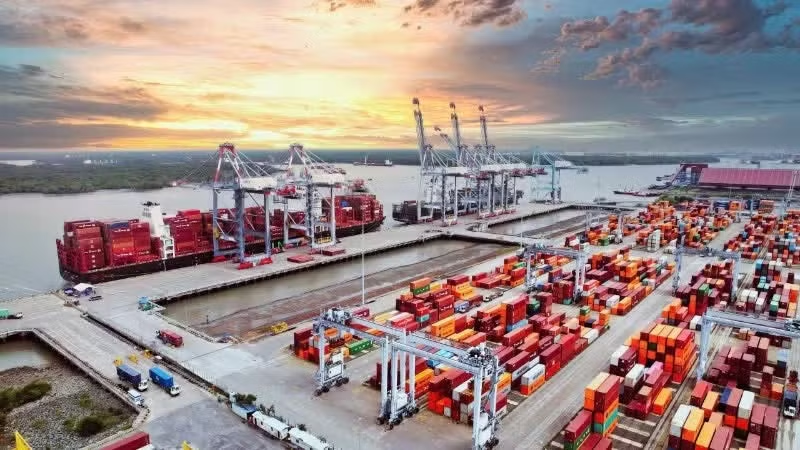
As logistics costs account for an increasingly large share of product prices, many businesses believe that unless bottlenecks in infrastructure, connectivity, and policy mechanisms are addressed promptly, the competitiveness of Vietnamese goods will continue to decline.
This was also one of the key topics discussed and shared by businesses at the 90th business coffee programme recently organised by the Ho Chi Minh City Union of Business Associations (HUBA).
Businesses struggle with rising logistics costs
Within just a few months, logistics costs have become a major burden for many exporting businesses, particularly those in the agricultural, food, and fresh produce sectors. In addition to sharp increases in freight rates, businesses are facing longer delivery times, shortages of transport capacity, and a range of additional surcharges.
Phan Minh Thong, Chairman of the Board of Directors of Phuc Sinh Joint Stock Company, said: "Never before have logistics costs placed such enormous pressure on businesses. Previously, we spent only around 7–8 billion VND per month on shipping costs. However, in June alone, this figure reached 17 billion VND. Including other surcharges, our total logistics costs rose to around 22 billion VND, accounting for more than half of our monthly operating expenses."
"These costs are directly eroding business profits, reducing resources available for production expansion and weakening the competitiveness of Vietnamese goods in international markets," Thong added.
Similarly, Vina T&T Group is also struggling with rapidly increasing transportation costs. Nguyen Dinh Tung, Chairman and Chief Executive Officer of the company, said that within a short period, ocean freight rates for refrigerated containers had increased from approximately 2,800 USD to 7,800 USD per container, representing an increase of nearly 200%.
More importantly, even after agreeing to these exceptionally high rates, businesses still face difficulties in securing shipping space and must arrange transportation plans well in advance. Meanwhile, contracts with overseas partners have already been signed, leaving businesses with virtually no room to adjust selling prices. As a result, they must absorb almost all the additional costs themselves.
Beyond market fluctuations, one of the major bottlenecks of Viet Nam's logistics sector is its infrastructure and transport connectivity.
Vu Hai Ha, Director of S.O.P.A.S Maritime, Oil and Gas and Real Estate Development Company Limited, said that although Viet Nam currently has more than 300 seaports, their operational efficiency remains below expectations.
"The country's seaport and railway infrastructure has not developed into an integrated transport network, meaning that most cargo still has to be transported by road, which is the most expensive transport mode and the one that places the greatest pressure on transport infrastructure. Transport costs alone account for around 60% of total logistics costs, whereas in many other countries the figure is only about 30," Ha explained.
Nguyen Ngoc Hoa, Chairman of HUBA, also expressed concern that logistics is becoming a major "bottleneck" for the economy.
According to Hoa, the association has received numerous reports from businesses about continuously rising logistics costs, which are directly affecting production, business operations, and competitiveness. Without comprehensive solutions, logistics costs will continue to reduce profits and limit the ability of Vietnamese businesses to expand into new markets.
Improving infrastructure and digital transformation to reduce logistics costs
Many experts believe that solving logistics challenges at their root requires simultaneously addressing infrastructure bottlenecks, reorganising supply chains, and strengthening businesses' management capabilities.
In addition to geopolitical tensions that have driven up fuel prices and freight rates, transport infrastructure has not kept pace with economic growth, which is significantly increasing the cost of goods circulation.
Businesses are also facing rising expenses related to technology, software licenses, data management, and many other hidden costs, all of which continue to inflate logistics expenditure.
Given these realities, experts believe businesses need to change their management mindset instead of continuing to invest in a fragmented manner. Developing a shared logistics model — through the shared use of warehouses, transport fleets, and distribution networks to improve operational efficiency — is regarded as one of the most effective solutions.
From the perspective of government management, Le Van Danh, Deputy Director of the Ho Chi Minh City Department of Industry and Trade, said that Viet Nam's logistics costs currently account for approximately 17–18% of GDP, considerably higher than those of many countries in the region, including Singapore and Malaysia. This represents significant potential for improving the country's economic competitiveness.
Ho Chi Minh City has set a target of reducing logistics costs to around 11–14% of the city's Gross Regional Domestic Product (GRDP) during the 2026–2030 period.
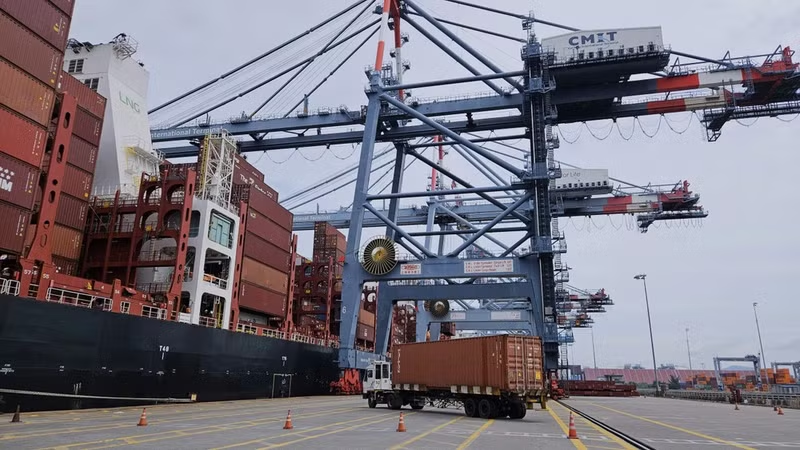
To achieve this goal, the city is focusing on developing a comprehensive multimodal transport network that incorporates all five modes of transport: road, inland waterways, rail, air, and seaports.
At the same time, the city is planning several new railway lines, including a key route connecting Bau Bang with the Cai Mep–Thi Vai Port complex. This railway is expected to significantly improve cargo transportation from industrial parks to seaports at much lower cost than road transport.
In addition to infrastructure development, digital transformation, green transformation and workforce development have also been identified as key pillars of the city's future logistics development strategy. Ho Chi Minh City is studying plans to establish a specialised logistics training centre while promoting international cooperation to gain access to advanced management models, new technologies, and development experience from countries with well-developed logistics industries.
From the business perspective, Vu Hai Ha also proposed that the state concentrate resources on developing railway and inland waterway routes directly connected to seaports rather than continuing to spread investment across numerous new ports. In his view, only when a truly integrated multimodal transport network is established, will logistics cease to be a "bottleneck" for the economy.
Author: NDO
RECOMMENDED TOPICS