VN
VN
 EN
EN
09/07/2026, 11:15
Investment
How open-end funds perform ahead of Vietnam stock market reclassification
Market developments at the start of 2026 are showing increasingly positive signs, raising expectations of a potential “major rally” in the period ahead, according to fund managers.

The VN-Index ended January 2026 up 2.5%, equivalent to a gain of more than 44 points.
Data from Fmarket for January 2026 indicate that the majority of open-end funds outperformed the VN-Index, with some funds even posting double-digit returns in the first month of the year.
Shifting capital flows
After a period of strong gains in so-called “ecosystem” stocks, market capital has shown signs of rotating toward companies with more stable fundamentals—particularly State-owned enterprises (SOEs) expected to benefit from the Politburo’s Resolution 79/NQ-TW. Against this backdrop, the VN-Index ended January 2026 up 2.5%, equivalent to a gain of more than 44 points.
If 2025 was marked by a disconnect—when the index rose sharply while more than 46% of VN-Index constituents delivered negative returns, despite generally solid corporate earnings—the market picture entering 2026 appears to be shifting.
Beyond SOEs, listed companies’ earnings have broadly remained healthy and are improving more evenly. As a result, although the VN-Index faced some downward pressure from large-capitalization stocks such as the Vingroup group, most equity funds were still able to maintain positive performance thanks to diversified portfolios and effective stock selection.
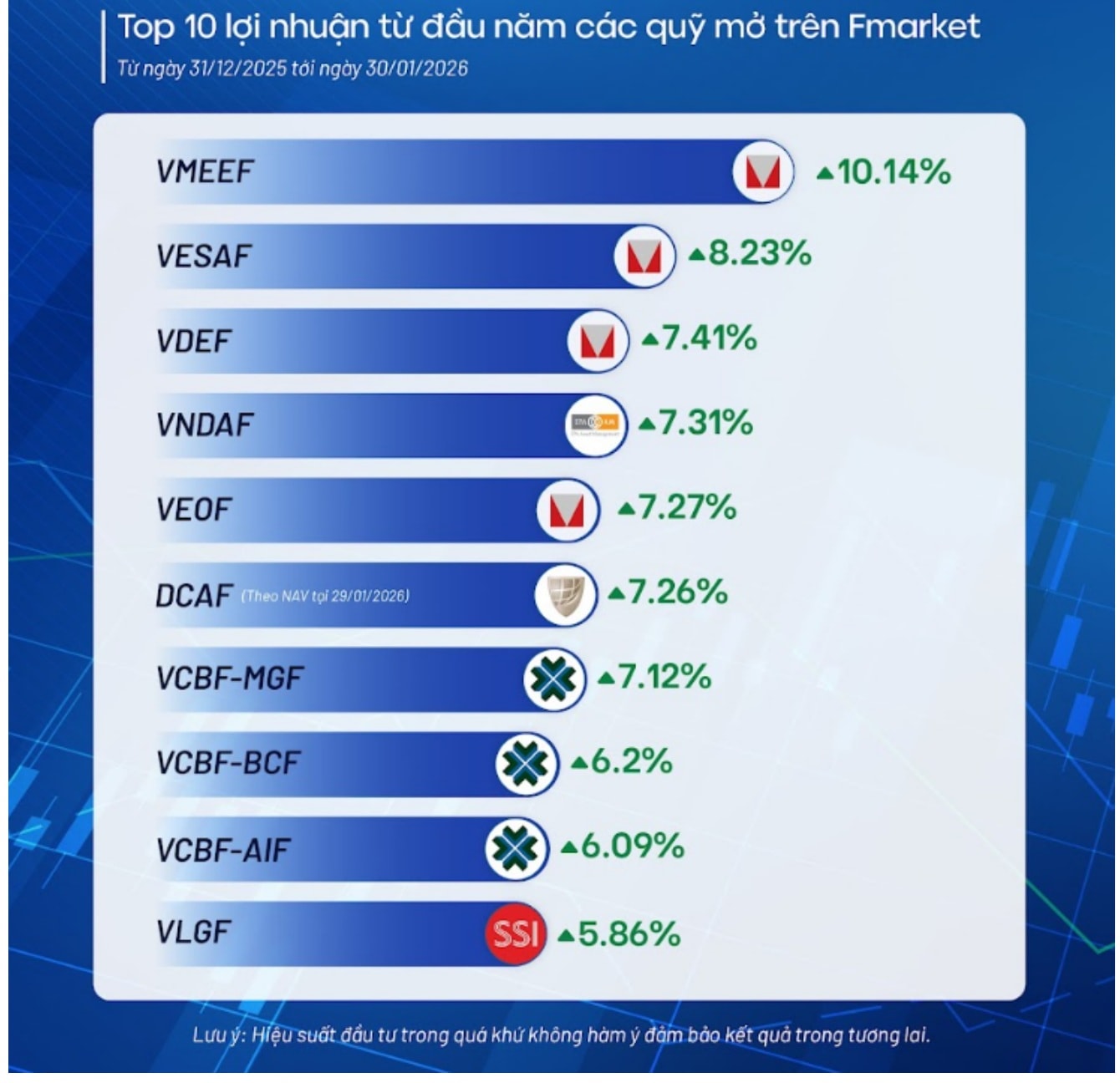
Performance data from the start of the year (December 31, 2025 to January 30, 2026) on the Fmarket platform show that many open-end funds generated returns that significantly outpaced the benchmark index. VinaCapital’s fund group stood out, with all four of its funds leading the January Top 10 performance rankings. In particular, the VINACAPITAL-VMEEF fund recorded a double-digit return of 10.14%, more than four times the VN-Index’s gain. Two other VinaCapital funds—VINACAPITAL-VESAF and VINACAPITAL-VDEF—ranked second and third with returns of 8.23% and 7.41%, respectively. VINACAPITAL-VEOF followed closely in fourth place with a return of 7.27%.
When asked whether there had been a strategic shift, VinaCapital emphasized that its investment approach remains consistently grounded in fundamental analysis. Accordingly, the firm does not adjust strategy simply to “ride market waves,” even for themes currently attracting attention such as SOE stocks. In practice, any SOE holdings in its portfolios are the result of prior screening based on core criteria, including business fundamentals, growth prospects, and reasonable valuations, rather than short-term market cycles.
Beyond VinaCapital, VCBF funds also posted notable results in January 2026, with three funds appearing in the Top 10 performance rankings: VCBF-MGF (7.12%), VCBF-BCF (6.2%), and VCBF-AIF (6.09%). Other funds with strong performance included VNDAF (7.31%), DCAF (7.26%), and VLGF (5.86%), reflecting a broad-based improvement across the open-end fund market.
According to Pham Le Duy Nhan, Director of Portfolio Management at VCBF, the broader improvement in corporate fundamentals—including among SOEs—created favorable conditions for VCBF funds to deliver positive performance early in the year. As macroeconomic conditions and capital flows improve, portfolios built on reasonable valuations and high-quality businesses tend to be re-rated by the market, allowing share prices to more accurately reflect underlying intrinsic value.
Expectations surrounding a 2026 market “upgrade”
The year 2026 is widely expected to open a new cycle of opportunities for Vietnam’s stock market, as the government continues to target GDP growth of up to 10% while accelerating public investment and large-scale infrastructure development.
Notably, Fitch Ratings recently upgraded Vietnam’s secured long-term debt instruments to BBB-, marking the first time a Vietnam-related debt instrument has achieved investment-grade status.
VinaCapital believes that if an official sovereign credit rating upgrade materializes, its positive impact on Vietnam’s capital markets could exceed that of FTSE Russell’s inclusion of Vietnam in its emerging market watch list. Once credit-rating barriers are removed, many international institutional investors—previously constrained by internal mandates—would be able to allocate more capital to Vietnam’s equity and bond markets, providing additional medium- to long-term growth momentum.
As the market enters a new cycle characterized by stronger participation from large-scale institutional capital, investment opportunities are expanding not only for retail investors but especially for professional investment funds—entities with access to long-term capital, disciplined portfolio construction, and the ability to effectively navigate growth cycles.
Nguyen Hoai Thu, CFA, Deputy CEO of VinaCapital Fund Management Joint Stock Company, noted that most investors initially begin by investing directly in equities, often while managing portfolios alongside their primary jobs and with limited experience. Over time, as they recognize constraints in time, expertise, and investment discipline, many gradually shift toward open-end funds as a more suitable solution.
However, a significant number of investors still approach open-end funds with a short-term mindset, frequently switching between funds based on predictions of which will perform best in a given year. As a result, long-term returns may be weak or even negative due to poor market timing—particularly selling during periods when funds are most attractive. Fund experts therefore recommend that investors approach open-end funds with a long-term perspective and the necessary patience.
Author: AN DINH - TRUONG DANG
RELATED TOPICS
RECOMMENDED TOPICS