VN
VN
 EN
EN
26/07/2026, 11:20
Investment
My Thuy seaport: A “Golden coordinate” for a new wave of investment in Quang Tri
Once operational, the My Thuy Port Terminal project in Quang Tri will not only remove long-standing bottlenecks in the province’s maritime economic infrastructure but will also officially open a vital logistics artery along the East–West Economic Corridor.
With the advantages of a deep-water port capable of accommodating vessels of up to 100,000 DWT, combined with a synchronized industrial–energy ecosystem, My Thuy is emerging as a “golden coordinate” attracting both domestic (DDI) and foreign (FDI) investment. The project is expected to help realize the ambition of transforming the former war-torn land of Quang Tri into an international cargo transshipment hub and a new growth pole in central Vietnam.
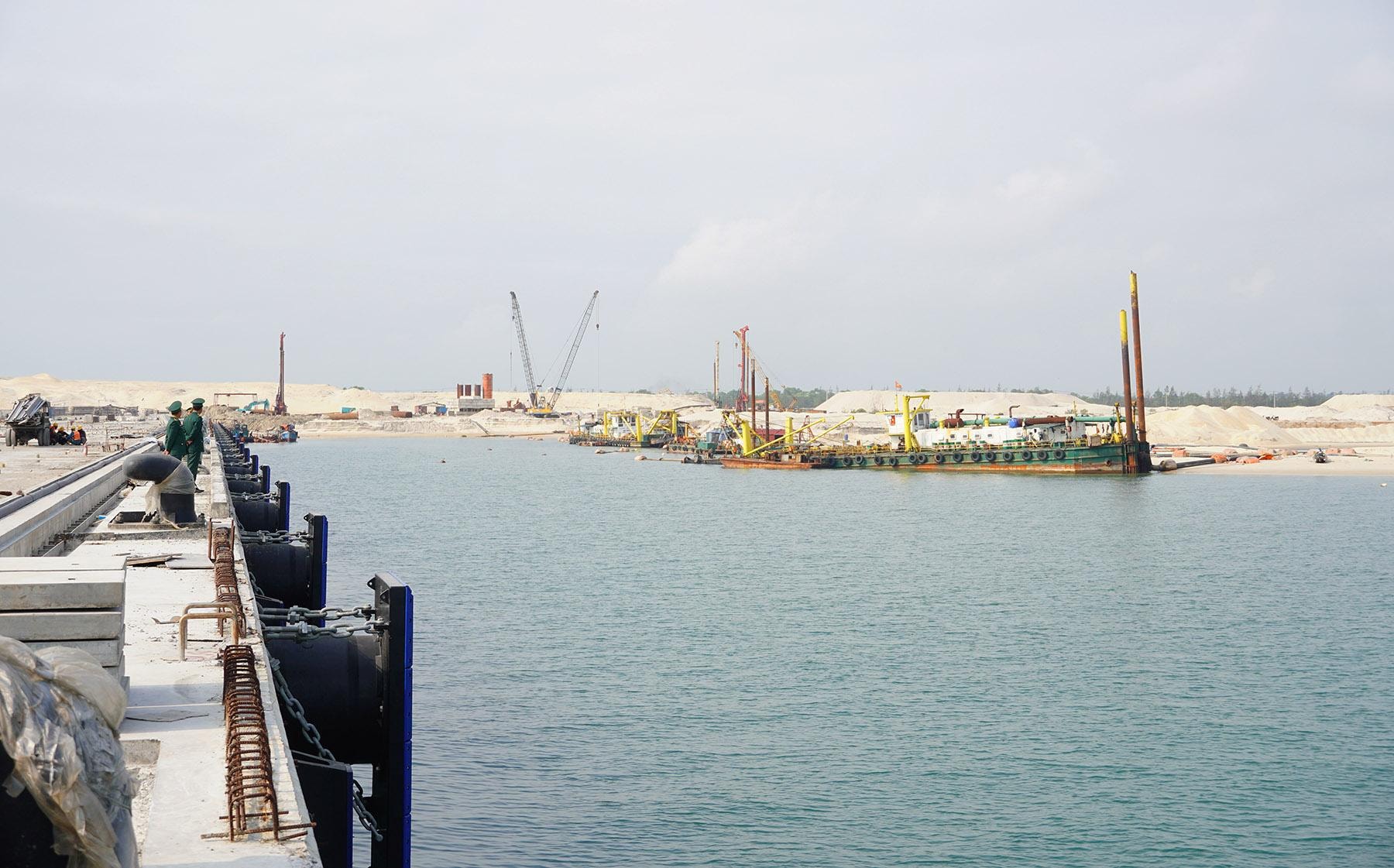
Contractors are accelerating construction of the project’s key components.
The Strategic Scale of a Deep-Water Port
For decades, Quang Tri has been regarded as an infrastructure “low point” in central Vietnam despite its highly strategic geopolitical location. Goods from Laos and Thailand seeking access to the East Sea often had to travel longer routes through neighboring provinces.
This situation is now rapidly changing as the province attracts investment into My Thuy Port.
The My Thuy Port Terminal project is developed by My Thuy International Port Joint Venture Company (MTIP) with a total investment of approximately VND 15 trillion. The project spans 685 hectares and includes 10 berths to be developed in three phases.
The key distinguishing feature—and the source of My Thuy’s competitive advantage—is the depth of its shipping channel. Designed to receive vessels of up to 100,000 DWT, My Thuy ranks among Vietnam’s leading deep-water ports. The ability to accommodate large vessels is crucial for attracting international shipping lines, reducing transshipment costs, and increasing the value-added of traded goods.
With its advantageous geopolitical position relative to economic regions along the Trans-Asian Economic Corridor and the national North–South axis, combined with the benefits of a deep-water port, My Thuy is becoming a strategic infrastructure project capable of stimulating local economic growth and driving strong economic development in Quang Tri.
Once operational, the port will attract additional domestic and international investment into the Southeast Quang Tri Economic Zone as well as supporting industries such as agricultural and forestry processing, energy, construction materials, and transport and logistics services.
Located along the East–West Economic Corridor (EWEC), which connects Southeast Asia, China, and the Indian Ocean, My Thuy Port positions Quang Tri as an international trade gateway. It will expand import–export markets abroad, particularly by facilitating cargo flows from Laos, Thailand, and Myanmar through the international border gates of La Lay and Lao Bao to My Thuy Port.
Improved transport connectivity and shorter shipping distances will help reduce logistics costs and enhance supply chain efficiency. This will increase the competitiveness of local products in international markets, boost trade volumes, and attract international markets.
At the same time, the economic pull of My Thuy Port will encourage regional connectivity and infrastructure development, including National Highway 15D linking the port to international border gates such as La Lay and Lao Bao. This will play an important role in forming a multimodal logistics system for the wider region.
The port is also expected to significantly impact the labor market by creating tens of thousands of direct and indirect jobs in transportation, warehousing, services and manufacturing. This will raise incomes, improve living standards and reduce unemployment in the province.
Currently, construction at My Thuy Port is entering a critical acceleration phase. At berths No. 1 and No. 2, bored piling works have been completed and the beam system and deck concrete have reached about 70% completion. These two berths are expected to be completed in March 2026, with one berth scheduled to begin operations in April 2026.
The breakwater, approximately 1,735 meters long, has already reached more than 1,200 meters in construction and is expected to be completed in December 2026. Meanwhile, land clearance has yet to be completed for the 20.02-hectare turning basin and 15 hectares of storage yards.
To ensure project progress, the Management Board of Quang Tri Economic Zone has proposed that the provincial People’s Committee issue the 2026 land price adjustment coefficient as soon as possible to serve as the basis for compensation and support for residents in the Phase 1 expansion area. Relevant units have also been requested to complete land clearance for dredged material storage sites in the first half of 2026.
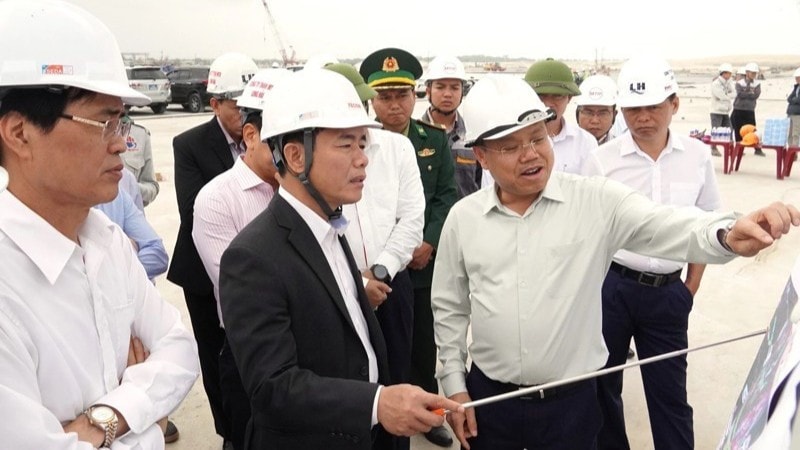
Quang Tri Provincial Party Secretary Nguyen Van Phuong praised the investor’s determination to bring the My Thuy Port Terminal project into operation soon.
Activating a Billion-Dollar Ecosystem
In reality, demand for cargo transport from southern Lao provinces such as Sekong and Attapeu, as well as northeastern Thailand, to Vietnam is growing rapidly—particularly for commodities such as minerals (coal), agricultural and forestry products, and construction materials.
Instead of routing shipments through more distant ports, direct connectivity from the international border gates of La Lay and Lao Bao to My Thuy Port via National Highway 15D will shorten maritime routes between the Indian Ocean and the Pacific Ocean.
Economic studies suggest that once My Thuy becomes operational, logistics costs per ton of cargo passing through the area could decrease by between 15% and 25%. The synchronized connection between the port, road networks, railways, and border gates will shorten the time required to transport goods from inland areas to global markets.
More broadly, My Thuy Port is envisioned not merely as a seaport but as an international logistics hub for the Central Highlands, central Vietnam and the Greater Mekong Subregion, positioning Quang Tri as a key logistics center.
The port is designed to handle not only containers but also bulk cargo, LNG, coal, heavy industrial products and strategic energy reserves. This will expand logistics segments, support a wider range of cargo types and enable more complex supply chains.
The establishment of the port will also generate strong demand for warehousing services, logistics centers, freight forwarding services, supply chains and multimodal transportation—attracting modern logistics services to the region. In the context of growing regional trade, this presents an opportunity to develop major logistics centers in central Vietnam.
The advantages of My Thuy Port are expected to quickly spread to the Southeast Quang Tri Economic Zone and nearby industrial parks such as Quan Ngang and Nam Dong Ha. Once the port becomes operational, factories producing electronic components, supporting mechanical industries and port equipment manufacturing will have a direct gateway for importing raw materials and exporting finished products.
In particular, the My Thuy High-Tech Petrochemical Industrial Park project is becoming a priority destination for corporations from Japan, South Korea and Thailand. Access to a deep-water port allows these companies to build integrated petrochemical value chains—an economic model with strong competitiveness within the ASEAN region.
Nguyen Xuan Dat, Director of the Quang Tri Department of Finance, said that located at the East Sea gateway of the East–West Economic Corridor, My Thuy Port serves as a strategic link connecting the North–South and East–West transport axes.
Once operational, the project will remove trade bottlenecks, drive local socio-economic development, enhance Quang Tri’s competitiveness, and particularly strengthen the province’s ability to attract both domestic and foreign investment into industrial zones and logistics services, turning Quang Tri into an attractive destination for major investors.
“My Thuy Port, together with a synchronized system of transport and industrial infrastructure, forms a critical foundation for breakthroughs in key economic sectors such as oil and gas, energy, inland ports, logistics, transportation and high-tech manufacturing. It will play an important role in promoting economic restructuring and creating sustainable development momentum for Quang Tri in the future,” Dat emphasized.
Commitment to Accompany Investors and Capture New Investment Waves
Quang Tri’s current appeal lies not only in its infrastructure but also in its pro-business governance approach. The province is implementing a strategy of strong investment incentives, including corporate income tax reductions, labor training support and administrative reforms.
At a time when the global economy is shifting toward green growth, My Thuy Port is being built according to Green Port and Smart Port standards. Its port management system will be fully digitalized—from electronic bills of lading to AI-powered vehicle monitoring—helping businesses minimize cumbersome administrative procedures.
As a result, investors will no longer face concerns about delays or hidden costs. All logistics data will be connected in real time, enabling companies to optimize production and distribution plans.
Beyond legal support, Quang Tri has prioritized transportation infrastructure development. The synchronized development of My Thuy Deep-Water Port, Quang Tri Airport and the North–South Expressway has created a strong economic foundation.
Recently, during an on-site inspection early in the year (February 24), Nguyen Van Phuong, Member of the Party Central Committee and Secretary of the Quang Tri Provincial Party Committee, emphasized that the province identifies My Thuy as a new growth pole.
“Quang Tri is not only building a port but also building trust for investors,” he said. The province will accompany businesses from the initial survey stage until projects become operational, ensuring an open, safe and sustainable investment environment.
With preferential policies and efforts to create a transparent and attractive investment environment, Quang Tri is no longer merely a stopover but is gradually becoming an international cargo transshipment hub and a new focal point for investment in the evolving economic landscape.
Foreign investment flows are expected to shift not only into traditional sectors but also toward high-end logistics services, cold storage and deep processing of agricultural and seafood products.
Author: NGUYET HA (Truong Dang translates)
RELATED TOPICS
RECOMMENDED TOPICS