VN
VN
 EN
EN
19/07/2026, 11:00
Business economics
How Vietnam becomes the hub of Asia’s new AI trade map
Artificial Intelligence (AI) is usually discussed as a technology story, but in Asia it has become a trade story, and for an economy as export dependent as Vietnam that makes it a national one.
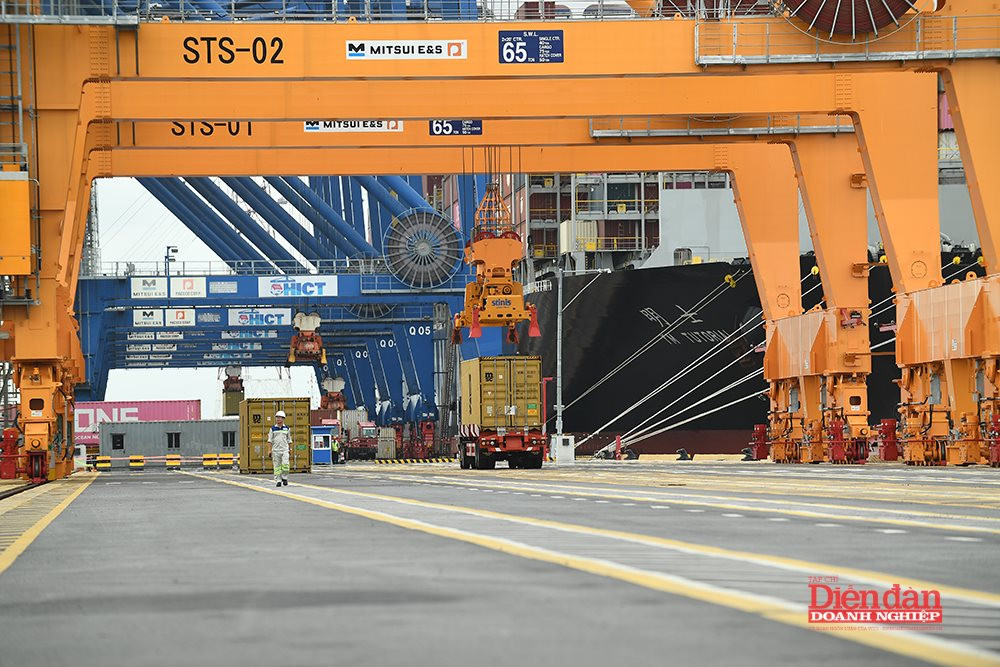
Vietnam's global market share in AI-related equipment has increased from 1.2% in 2015 to 12.4% in 2025. Photo: Quoc Tuan
Intra-Asian trade in AI-enabling goods, the chips, components and equipment on which the technology runs, has doubled to nearly USD2 trillion in 2025 compared with pre-pandemic levels, according to HSBC Global Research, and AI-linked goods now account for 35% of Asia's total exports, up from 19% a decade ago.
The trade agreements of the past two decades promised deeper regional integration, and AI is now delivering it. New corridors are forming between North Asia and Southeast Asia, connecting Korea's memory chips, Taiwan's advanced foundries, Japan's precision equipment and ASEAN's fast-expanding assembly and testing capacity into a single production network, with more than 30% of Asia's AI trade now taking place within the region itself.
Vietnam's new position in the supply chain
Within this reshaped landscape, Vietnam has moved further and faster than any other economy. Its share of global trade in AI-related equipment has risen from 1.2% in 2015 to 12.4% in 2025, the largest single-economy gain in the world over that period. In the first quarter of 2026, Taiwan recorded its first quarterly trade deficit with Vietnam on record, and in the three months to May, Taiwanese imports from Vietnam surged 173% year on year, driven overwhelmingly by machinery, electrical equipment and appliances. Korea's exports to Vietnam posted the biggest jump within ASEAN in early 2026, reflecting deep manufacturing links and Vietnam's growing role in the final assembly of computing hardware, including AI server-related equipment.
These figures represent a major shift. Vietnam is no longer a low-cost assembly point at the end of someone else's supply chain but a node in a multi-directional network, importing high-value inputs from Taiwan and Korea, adding manufacturing scale and sophistication, and exporting finished and intermediate goods back into the region and beyond. Two-way flows are deepening, and Vietnam's position within them is strengthening.
That rise reflects policy as much as geography. The government has set out a national semiconductor strategy with ambitions to train tens of thousands of chip engineers by 2030 and has made science, technology and digital transformation a declared pillar of national development. Global manufacturers have responded with major investments in chip packaging, testing and electronics production across the country, while partnerships with leading technology firms are bringing research and design capability onshore alongside the production lines.
Vietnam is also beginning to build the demand side of the equation. Announced FDI in data centres globally exceeded USD270 billion in 2025, with Southeast Asia claiming a growing share, and Vietnam's young, digitally native population and rapidly formalising enterprise sector position it to become a meaningful consumer of AI services as well as a producer of AI hardware. The economies that gain most from this era will be those participating at several points of the value chain at once, making the hardware, hosting the infrastructure and applying the technology to lift productivity across the wider economy.
The decade ahead
The risks deserve acknowledgement. Deeper specialisation brings greater exposure to shared shocks, whether a downturn in global AI capital spending, tighter export controls or sharp swings in semiconductor prices, and higher chip and electronics prices could add to inflation pressures across the region. Some of today's export strength may also reflect front-loaded orders that normalise over time.
The structural forces nonetheless favour Vietnam. Supply chains are diversifying across Asia rather than concentrating in any single location, regional agreements such as RCEP and CPTPP continue to lower frictions, and Vietnam has shown over successive waves of investment that it can absorb capacity, move up the value chain and deliver at scale. As Asia evolves from an export platform into an AI demand centre in its own right, Vietnam sits geographically and economically at the centre of that transition.
If Vietnam converts its manufacturing momentum into a genuine AI ecosystem, pairing hardware scale with skills, infrastructure and enterprise adoption, the returns will show up well beyond export receipts, in the productivity of factories, services and the daily operations of hundreds of thousands of businesses. A decade ago, Vietnam's role in global technology trade was measured in fractions of a percent. The task for the decade ahead is to ensure it is defined not only by what Vietnam makes for the AI era, but by what AI makes possible for Vietnam.
Author: Tim Evans, CEO, HSBC Vietnam
RECOMMENDED TOPICS