VN
VN
 EN
EN
19/07/2026, 11:00
Business economics
Viet Nam’s maritime economy charts a new growth horizon
After eight years of implementing Resolution No. 36-NQ/TW, dated October 22, 2018, on Viet Nam’s Sustainable Marine Economic Development Strategy to 2030, with a vision to 2045, Viet Nam’s maritime economy has delivered significant achievements. The maritime economy has advanced, elevating the sea’s role in national development.
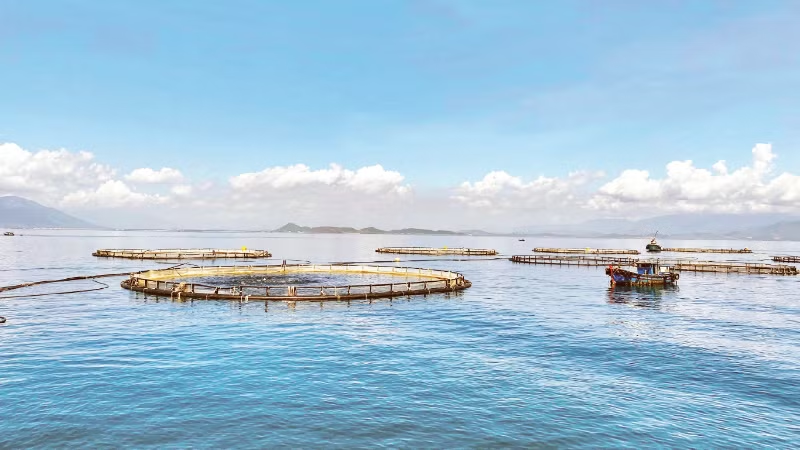
Aquaculture and fisheries have flourished, improving the livelihoods of millions of farmers and fishers. Viet Nam’s 3,200 km of coastline is not only a natural treasure but also a strategic foundation for the fisheries sector to make historic strides, transforming the sea into a genuine driver of national growth.
Growth momentum from the sea
Quang Ninh province, once characterised by fragmented aquaculture, is now entering a new phase of maritime economic development. By streamlining procedures and accelerating sea area allocation, the province has paved the way for large-scale marine farming projects spanning hundreds of hectares.
Nguyen Ba Ngoc, Chairman of Bien Dong Squid Joint Stock Company, whose firm was recently allocated nearly 210 ha in the Co To Special Zone, emphasised that the greatest challenge for enterprises lies not in natural conditions but in administrative procedures. He praised Quang Ninh’s reforms, noting that processes which elsewhere could take years were resolved locally within three months.
Recently, on June 30, the company broke ground on a concentrated aquaculture zone in Co To. Equipped with 40 High-Density Polyethylene (HDPE) cages, the project represents an industrial-scale, high-tech marine farming model. It aims to cultivate marine fish, squid and seaweed — all of high economic value — with an expected annual output of around 670,000 tonnes.
With over 250 km of coastline and 6,100 sq.km of sea surface, Quang Ninh is well positioned to expand from traditional methods into offshore, industrial-scale aquaculture.
Viet Nam’s 3,200 km of coastline is not only a natural treasure but also a strategic foundation for the fisheries sector to make historic strides, transforming the sea into a genuine driver of national growth.
To prevent unregulated farming, the province has integrated aquaculture into its 2021–2030 plan, with a vision to 2050, designating more than 45,000 ha for marine farming. Modern HDPE buoy systems now dot the deep blue waters of Van Don and Co To, serving both as technological symbols and as “shields” protecting marine ecosystems.
Khanh Hoa province, following recent administrative mergers, boasts Viet Nam’s longest coastline at nearly 500 km, encompassing iconic bays such as Nha Trang, Cam Ranh and Van Phong.
Rich in natural resources and diverse ecosystems, Khanh Hoa has capitalised on its advantages to attract investment aligned with Resolution No. 36-NQ/TW. According to provincial leaders, aquaculture has grown rapidly, generating high economic value, restructuring rural economies, creating jobs and raising living standards for coastal communities.
A strategic shift in maritime thinking
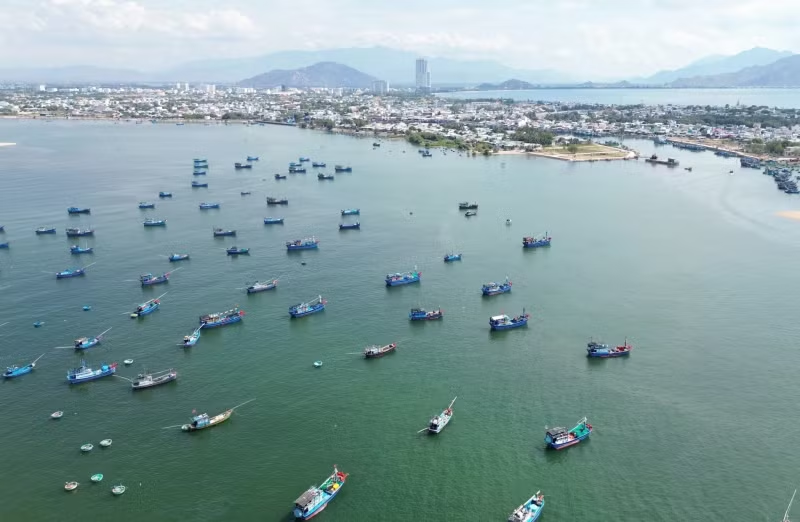
The implementation of Resolution No. 36-NQ/TW has laid the groundwork for modernisation, driven by science, technology and ecosystem protection.
Nguyen Hoai Nam, General Secretary of the Viet Nam Association of Seafood Exporters and Producers (VASEP), highlighted the sector’s resilience despite challenges ranging from the COVID-19 pandemic and trade barriers to natural disasters.
Viet Nam has become one of the world’s top three seafood exporters, with products reaching more than 160 countries and territories, generating annual revenues of 8–11 billion USD.
After eight years of implementing the Resolution No. 36-NQ/TW, awareness of the sea’s strategic role has deepened; institutional frameworks have been strengthened; maritime sectors have expanded; coastal livelihoods have improved; and national defence and sovereignty at sea have been reinforced.
Viet Nam has become one of the world’s top three seafood exporters, with products reaching more than 160 countries and territories, generating annual revenues of 8–11 billion USD.
Yet, as Viet Nam enters a new era, a decisive shift is needed — from viewing the sea merely as a resource base to recognising it as a strategic development space. The maritime domain must be seen as a nexus of economic growth, security, science, technology and international integration.
Deputy Minister of Agriculture and Environment Dang Ngoc Diep stressed the importance of issuing a new resolution on sustainable maritime economic development, alongside amendments to the Law on Marine and Island Resources and Environment.
This would establish modern, unified and effective ocean governance models, driving a green maritime economy, improving coastal livelihoods and strengthening national sovereignty.
“The Ministry of Agriculture and the Environment will continue to work closely with ministries, sectors and localities to implement coordinated solutions, contributing to Viet Nam’s emergence as a strong maritime nation — sustainably developed, prosperous and responsible in regional and global ocean governance,” Deputy Minister Dang Ngoc Diep affirmed.
Author: NDO
RECOMMENDED TOPICS