VN
VN
 EN
EN
25/07/2026, 02:00
Business economics
Laying foundation for energy self-sufficiency and green growth
As the energy transition and green development become an inevitable trend, championing the use of E10 biofuel in Viet Nam is not only a solution to diversify energy supply and reduce greenhouse gas emissions, but also an opportunity to develop a modern biofuel industry linking agriculture, processing industries, and the energy sector.
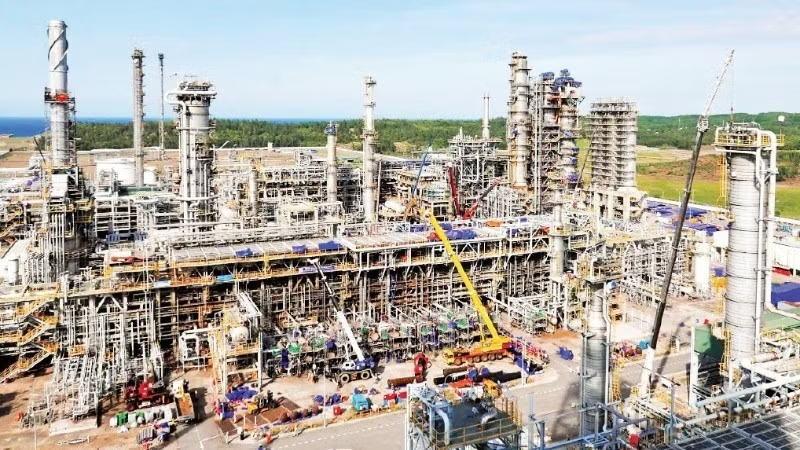
To achieve this goal, relevant agencies need to forge an integrated value chain spanning feedstock production, ethanol manufacturing, and distribution systems, laying the foundation for energy self-sufficiency and green growth.
Driving the development of a new industry
Many countries, including the US, Brazil, and Thailand, regard biofuels as an important component of energy security and a means of fulfilling their emissions reduction commitments.
Ethanol not only provides an additional source of clean fuel, but also catalyses the processing industry, expands markets for agricultural products, and creates value chains with wide-ranging benefits for the economy.
Viet Nam should evaluate the deployment of E10 biofuel from this perspective.
In practice, Viet Nam has invested in a number of ethanol plants, but their performance has drastically underperformed expectations. Limited consumption has forced many facilities to operate below capacity or halt production.
Unstable market demand has deterred businesses from investing in technology, while farmers have lacked incentives to expand feedstock cultivation.
According to Dr Dang Tat Thanh of the Department of Innovation, Green Transition, and Industrial Promotion under the Ministry of Industry and Trade, the key is not merely to introduce E10 petrol to the market, but to cultivate a sustainable biofuel ecosystem covering feedstock production, ethanol manufacturing, storage, distribution, and consumption.
Unstable market demand has deterred businesses from investing in technology, while farmers have lacked incentives to expand feedstock cultivation.
Only when every link in the value chain is seamlessly integrated can the biofuel programme secure long-term viability.
This reflects a shift in thinking on biofuel development, from simply increasing the ethanol blending ratio to engineering an industry that creates added value across multiple sectors of the economy.
It is also congruent with the requirements of green growth, the circular economy, and low-emission development. With stable policies and a sufficiently large market, the biofuel industry will have the conditions needed to flourish, contributing to energy self-sufficiency and green growth.
Generating momentum for biofuels
According to Do Van Tuan, Chairman of the Viet Nam Biofuels Association, once E10 petrol achieves widespread market penetration, demand for ethanol used in blending is projected to hit between 90,000 and 100,000 cubic metres per month.
With their current designed capacity, domestic ethanol plants are capable of satisfying around 45% of this demand. However, actual output currently languishes at a mere 20% because many facilities remain idle. This indicates considerable potential for expanding domestic production if stable policies are put in place.
Tuan noted that, in the short term, Viet Nam would still need to combine domestically produced and imported ethanol to ensure adequate supply.
In the longer term, however, gradually increasing the share of domestically produced ethanol will help reduce dependence on imports while creating conditions for previously invested plants to resume operations, expand feedstock procurement, and establish sustainable linkages between businesses and farmers.
Dr Dang Tat Thanh asserted the biofuel ecosystem could operate effectively only if it is developed in an integrated manner, covering feedstock production, manufacturing, storage, distribution, and consumption.
This requires close coordination among ministries, sectors, localities, and businesses in planning feedstock production areas, developing logistics infrastructure, and improving processing capacity.
One of the most important links in the chain is the feedstock production area. According to experts, developing feedstock areas does not mean expanding cultivation at all costs, but should be based on scientific planning tailored to the capacity of each ethanol plant and the advantages of each locality.
Transitioning low-efficiency farmland to crops suitable for ethanol production, while establishing long-term linkage and off-take mechanisms, will help businesses secure stable supplies and instil greater confidence in farmers to invest in production.
Behind feedstock production lies an opportunity to invigorate the rural economy. By participating in production linkages, farmers can secure stable markets, gain access to advanced production practices, and improve productivity.
The value of cassava, maize, and agricultural by-products can also be enhanced through deep processing, contributing to the circular economy, and increasing farmers' incomes.
Alongside material area, technological innovation will determine the industry's competitiveness. Modern ethanol plants not only produce ethanol but also make effective use of co-products such as CO2, maize residue for animal feed, and corn oil for the production of next-generation biofuels.
The value of cassava, maize, and agricultural by-products can also be enhanced through deep processing, contributing to the circular economy, and increasing farmers' incomes.
This model improves resource efficiency, reduces costs, and increases added value.
In the long term, Viet Nam needs to gradually master technologies for producing ethanol from agricultural by-products and biomass, in alignment with the country's circular economy and emissions reduction goals.
The success of the biofuel programme will not be measured solely by the volume of E10 petrol consumed, but more importantly by its ability to establish a complete value chain in which agriculture supplies feedstock, businesses invest in technology, the State creates enabling policies, and the market provides the driving force for development.
Once these links are fully integrated, biofuels will become an industry with broad spillover effects, contributing to energy security, green development, and the competitiveness of the economy.
Author: NDO
RECOMMENDED TOPICS