VN
VN
 EN
EN
25/07/2026, 02:00
Business economics
Repositioning the development model of Viet Nam’s garment industry
In the first six months of 2026, Viet Nam’s garment exports exceeded 22.2 billion USD, up 1.7% year-on-year. These figures reflect the considerable efforts made by businesses to navigate market volatility, particularly supply chain disruptions, rising freight costs and increasing prices for raw materials.
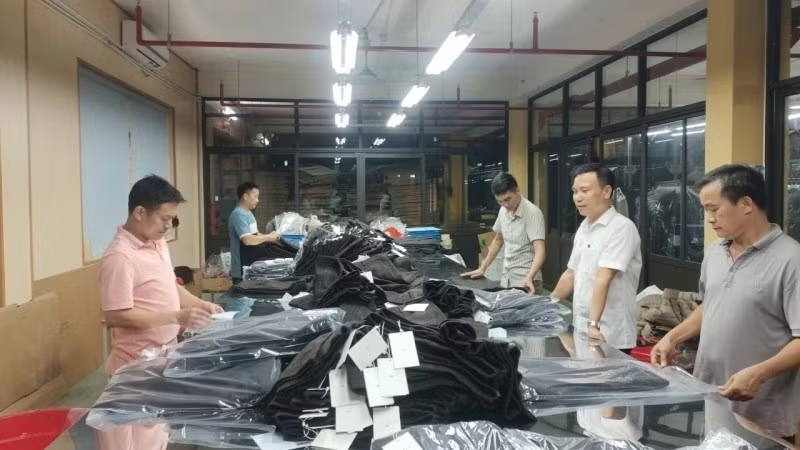
To achieve the industry’s export target of 48 billion USD this year, garment makers will need to strengthen management, improve productivity, expand production and boost exports.
Mounting pressures
Cao Huu Hieu, General Director of the Viet Nam National Textile and Garment Group (Vinatex), said the group generated revenue of more than 10 trillion VND (380 million USD) in the first half of the year, up 9.6% year-on-year, with pre-tax profit reaching 882.9 billion VND (33.5 million USD), an increase of 32.4%.
In response to market fluctuations, the group’s specialist departments have introduced measures to improve inventory management, optimise cotton procurement and enhance the efficient use of raw materials, helping reduce risks arising from fluctuations in cotton prices and exchange rates.
At the same time, Vinatex has actively adjusted its product portfolio to better meet market demand, while gradually expanding its supply capacity to serve customers in China, foreign-invested enterprises and the domestic market.
“The group has also worked closely with member companies to secure orders, assess competitiveness and restructure product portfolios towards higher value-added products. Closely monitoring customer demand, improving productivity and optimising production management have helped maintain stable operations across our subsidiaries, laying the foundation for growth despite challenging market conditions,” Hieu stressed.
The global economic outlook remains uncertain, with competitive pressures continuing to intensify. In particular, the temporary 10% tariff imposed on all goods imported into the United States is due to expire on July 24. At the same time, weakening global growth is expected to place further pressure on businesses during the remainder of the year.
According to Hieu, demand in major export markets continues to weaken, putting greater pressure on prices. Borrowing costs and raw material prices may remain volatile, while increasingly fierce competition from other garment-exporting countries will further affect business operations.
For the yarn sector, the key challenge is maintaining profit margins as demand begins to level off. Meanwhile, garment manufacturers face mounting pressure from a shortage of orders in the third and fourth quarters, coupled with increasingly intense price competition.
To achieve its full-year targets of revenue of over 20 trillion VND (760 million USD), profit of 1.4 trillion VND (53.2 million USD) and a 10% increase in its trade surplus, the group is implementing a comprehensive package of measures.
These include reviewing and restructuring its customer portfolio while prioritising strategic clients; introducing productivity improvement initiatives and strengthening cash flow management; accelerating digital transformation and upgrading management platforms; enhancing quality management systems and corporate social responsibility standards; and tightening controls over origin verification to meet increasingly stringent requirements in export markets.
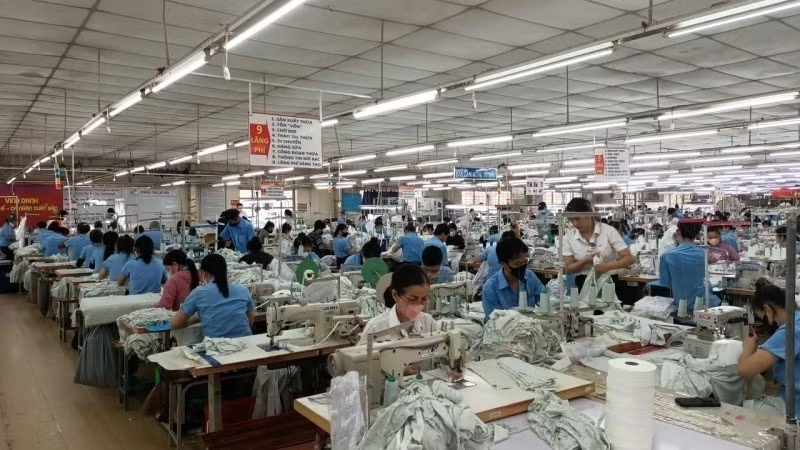
Developing strategic pillars
Nguyen Ngoc Binh, General Director of Hoa Tho Textile and Garment Joint Stock Corporation, said the company had faced considerable challenges during the first half of the year as rising logistics costs, higher raw material prices and increasing trade risks squeezed profit margins.
Thanks to the efforts of employees across the company, revenue reached 2.9 trillion VND (110.2 million USD), up 9% year-on-year and equivalent to 52% of the annual target. Export revenue totalled 148.5 million USD, up 14% over the same period last year.
During the remainder of the year, the company will continue to focus on operational efficiency with the aim of meeting its annual targets.
It will also accelerate new product development, digital transformation, technology adoption and automation, thereby enhancing competitiveness and strengthening its market position.
Vu Duc Giang, Chairman of the Viet Nam Textile and Apparel Association (VITAS), said the country’s textile and garment exports reached more than 22.2 billion USD in the first six months of the year, up 1.7% year-on-year. Imports of textile and garment materials totalled 13.24 billion USD, an increase of 4.3% compared with the same period in 2025.
Despite these positive results, the industry continues to face significant challenges. Demand in major markets is recovering slowly; price competition remains fierce; 60-70% of raw materials still have to be imported; and compliance costs related to environmental, social and governance (ESG) standards and product traceability continue to rise.
Viet Nam’s garment industry has limited scope for further growth based solely on expanding production scale.
To achieve the annual export target of 48 billion USD, the industry must shift its focus towards improving productivity and increasing value added, securing a more stable supply of raw materials, diversifying export markets, and accelerating both digital and green transformation.
At the same time, it should concentrate on developing key strategic pillars, including expanding the domestic market, building Vietnamese fashion brands and a national fashion industry, strengthening integration into global supply chains, attracting investment into textile, dyeing and finishing operations, and promoting automation, smart factories and artificial intelligence applications.
Author: NDO
RECOMMENDED TOPICS