VN
VN
 EN
EN
26/07/2026, 02:38
Business economics
Meeting green packaging requirements can boost Viet Nam’s export edge
As importing countries tighten environmental standards, extended producer responsibility (EPR) has become a critical compliance obligation for Vietnamese businesses exporting agro-forestry-fishery products. In particular, new packaging regulations are emerging as significant technical barriers, directly affecting exporters’ ability to maintain and expand their market access.
Expanding the scope of regulation
According to the Viet Nam Sanitary and Phytosanitary Notification Authority and Enquiry Point (Viet Nam SPS Office), in the first half of April alone it received 40 notifications covering both proposed and enacted regulations on food safety and SPS measures, many of which relate to EPR.
Ngo Xuan Nam, Deputy Director of the Viet Nam SPS Office, noted that the EU has notified a draft amendment to Regulation (EU) 2022/1616 (G/SPS/N/EU/940) concerning recycled plastic materials and articles intended to come into contact with foods.
The proposal strengthens requirements for compliance documentation, control, and traceability across the entire supply chain, including imports into the EU; adds provisions on declarations of compliance at the pre-processing, recycling, and processing stages; requires records to be retained and made available upon request by competent authorities; and mandates submission of documentation when goods are placed on the EU market.
It also amends rules on maintaining electronic registers for recycling technologies, facilities and equipment; specifies testing methods for input plastics; and establishes a legal basis for applying commodity codes to certain recycled plastic products. This reflects a trend towards tighter control not only of technical standards but also of product classification and supply-chain traceability.
Meanwhile, the East African Community (EAC) has notified a set of draft technical standards (DEAS) stipulating hygiene conditions during production, appropriate packaging materials, labelling, and related requirements, effectively elevating packaging from a secondary concern to a market access condition.
According to the Viet Nam Association of Seafood Exporters and Producers (VASEP), these regulations are putting significant pressure on the seafood sector, which relies heavily on packaging and serves a wide range of export markets.
Tran Hoang Yen, an expert at VASEP, noted that the EU has issued Regulation (EU) 2025/40 on packaging and packaging waste (PPWR), extending its scope to cover all tiers of packaging and their design requirements. Familiar packaging materials used in seafood exports, such as plastic bags, trays, boxes, cartons, plastic pallets, and wrapping films, are now subject to the new regulation.
Notably, food-contact packaging containing PFAS (so-called “forever chemicals”) at or above regulated thresholds will be subject to stricter controls from August 12, 2026, requiring businesses to monitor and declare PFAS levels in their technical dossiers.
In addition, under the PPWR roadmap, by 2030 all packaging placed on the EU market must be designed for recyclability and must meet requirements to reduce volume and limit empty space during transport, seemingly minor details that will nonetheless require exporters to optimise their carton packing specifications.
By August 12, 2028, all packaging must carry harmonised waste-sorting labels in line with EU standards to guide consumers.
Beyond material requirements, EU rules also impose obligations to demonstrate compliance. Each type of packaging must be accompanied by a Declaration of Conformity (DoC) and a technical dossier detailing materials used, technical drawings, applicable standards and test reports. Crucially, these documents must be kept up to date whenever there are changes in design or applicable standards.
Ready to adapt
Commenting on the stringent packaging requirements, Nguyen Van Kich, General Director of Cafatex Corporation, said that although businesses still mainly use traditional packaging due to its stability and reasonable cost, they are prepared to transition to alternatives when required by importing markets.
However, a key obstacle is the limited domestic supply, as packaging manufacturers have yet to develop a diverse range of recycled materials. Most packaging for food products, including frozen goods, currently relies on multi-material structures that extend shelf life but limit recyclability.
In response, the Government issued a decree in early April on producers’ and importers’ responsibilities for recycling products and packaging, and for waste treatment. In addition to consolidating the legal framework for EPR, the decree is expected to stimulate the domestic recycled materials market, gradually easing supply constraints.
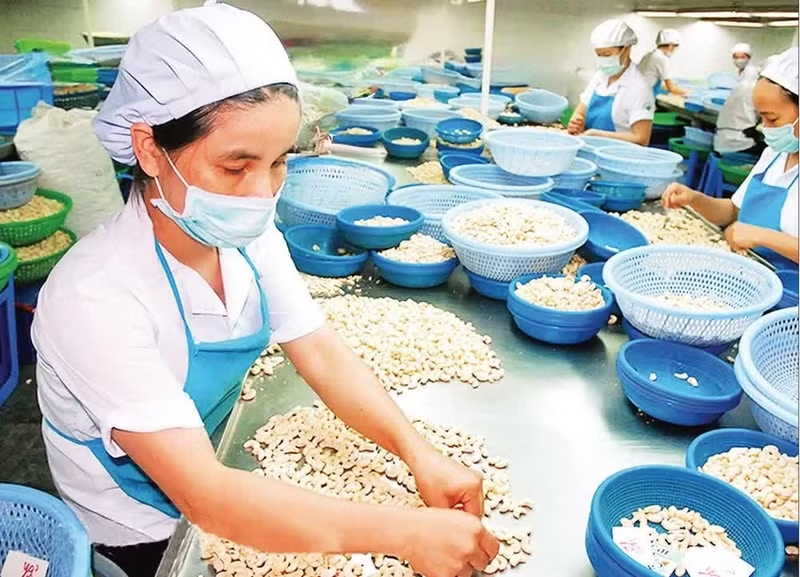
In practice, most of Viet Nam’s key export agricultural products, including seafood, pepper, cashew nuts and fruit, are affected by the new packaging regulations, as they require multiple layers of packaging during transport.
Therefore, while implementing EPR requirements remains challenging, the need to adapt, particularly for the EU market, is clear and time-bound. Authorities recommend that businesses proactively study EU regulations to fully understand new requirements for packaging design, recyclability and labelling; closely follow forthcoming guidance (expected before August 12, 2026) on harmonised waste-sorting labels; review their entire packaging systems; and prepare compliance documentation well in advance of August 2026.
Early adaptation and stronger compliance capacity will not only benefit businesses in the EU market but also strengthen their competitiveness across other markets, enabling them to turn regulatory barriers into a competitive advantage.
Author: NDO
RECOMMENDED TOPICS