VN
VN
 EN
EN
26/07/2026, 02:38
Business economics
New prospects for low-emission rice
After more than two years implementing the project on sustainable development of 1 million hectares of high-quality, low-emission specialised rice cultivation associated with green growth in the Mekong Delta through 2030 (the Project), the gradually improved policy framework has paved the way for clear changes in the fields.
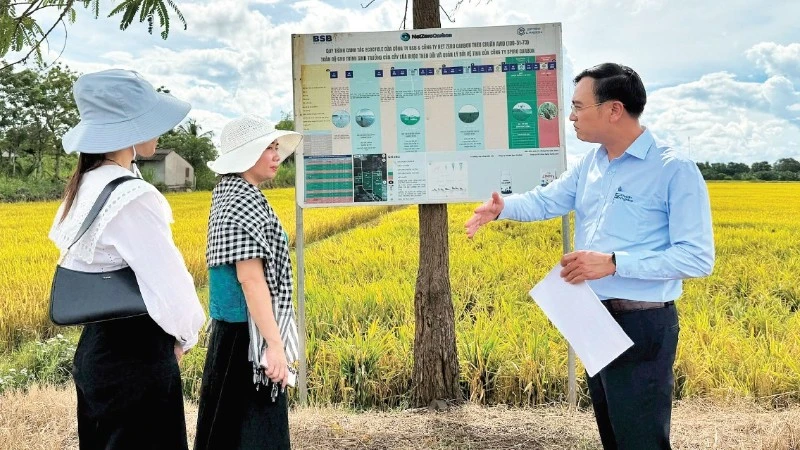
Advanced cultivation processes have been transferred to farmers, while enterprises have focused on standardising raw material areas, creating a solid foundation for the greening of the rice sector.
In the 2025 summer–autumn crop, 11 models were implemented over a 543.5 ha area, with the participation of 355 households; production costs were reduced by 1.7 to 4.9 million VND per hectare; and profits increased by 4.6 to 15.8 million VND per hectare compared with non-model areas.
New techniques, high efficiency
Nguyen Cao Khai, Director of Tien Thuan Agricultural and Service Cooperative (Thanh Quoi Commune, Can Tho City), said that the cooperative currently has about 70 ha of rice produced under the low-emission model, achieving high yield and quality. In the 2025 summer–autumn crop alone, rice yield reached nearly 7.9 tonnes per hectare, an increase of about 1.6 tonnes per hectare compared with non-model areas.
Meanwhile, seed use was reduced by 50–65%; fertiliser use fell by 15%; the number of pesticide sprayings was halved; irrigation frequency was reduced thanks to the application of alternate wetting and drying; and straw was collected and removed from the fields. “After deducting production costs, profits from rice and by-products increased by 7 to 8 million VND per hectare compared with non-model areas. As a result, many farming households have expanded their participation in the model. It is expected that the coming winter–spring crop will see the cooperative expand the low-emission rice cultivation area to more than 100 ha,” Khai emphasised.
According to the Department of Crop Production and Plant Protection (Ministry of Agriculture and Environment), across the 11 low-emission, high-quality rice models in the 2025 summer–autumn crop, fertiliser use was reduced by an average of 31.3%; pesticide spraying was reduced by one to three times; seeding rates were cut by 70–130 kg per hectare; and most models ensured the required number of drainage cycles.
All models collected straw from the fields, with five models selling straw at a value of up to 1 million VND per hectare.
Notably, in terms of reorganising production, all farmers were organised into cooperatives with linked input supply and output consumption. To facilitate the implementation of the Project, a compliance assessment tool for production processes, named ViRiCert, has recently been developed. This tool is expected to become a “green compass” guiding millions of farmers on their journey towards sustainable cultivation.
Nguyen Van Hung of the International Rice Research Institute (IRRI) said that the tool is designed with a scoring system based on 10 practice stages, with different weightings for each factor.
Among these, water management based on the principle of alternate wetting and drying and the non-burning of straw in fields are mandatory threshold requirements, with the water management criterion carrying double weighting as it is the most decisive factor in reducing greenhouse gas emissions.
A key feature of the tool is its high applicability and ease of access, enabling farmers to adopt it quickly. With only a smartphone and an internet connection, farmers can access the website https://viricert.easyfarm.vn
or scan a QR code to immediately assess their own fields against the 10 criteria. When widely shared, the tool will accompany farmers, helping them monitor and improve cultivation practices day by day.
According to Le Thanh Tung, Vice Chairman of the Viet Nam Rice Sector Association (VIETRISA), the importance of the assessment tool lies not only in measuring compliance with production processes, but also in creating a transparent mechanism that enables farmers to confidently affirm the value of their green products in the market.
New advantages for exports
Pham Thai Binh, Chairman of the Board of Directors of Trung An High-Tech Agriculture Joint Stock Company, assessed that high-quality, low-emission rice is gaining an increasing advantage in export markets. When enterprises establish standard-compliant raw material areas and can demonstrate emission reductions through measurement, they will increase their chances of negotiating better prices with importers, especially as many foreign partners are now paying close attention to the “carbon footprint” of products.
“At present, the company is accelerating the production and export of low-emission rice. In June 2025, the company exported 500 tonnes to Japan; by September 2025, it exported 160 tonnes to the Australian market; and in December it exported an additional approximately 500 tonnes to this market. To increase the output of low-emission rice, we hope that projects under the Project will be approved soon to create close linkages among participating parties and serve as a basis for bank loans,” Mr Binh proposed.
According to many enterprises, the true value of low-emission rice lies in its “two-tier” benefits: increasing direct selling prices, establishing rice brands in the premium segment, and laying the groundwork for Viet Nam’s rice sector to participate in carbon credit mechanisms in the future.
Recognising that the Project is not only a production initiative but also plays a role in restructuring the rice sector, the Ministry of Agriculture and Environment will, in the coming period, implement a range of solutions to expand both the area and quality of the models.
According to Deputy Minister of Agriculture and Environment Tran Thanh Nam, the ministry will finalise and issue procedures for measurement, reporting, and verification of emission reduction solutions (MRV); promulgate regulations on value chain linkages; mobilise resources from international partners; and promote communication and outreach on low-emission rice.
At the local level, plans will be developed by ecological zones linked with consumption; cooperatives will be supported to enhance capacity and mechanise production; training and capacity-building on MRV processes will be provided for farmers and cooperatives; expansion areas will be reviewed to ensure alignment with the Project’s objectives; and enterprise–cooperative linkage projects will be approved at the request of enterprises.
In the context of global rice trade shifting strongly towards sustainability standards, accelerating the implementation of the Project will have a major impact on Vietnamese enterprises’ capacity to expand markets.
Meanwhile, it will create new value in the fields by encouraging farmers to innovate production in a more professional manner, with greater responsibility towards green agricultural standards.
Author: NDO
RECOMMENDED TOPICS