VN
VN
 EN
EN
23/07/2026, 01:50
Legal environment
Political stature and strategic significance of Viet Nam–China relations
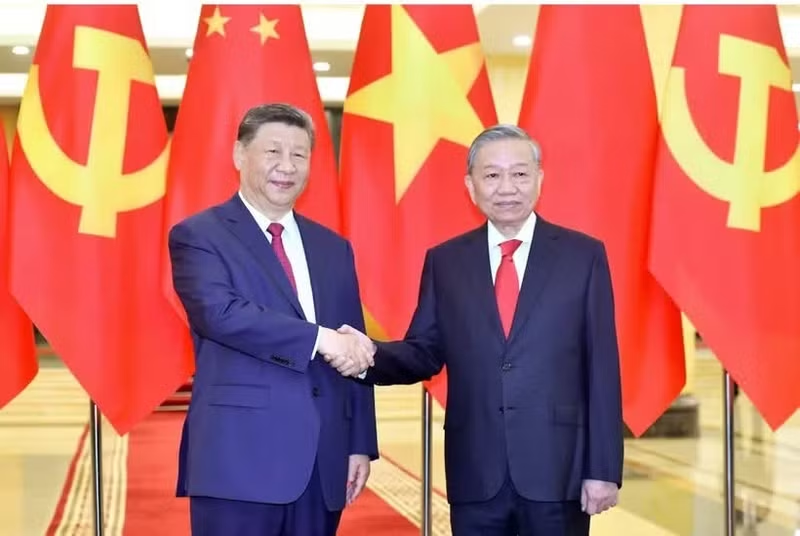
The state visit to China by General Secretary and State President To Lam at the invitation of General Secretary and President of China Xi Jinping is a major event for both parties and countries, fully reflecting the political stature and strategic significance of Viet Nam–China relations.
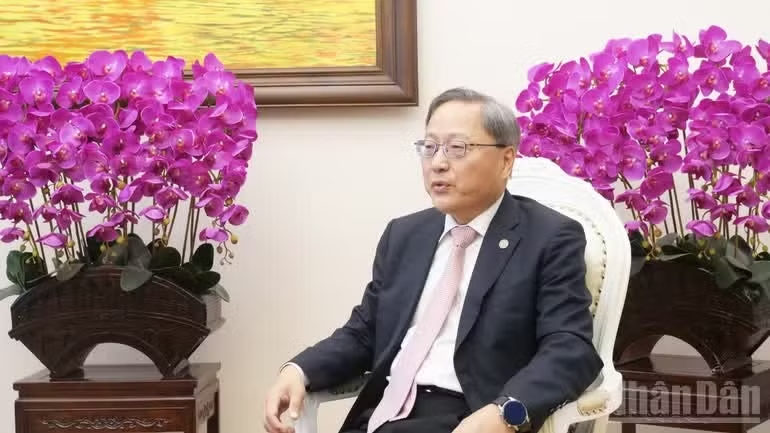
This is the view of Ambassador Zhang Jianguo, Secretary-General of the Charhar Institute — a research body specialising in diplomacy and international relations in China — in an exclusive interview granted to a Nhan Dan Newspaper correspondent based in China on the occasion of the visit.
New milestone in bilateral relations
Sharing his assessment of the visit’s significance, Ambassador Zhang Jianguo emphasised that it takes place shortly after General Secretary To Lam was elected President, demonstrating the high importance attached by the Vietnamese Party and State leader to the development of bilateral relations. It also consistently reflects Viet Nam’s position of prioritising ties with China in its foreign policy strategy, serving as evidence of the close neighbourly relationship described as “mountains connected to mountains, rivers connected to rivers” and the special friendship of “comrades and brothers” between the two countries.
The visit continues the tradition of regular exchanges and contacts between the two sides’ leaders, contributing to the concretisation and deepening of important shared understandings. It provides an opportunity for both sides to exchange views on the long-term direction of bilateral relations, common challenges in the process of building socialism, as well as regional and international issues of mutual concern. Such strategic exchanges play an irreplaceable role in ensuring that Viet Nam–China relations develop in a stable and sound manner along the right trajectory.
According to Ambassador Zhang Jianguo, this visit is expected to bring greater depth and substance to the building of a Viet Nam–China community with a shared future of strategic significance. Both sides are likely to reach important common understandings centred on the “six better” orientation as well as put forward numerous practical cooperation measures. At the same time, the visit serves as a model of cooperation, demonstrating the determination of both Viet Nam and China to steadfastly advance the socialist cause and jointly address shared challenges amid a complex, unpredictable, and profoundly changing international landscape. It is expected to have a positive and far-reaching impact on maintaining peace and stability and promoting development and prosperity in the region and beyond.
“This visit by General Secretary To Lam marks an important new milestone in the history of China–Viet Nam relations. I have high expectations for its success and firmly believe that, under the strategic guidance of the top leaders of both Parties, China–Viet Nam relations will embrace a brighter future,” Ambassador Zhang Jianguo stressed.
Substantial achievements, strong momentum
The year 2025 marks the 75th anniversary of the establishment of diplomatic ties and is also designated as the Year of Viet Nam–China People-to-People Exchanges. Reflecting on the development of bilateral relations over the past year, Ambassador Zhang Jianguo summarised it as “substantial achievements and strong momentum.”
Politically, high-level exchanges have maintained a positive trajectory, with close interactions across multiple channels contributing to the sharing of governance experience and the alignment of development strategies. Practical economic cooperation has yielded notable results, withbilateral trade turnover exceeding 290 billion USD in 2025, according to Chinese customs statistics. China has remained Viet Nam’s largest trading partner for many consecutive years, while Viet Nam is China’s largest trading partner within ASEAN.
The two countries’ industrial and supply chains are deeply interconnected, with increasingly evident complementary advantages, particularly in sectors such as electronics, textiles, and agriculture. Meanwhile, China’s investment in Viet Nam has been accelerated, covering many emerging areas such as new energy, the digital economy, and infrastructure. From cross-border railway planning to the development of smart border gates, from facilitating cross-border payments to promoting local currency settlements, cooperation between the two countries is shifting from quantitative expansion to qualitative improvement.
In terms of people-to-people exchanges, activities have been rich and diverse, with tourism recovering significantly. According to incomplete statistics, more than 5.3 million Chinese tourists visited Viet Nam in 2025, while nearly 2 million Vietnamese tourists travelled to China. Exchanges among youths, women, media organisations, and research institutions have been particularly close, while the number of students studying in each other’s countries has increased, becoming a new driver of friendship. Cultural performances, film and television exchanges, and book translations have also been warmly received by the public in both countries.
Looking ahead, Ambassador Zhang Jianguo noted that there remains ample room for cooperation, particularly in areas such as smart transformation (artificial intelligence, digital economy, smart cities, e-commerce); green and low-carbon transition (renewable energy, clean energy technologies, environmental protection, wind power, solar power, electric vehicles); enhanced connectivity through road and cross-border railway systems and border infrastructure; and exchanges of governance experience, especially in party building, anti-corruption efforts, poverty reduction, and rural development. Regarding maritime issues, he stressed that as long as both sides adhere to principles of mutual respect, equality, mutual benefit, and a spirit of friendly consultation, differences can be effectively managed.
Promoting the role of research institutions
As a key Chinese research institution in diplomacy and international relations, the Charhar Institute has consistently worked to advance both research and practice in areas such as public diplomacy, peace studies and regional cooperation. At the same time, it places great importance on and actively promotes the development of Viet Nam–China relations.
Sharing his views on the role of research institutions in strengthening and advancing bilateral ties, Ambassador Zhang Jianguo stated that such institutions must make a significant contribution to deepening political trust. Both sides can enhance cooperation in areas such as joint research on major theoretical and practical issues related to socialist construction, including how to appropriately manage the relationship between the state and the market, promote common prosperity, and address population ageing. They can also discuss pressing regional and international issues to seek common ground, and conduct “Track II” dialogues to build consensus and pave the way for official negotiations.
In addition, research institutes and think tanks can serve as a bridge for “people-to-people connectivity” by organising dialogues, forums, and seminars among scholars and experts, as well as carrying out joint research and publications, thereby enhancing mutual understanding and bonds between the intellectual communities of the two countries.
Research institutions in particular should play a role in firmly consolidating the “social foundation”. China and Viet Nam are geographically close and share many cultural similarities; however, differences in public perception still exist due to information asymmetry. Research institutions have the responsibility to help the public gain an accurate and comprehensive understanding of bilateral relations through objective and well-founded research outcomes. In this process, the role of youth is especially important, and exchanges among young scholars and youth leaders should be strengthened to provide a solid guarantee for the long-term development of Viet Nam–China relations.
“China–Viet Nam relations have gone through an extraordinary 75-year journey. From standing shoulder to shoulder in revolution, to learning from each other during the periods of reform and opening, and now jointly building a community with a shared future in the new era, the peoples of both countries have worked together to nurture the precious tree of friendship that we enjoy today. The upcoming visit to China by top leader To Lam will certainly inject new vitality into this great tree,” the scholarand veteran Chinese diplomat emphasised.
Author: NDO
RECOMMENDED TOPICS