VN
VN
 EN
EN
20/07/2026, 14:32
Legal environment
Expanding breakthrough “eCitizen Hub” model nationwide
Prime Minister’s Decision No. 826/QD-TTg, issued by the Prime Minister on May 11, 2026, approves the Programme on developing applications of population data, identification and electronic authentication to serve national digital transformation for the 2026-2030 period, with a vision to 2035.

It highlights a notable focus on studying and expanding the “eCitizen Hub” model, aimed at bringing public services, digital healthcare and other digital utilities closer to people’s daily lives.
The programme clearly sets the target that by 2030, citizens and businesses will benefit from convenient, rapid, and secure digital services, with no barriers caused by paperwork or administrative boundaries. To realise this roadmap, investing in modern and secure digital infrastructure serving administrative procedure settlement and the provision of online public services is one of the urgent tasks.
The Prime Minister requested local People’s Committees to coordinate with the Ministries of Public Security, Justice, Science and Technology, and Health to study and propose “eCitizen Hub” solutions at public locations, administrative agencies, and service centres, with a view to nationwide deployment from January 2027.
The launch and expansion of this breakthrough digital infrastructure model with multiple utilities and functions is the result of an important shift from “administrative management” to “administrative service,” applying technology to better serve people. It also demonstrates efforts to concretise the viewpoint that people are “the centre, the objective, the subject, the resource, and the driving force of digital transformation” as affirmed in the programme.
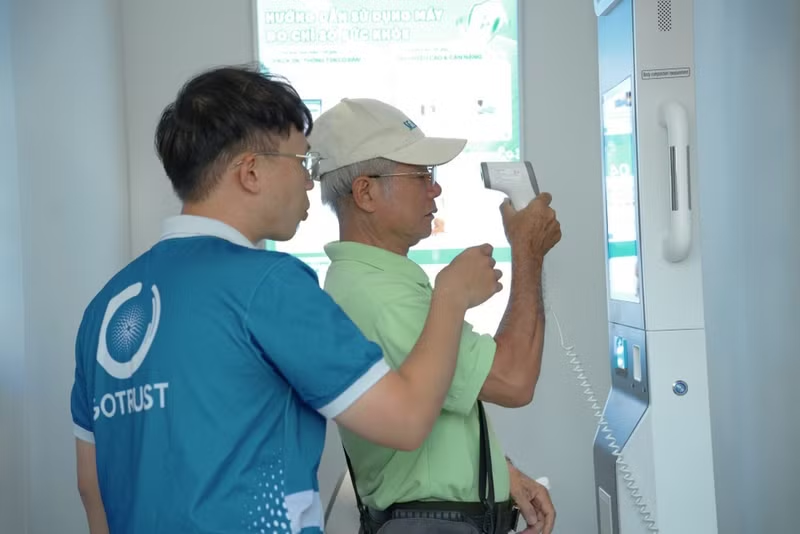
Currently being piloted in residential areas in Ho Chi Minh City, “eCitizen Hub” are promoting their role as a safe and reliable connection channel between the State, people, and businesses. Based on the national electronic identification and authentication platform (VNeID), the model brings public services, digital healthcare, and many civil utilities closer to people, contributing to improving service quality and building grassroots digital government.
At these stations, citizens can fully access core functions, including online public services (submitting applications, paying fees online, looking up information, and tracking the progress of administrative procedures on the National Public Service Portal without having to visit administrative offices); social welfare utilities (looking up health insurance information, paying traffic fines, conducting basic banking transactions, and many other practical utilities directly at the station); security reporting (integrating an SOS button directly connected to local security forces to ensure citizens’ safety); and digital healthcare (checking basic health indicators, receiving remote health consultations, digitising pharmaceutical supply processes, and managing personal health records).
This represents a breakthrough step in applying technology and artificial intelligence to serve people, contributing to building a modern and transparent e-government. Expanding the presence of such “touchpoints” at public places, administrative agencies, and service centres will continue to enhance universal access while promoting digital skills and digital culture throughout society.
Digital healthcare functions developed with the participation of public-private units are an important component of the “eCitizen Hub.” This collaboration provides comprehensive solutions, from technological infrastructure to supply and professional capacity, helping people access standardised healthcare services quickly and conveniently right where they live.
People can check basic health indicators using smart devices while also accessing consultation services, purchasing medicines, and using other essential healthcare utilities directly in their communities. The process is designed to be simple and convenient, helping reduce travel and waiting time while improving access to services.
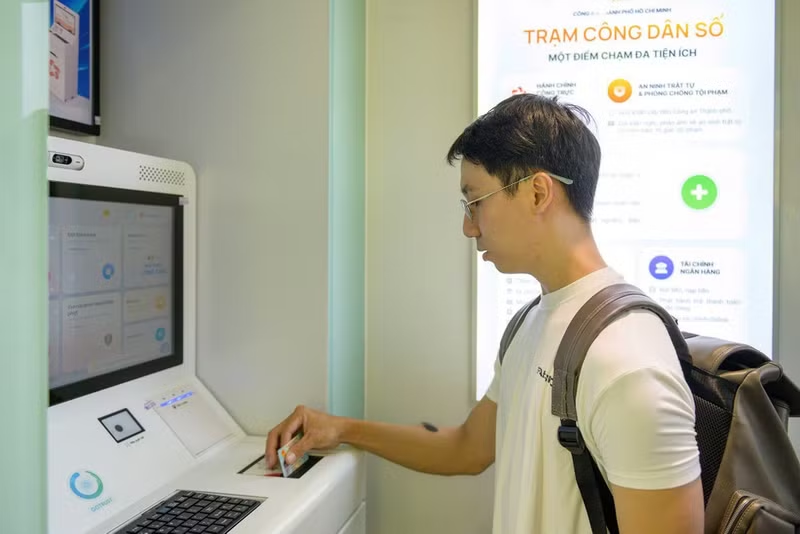
Notably, the application of electronic identification and authentication in healthcare services, particularly pharmaceutical supply, helps ensure the principle of “right person–right prescription,” while improving safety, transparency and data security.
Located close to residential communities, the stations also maximise the advantage of being “close to the people”, becoming safe and reliable healthcare support points in emergency situations or sudden illness and fever.
Under the direction of the Police Department for Administrative Management of Social Order and the Ho Chi Minh City Public Security, healthcare solutions at the stations are being deployed according to modern and high-quality standards, ensuring absolute data security.
The FPT Long Chau pharmacy and vaccination chain, with its extensive network and modern technology platform meeting all standards of information safety and security, has been selected to operate healthcare utilities at the stations, contributing to completing the grassroots public-private service ecosystem and bringing practical services closer to people. Previously, this healthcare enterprise was also among the pioneers in integrating services on the VNeID platform and applying population data to community services.
Under the vision to 2035, Viet Nam aims to become a comprehensively and sustainably developed digital nation, in which all transactions between people and the government are conducted in the digital environment. At that point, national databases and population data, serving as the core, will be effectively connected, shared, and utilised to build a smart government and support real-time data-based decision making.
Experts believe that community-based touchpoints such as “eCitizen Hub” are an important link helping connect and integrate data with the national system. Population data, healthcare data, and related information are integrated, authenticated, and managed on digital platforms, contributing to building an ecosystem of “accurate, sufficient, clean, live, and unified” data to effectively support governance and long-term citizen care.
Author: NDO
RECOMMENDED TOPICS