VN
VN
 EN
EN
02/07/2026, 02:00
Legal environment
Raising income ceilings for social housing purchase: Extra measures needed
The proposal to raise the income ceilings for purchasing social housing to VND 50 million per month could broaden access for middle-income earners. However, the policy’s effectiveness will depend largely on the coordinated implementation of accompanying measures.
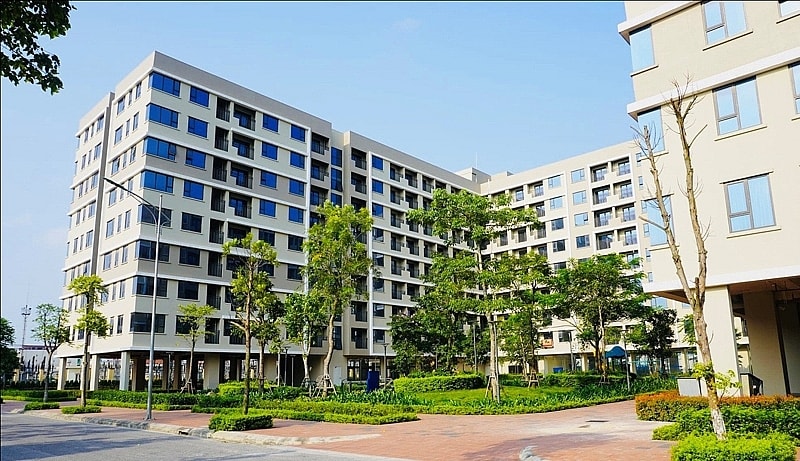
As assigned by the Prime Minister, the Ministry of Construction is drafting a decree amending and supplementing several provisions of Decree 100/2024, which details the Housing Law on the development and management of social housing. Notably, the draft proposes relaxing income eligibility criteria, thereby expanding the pool of eligible buyers and lease-to-own applicants.
A Growing “Gap” in the Market
Under current regulations, social housing buyers must meet multiple criteria, including income thresholds. Specifically, single individuals must earn no more than VND 20 million per month; single parents raising minor children, no more than VND 30 million; and married couples, no more than VND 40 million combined.
In practice, however, a large segment of the workforce falls into a “gap”: they do not qualify for social housing under existing rules, yet lack the financial capacity to access commercial housing. A report by the Ho Chi Minh City Real Estate Association shows that typical urban individual incomes range from VND 21–35 million per month, while household incomes are around VND 41–55 million.
Meanwhile, commercial housing prices in major cities remain persistently high. Many apartment projects in Hanoi and Ho Chi Minh City are priced at VND 50–60 million per square meter and even higher in central areas. A typical 70-square-meter unit can cost between VND 3–5 billion, far beyond the savings capacity of most households.
By contrast, social housing, priced at around VND 15–30 million per square meter, is considered more accessible. Yet current income thresholds effectively exclude many households with genuine housing needs from benefiting from this segment.
Analyzing the issue, Dr. Chau Dinh Linh, a lecturer at the Ho Chi Minh City Banking University, noted that raising the income ceiling is a necessary step given rising living costs and shifting income levels. Housing demand in Vietnam remains fundamental, but the real estate market has long skewed toward mid- and high-end segments, pushing prices steadily upward.
In major cities such as Hanoi and Ho Chi Minh City, average housing prices of around VND 100 million per square meter far exceed the affordability of low-income workers, and even middle-income groups face significant barriers to accessing commercial housing. As a result, homeownership is increasingly out of reach, exacerbating social disparities.
Moreover, existing income ceilings no longer reflect economic realities, particularly as wages, living costs, and standards of living have all increased.
Adjusting the ceiling would expand access to social housing, especially for those caught in the “gap”—ineligible for both commercial housing and current social housing programs.
As a concrete example, Dr. Linh noted that for a VND 5 billion apartment, if buyers borrow VND 2–3 billion from banks, monthly repayments could reach nearly VND 30 million. This level of repayment consumes a large share of household income, making financial balance difficult. Raising the income ceiling is therefore not only about expanding eligibility but also about “bridging the gap” between social and commercial housing—one that is widening over time.
The Need for Policy Coordination
Despite its positive implications, experts caution that raising the income ceiling will also increase demand for social housing significantly.
According to Dr. Can Van Luc, Chief Economist at BIDV and Director of the BIDV Training and Research Institute, expanding eligibility will drive up demand while supply remains limited. Without corresponding project development, competitive pressure will intensify.
Echoing this view, Associate Professor Dr. Dinh Trong Thinh emphasized the need for appropriate prioritization mechanisms to ensure that low-income groups—the core beneficiaries of social housing policy—are not disadvantaged as middle-income groups are included.
Experts also highlighted the importance of preferential credit policies and administrative reform. Developing long-term loan packages with stable interest rates would enhance affordability, while transparent, technology-enabled approval processes could reduce inefficiencies and potential misconduct.
The national program to develop one million social housing units by 2030 is expected to play a critical role in addressing supply constraints. If effectively implemented, it could enhance the practical impact of the policy and enable middle-income households to access stable housing.
Overall, the proposal to raise the income ceiling for social housing is a necessary adjustment to better align with current income levels and urban housing demand. However, its success will depend heavily on synchronized implementation of supporting measures—particularly expanding supply, improving credit mechanisms, and ensuring transparent approval processes.
Once these bottlenecks are addressed, social housing can not only expand access to homeownership but also contribute to stabilizing the real estate market and fostering more sustainable urban development.
Author: VI ANH - TRUONG DANG
RELATED TOPICS
1. Warehousing, semiconductors, and data centres — three driving forces of industrial real estate in 2026
2. HCMC Real Estate: Increasing Liquiditiy Drives Clear Market Segmentation
3. Amending the Decree on e-invoices: Reducing procedures and removing bottlenecks for enterprises and household businesses
RECOMMENDED TOPICS