VN
VN
 EN
EN
10/07/2026, 10:58
VCCI
Amending the Decree on e-invoices: Reducing procedures and removing bottlenecks for enterprises and household businesses
The draft Decree on electronic invoices and documents is being finalized with a focus on significantly reducing administrative procedures and prioritizing taxpayers. At the workshop on March 27th, many businesses proposed removing "bottlenecks" for household businesses operating on e-commerce platforms, contributing to the enforcement of the policy.
Strong reforms toward a taxpayer-centered approach
At the workshop to gather feedback on the draft Decree detailing the Law on Tax Administration and the Decree on electronic invoices and electronic documents held on March 27, 2026, representatives of the drafting agency stated that this draft has been developed with a streamlined and clearly reform-oriented approach.
In his opening remarks, Mr. Đậu Anh Tuấn - Vice Secretary General of the Vietnam Chamber of Commerce and Industry (VCCI) - noted that the drafting agency (Tax Department, Ministry of Finance) proactively consulting the business community during the drafting process demonstrates openness and a high sense of responsibility in lawmaking.
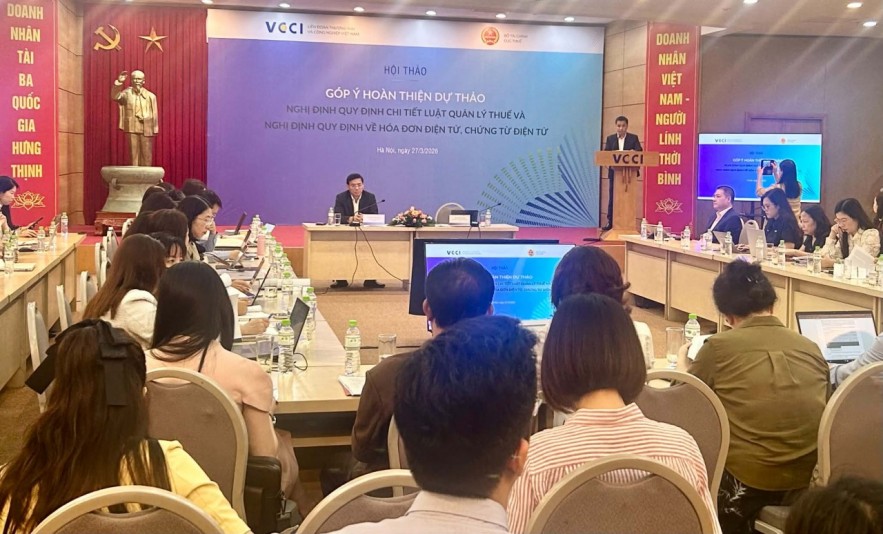
Overview of the workshop. Photo: Hải Anh
Through reviewing the draft, VCCI acknowledged the clear spirit of reform demonstrated by the drafting agency. The promotion of digital transformation in tax administration from electronic transactions and centralized databases to the application of artificial intelligence in risk analysis is aligned with international trends and practical requirements. The principle of placing taxpayers at the center is consistently applied throughout both drafts. The abolition of lump-sum tax, expansion of cases where tax declaration dossiers are not required when tax authorities are already connected to data systems, preferential treatment for compliant enterprises, and simplification of administrative procedures are all encouraging steps forward.
Representing the policy drafting agency, Ms. Phạm Thị Minh Hiền – Deputy Head of the International Tax Policy Division, Tax Department (Ministry of Finance) – stated that the draft Decree consists of 5 chapters and 43 articles, significantly reduced from 61 articles in the current Decree. This reduction aims to eliminate overlapping content while transferring certain technical provisions to circulars to enhance flexibility in administration.
According to Ms. Hiền, the drafting process adheres to five major viewpoints, with a focus on promoting digital transformation, completing a synchronized legal framework for modern tax administration, and especially minimizing administrative procedures. “The overarching principle is to place taxpayers at the center, simplify processes, and enhance transparency and feasibility of policies,” Ms. Hiền emphasized.
At the same time, the draft Decree aims to redesign tax administration processes toward automation, data integration, and enhanced connectivity and information sharing among agencies. Administrative procedures will be conducted in an electronic environment, independent of administrative boundaries, thereby maximizing convenience for enterprises.
A representative of the Vietnam Tax Consultants’ Association (VTCA), Ms. Lê Thị Duyên Hải, highly appreciated the drafting agency’s efforts in incorporating practical considerations into the draft. According to her, regulations on electronic invoices and documents are becoming increasingly clear and transparent, while encouraging individuals, enterprises, and tax authorities to strengthen the application of technology.
“Completing the Decree in a clear and understandable manner will help taxpayers comply more easily while improving the effectiveness of tax administration,” Ms. Hải commented.
In practice, the number of e-invoices in Vietnam has increased rapidly, with more than 20 billion invoices issued. This creates an urgent need to complete the legal framework to ensure effective management while supporting enterprises in adapting to the digital environment.
Removing bottlenecks for household businesses and reducing procedural burdens
In addition to positive aspects, the business community provided candid feedback, focusing on reducing procedural burdens and enhancing policy feasibility.
According to Mr. Đậu Anh Tuấn, the two Decrees under development will have a significant impact on the business environment and therefore should be designed to reduce compliance costs and maximize convenience for enterprises.
One notable issue is the regulation on e-invoices for household businesses operating on e-commerce platforms. According to Mr. Tuấn, requiring e-invoices for every small transaction would create significant pressure, increase costs and time, and potentially hinder business activities.
From this perspective, many opinions proposed not requiring household businesses on e-commerce platforms to issue e-invoices for each individual transaction. Instead, more flexible mechanisms should be allowed.
Notably, the proposal to allow daily consolidated e-invoices instead of per-transaction issuance received strong support from many enterprises. This approach is expected to significantly reduce compliance costs while being suitable for business models characterized by high transaction frequency and low value.
In addition, enterprises recommended further clarification of regulations related to the timing of invoice issuance, handling of technical incidents, and cases where e-invoices are not mandatory. These are common issues in practice but remain insufficiently specified in the draft.
Representing the American Chamber of Commerce in Vietnam (AmCham), Ms. Nguyễn Việt Hà appreciated the openness and receptiveness of the drafting agency. Accordingly, the draft has initially taken the right direction by focusing on addressing practical challenges faced by enterprises.
“Listening to and incorporating feedback from the business community will help improve the Decree and ensure its feasibility in implementation,” Ms. Hà noted.
Opinions at the workshop also emphasized the need to align with Resolution No. 68-NQ/TW, which sets a target of reducing at least 30% of administrative processing time and legal compliance costs. This is considered an important benchmark for assessing the effectiveness of the Decree’s reform efforts.
It can be seen that the draft Decree on electronic invoices and electronic documents is being refined in a direction that both strengthens management and reduces the burden on enterprises. Fully incorporating feedback—especially from the business community—will be a key factor in ensuring that once issued, the policy is effectively implemented, contributing to an improved business environment and promoting digital transformation in the tax sector.
Author: VCCI
RECOMMENDED TOPICS