VN
VN
 EN
EN
24/07/2026, 16:11
VCCI
Vietnam’s party-member entrepreneurs seen as key force in new business era
VCCI President Hồ Sỹ Hùng has proposed a broad set of reforms aimed at unlocking resources and expanding innovation space to help the private sector become a leading driver of growth in Viet Nam’s next development phase.
On May 25, the Vietnam Chamber of Commerce and Industry (VCCI), in coordination with the Party Central Policy and Strategy Commission, held a conference titled "Vietnamese Private Enterprises and Entrepreneurs with the Innovation of the National Development Model and the Policy for Party Members Engaging in Private Business".
The event gathered more than 100 representatives from major private corporations, leading businesses, and business associations across multiple sectors.
Speaking at the conference, VCCI President Hồ Sỹ Hùng said the composition of participating enterprises reflected the broad structure of Viet Nam’s private sector. Manufacturing and industrial processing firms accounted for around 20% of attendees, followed by construction, real estate, infrastructure, industrial parks, and energy at 19%. Agriculture, food, seafood, and medicinal products represented 15%, while technology, digital transformation, AI, software, and innovation firms made up 13%.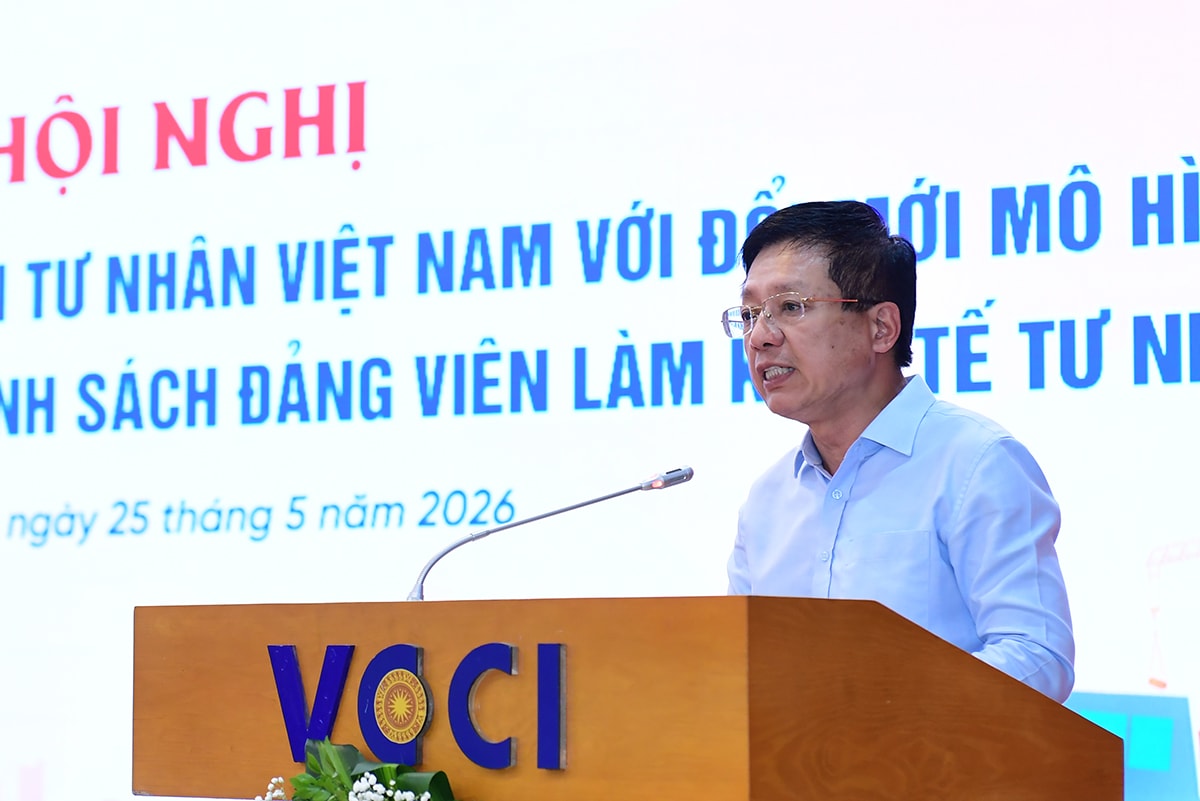
Associate Professor Dr. Hồ Sỹ Hùng, VCCI President, outlined two major groups of issues that require attention in the process of improving policies for the private economic sector.
More than 30 large multi-sector corporations with extensive ecosystems also attended, including companies involved in infrastructure, logistics, finance, agriculture, energy, and technology. According to Hùng, these businesses are capable of leading supply chains, creating large-scale employment, and driving innovation during Viet Nam’s next stage of development.
“This conference is not the voice of a few isolated sectors. It represents the diverse and comprehensive voice of Viet Nam’s private economy,” he said. “This is the force directly creating wealth, jobs, state revenue, production capacity, innovation, and economic competitiveness.”
Mr. Hùng said Viet Nam is entering a critical period in which the country must shift its growth model toward one driven by science, technology, innovation, and digital transformation. The goal is to achieve double-digit growth during 2026-2030 and become a high-income developed country by 2045.
He argued that the private sector would play a central role in that transition. Viet Nam currently has around one million private enterprises, accounting for roughly 97% of all businesses nationwide. The sector contributes about 50% of GDP, more than 30% of state budget revenue, and over 80% of jobs.
“The economy can no longer rely mainly on cheap labor, resource extraction, or traditional investment incentives,” Mr. Hùng said. “The most valuable assets today are technology, data, research and development capability, supply chain governance, ESG standards, and continuous innovation.”
To support this transition, VCCI proposed a series of reforms.
One key recommendation is to give private enterprises greater access to major infrastructure projects and strategic industries. VCCI also called for policies that would help build leading Vietnamese private corporations capable of integrating into regional and global supply chains, while simultaneously strengthening small and medium-sized enterprises.
The organization also urged the government to reduce institutional costs for businesses by addressing legal bottlenecks across investment, land, construction, environmental compliance, fire safety, taxation, customs, and import-export procedures.
Hùng emphasized the need to move toward a digital public administration model based on the principle of “one-stop, one-time, one responsible authority.” Businesses, he said, should be able to track their applications in real time and know exactly who is handling them and when they will be completed.
Alongside institutional reform, VCCI called for stronger financial support mechanisms for innovation, including green finance, venture capital funds, technology investment funds, credit guarantees, and pilot programs for intellectual property-based lending.
The organization also proposed expanding regulatory sandbox mechanisms for emerging sectors such as fintech, digital technology, smart logistics, drones, low-altitude economy services, smart agriculture, and digital healthcare.
“The spirit should not be ‘if you cannot manage it, ban it,’” Mr. Hùng said. “We need to create space for businesses to experiment, innovate, and enter new sectors.”
Another major issue discussed at the conference was the policy on Party members participating in the private economy.
Many business representatives expressed support for encouraging Party members to engage in private-sector activities, describing it as a significant shift in thinking about the role of entrepreneurs within Viet Nam’s socialist-oriented market economy.
According to Mr. Hùng, many Party-member entrepreneurs are already playing active roles in innovation, job creation, employee welfare, tax contributions, and social responsibility.
However, he said further clarification is needed regarding procedures and conditions for private business owners and workers to become Party members. He also stressed the importance of ensuring that Party organizations inside private enterprises support ethical business culture and legal compliance without creating additional administrative burdens.
VCCI suggested expanding flexible Party organization models in the private sector, including Party cells within business associations or inter-company Party structures for firms that are not large enough to establish independent Party organizations.
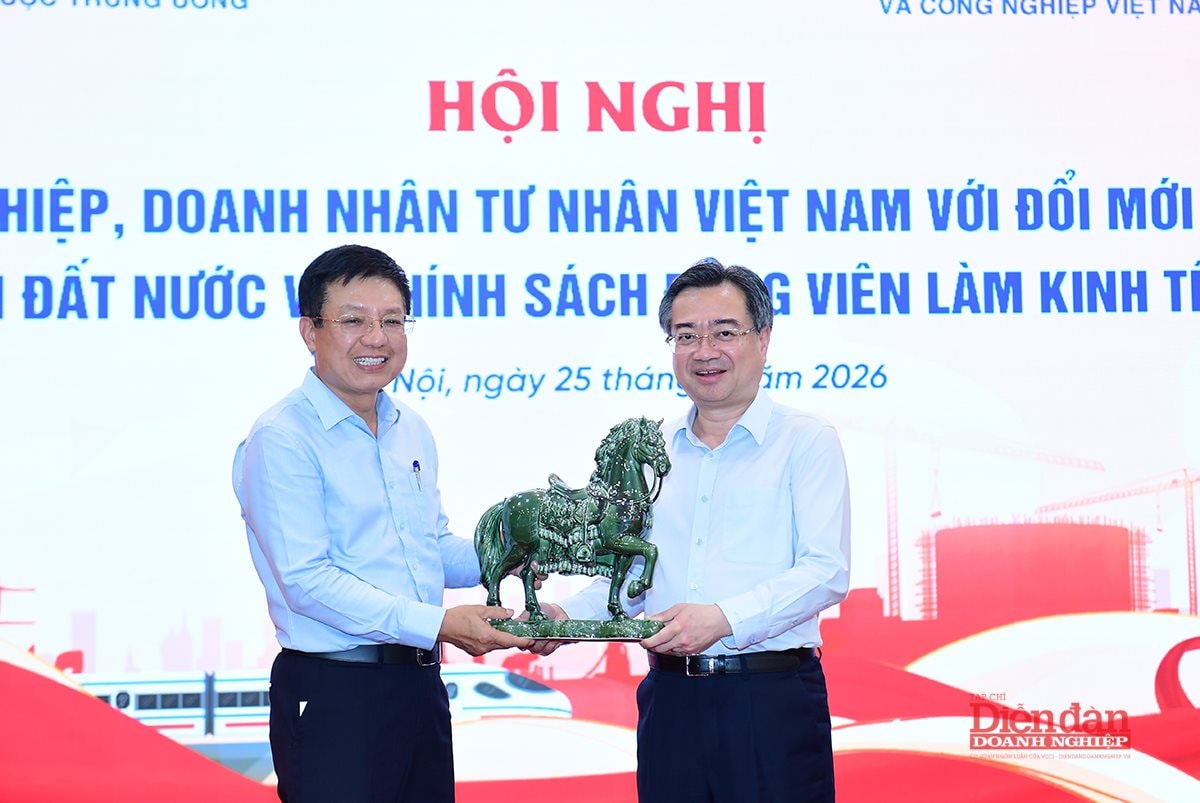
On behalf of VCCI and the business community, VCCI President Hồ Sỹ Hùng presented a commemorative gift to Nguyễn Thanh Nghị, Politburo Member, Secretary of the Party Central Committee, and Head of the Party Central Policy and Strategy Commission.
More broadly, Mr. Hùng said Viet Nam should build the image of Party-member entrepreneurs as representatives of a modern Vietnamese business culture grounded in lawful wealth creation, integrity, innovation, and responsibility toward workers, communities, and the country.
“History shows there is no strong nation without a strong private business community,” he said. “If Viet Nam wants an independent, competitive, and sustainable economy, it must have strong enterprises and entrepreneurs with ambition, intelligence, and responsibility toward the nation.”
Looking ahead, VCCI said it would continue focusing on improving the business environment, supporting digital and green transformation, strengthening links between enterprises and research institutions, and helping Vietnamese companies integrate more deeply into global supply chains.
The organization also pledged to maintain its role as a bridge between the business community and Party and State agencies, while helping communicate policies and collect feedback from enterprises nationwide.
Author: DIEM NGOC (Truong Dang translates)
RELATED TOPICS
RECOMMENDED TOPICS