VN
VN
 EN
EN
20/07/2026, 14:32
Legal environment
Relying on the people to build a deeply rooted and resilient Party
In the documents of the 14th National Party Congress, the viewpoint that “the people are the root” continues to be affirmed as a consistent principle of foundational significance and profound practical value. In response to the country’s development requirements in the new period, this viewpoint has been more thoroughly internalised and concretised through practical policies and solutions, helping to promote the people’s role as the central actors in Party building and rectification.
Taking public satisfaction as the yardstick
Embracing the principle that “the people are the root”, the documents of the 14th National Party Congress continue to emphasise the need to focus strongly on the grassroots, regarding them as the foundation and the place where the effectiveness of the Party’s leadership is directly tested. In particular, the effectiveness of serving the people and the level of public satisfaction are taken as key criteria for evaluating the quality of Party organisations, officials, and Party members.
This represents a new development in Party-building thinking, clearly reflecting the view that Party building must be closely linked to the practical lives of the people.
Implementing the motto “A strong Party stems from strong grassroots; strong Party organisations stem from strong Party members; rely on the people to build the Party”, the Standing Board of the Da Nang Municipal Party Committee has adopted the policy of focusing on the grassroots, considering grassroots realities both as the starting point and as the testing ground for Party-building policies and solutions.
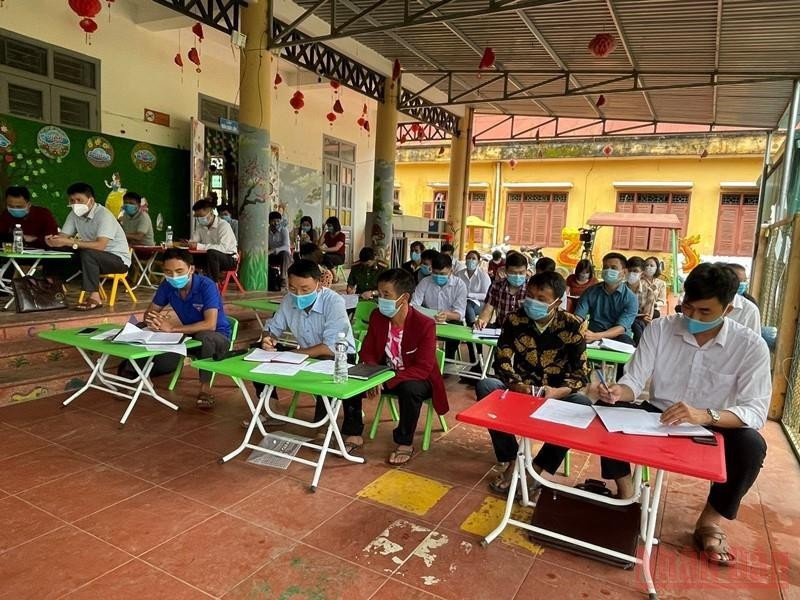
The assignment of members of the Standing Board, members of the municipal Party Executive Committee, and Party committee members at all levels to attend residential-area Party cell meetings, along with strengthened monitoring and close grasp of local situations, has helped promptly remove difficulties and obstacles arising at the grassroots level.
As a result, the quality of Party cell meetings has been improved, public trust strengthened, and the municipal Party organisation gradually consolidated from the grassroots level.
According to Doan Duy Tan, Head of the Da Nang Municipal Party Committee’s Commission for Organisation, specific approaches in Da Nang have demonstrated that the effectiveness of “relying on the people to build the Party” depends first and foremost on the role, responsibility, and exemplary conduct of officials and Party members at the grassroots level, especially Party cell secretaries.
Many Party cell secretaries have dared to think, act, and take responsibility. Together with village heads and residential group leaders, they regularly visit households, particularly in border areas and areas with religious communities, to listen to aspirations, promptly resolve emerging concerns, and prevent local “hot spots”.
Notably in Da Nang, during natural disasters and floods, the role of Party cell secretaries has been further affirmed as they have stood side by side with the people to respond swiftly and address consequences, demonstrating the close bond between the Party and the people and helping to strengthen public confidence in the Party’s leadership.
Sharing the view that development ensures stability and stability promotes development, and consistently improving people’s living standards; taking the satisfaction and trust of citizens and enterprises, along with work performance, as evaluation criteria, the Party organisation of Tan Khanh Trung Commune (Dong Thap Province) has clearly identified this not only as a guiding principle for action but also as a strong political commitment, affirming that all guidelines, policies, and laws must aim at improving quality of life, happiness, and public satisfaction.
In Tan Khanh Trung Commune, the viewpoint that “the people are the centre, the subject, the goal, and the driving force of development” has been consistently applied in leadership, direction, and implementation of local political tasks.
All resolutions of the communal Party organisation aim ultimately to improve people’s quality of life, taking public satisfaction as a criterion for evaluating work effectiveness.
Nguyen Thi Thuy Lam, Secretary of the Party Committee and Chairwoman of the People’s Council of Tan Khanh Trung Commune, said that after the merger of administrative units, with a larger area and population, the commune has striven to stabilise its organisational structure, maintain internal unity, and secure social consensus.
By substantively implementing the principle “The people know, the people discuss, the people do, the people inspect, the people supervise, and the people benefit”, the locality has achieved many positive results.
By the end of 2025, the poverty rate had fallen to just 0.81%; social welfare was ensured; agricultural production gradually shifted towards greater efficiency; and both material and spiritual life of the people continued to improve.
The implementation of administrative reform models such as “24/7 service-oriented government”, “Citizens do not write” and “No-writing, no-appointment Tuesdays” has clearly transformed the way grassroots authorities serve the people.
Officials proactively approach residents to provide support and resolve matters on the spot, thereby narrowing the gap between authorities and the people and building an image of a friendly, responsible, and people-oriented administration.
Strengthening dialogue with the people
Relying on the people to build the Party is reflected not only in staying close to the people but also in promoting grassroots democracy and enhancing the supervisory and social criticism role of the people over Party organisations and officials.
Through feedback, reflections, and petitions from the public, the Party can promptly identify shortcomings and inadequacies in leadership and management, thereby adopting appropriate adjustments and preventing from an early stage manifestations of degradation, “self-evolution”, and “self-transformation”.
When the people genuinely participate in the formulation, implementation, and supervision of policies, social consensus is reinforced and the strength of the great national unity bloc is brought into play.
Promoting democracy and the supervisory role of the people is truly effective only when accompanied by listening to and respecting the people, and by establishing direct and substantive dialogue channels between the Party, authorities, and the people.
Dialogue helps to promptly address emerging concerns, bridge “information gaps”, enhance forecasting capacity, limit complaints escalated beyond the grassroots level, and contribute to maintaining political and social stability.
Strengthening dialogue and relying on the people to build the Party have been implemented flexibly and effectively in localities, helping to address issues at their source.
The Resolution of the Party Congress of Hai An Ward (Hai Phong City) for the 2025–2030 term identifies as one of its key tasks the enhancement of meetings and dialogues between heads of Party committees and the people, especially at the grassroots level, and the timely and effective settlement of legitimate concerns and petitions.
In line with this spirit, according to Pham Thi Chuyen, Standing Deputy Secretary of the Hai An Ward Party Committee, regular dialogue sessions have become an important channel for heads of Party committees to meet residents directly and listen to their aspirations, reflections, and proposals.
Through dialogue, many issues related to planning, urban order, residential infrastructure, environmental sanitation, and security have been promptly resolved, limiting complaints escalated beyond the grassroots level, enhancing consensus, and contributing to maintaining stability in the locality.
Practical models and approaches in various localities show that relying on the people has become an inevitable requirement in current Party-building work. It is a long-term process that requires perseverance, consistency, and a high sense of political responsibility from each Party organisation and each official and Party member.
Author: NDO
RECOMMENDED TOPICS