VN
VN
 EN
EN
22/07/2026, 02:00
Business economics
“Strategic autonomy in science and technology: The time is ripe for action”
Strategic autonomy in science and technology is no longer a distant goal but an urgent requirement, now that the foundation is sufficient and the time for action is ripe. With unique advantages such as rare earth elements, tropical forests, and aquatic resources, Viet Nam has the basis to master technology from within, creating a distinct competitive advantage.
The core issue lies not in commitment, but in the capacity to realize it through concrete products and values, thereby affirming the role and responsibility of science and technology in the new development phase.
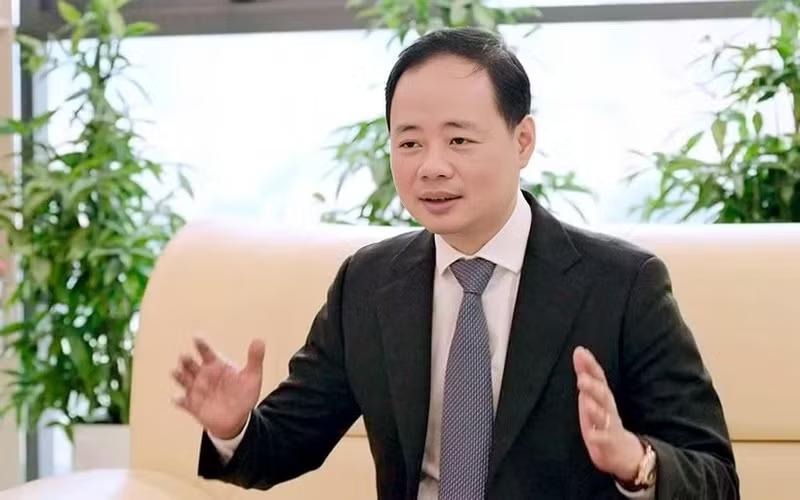
This was the assertion of Prof, Dr Tran Hong Thai, President of the Viet Nam Academy of Science and Technology, in an interview with Nhan Dan Newspaper. He emphasised the need to shift strongly from a research-oriented mindset to a value-creating mindset, using practical results as a measure, while proactively undertaking strategic science and technology tasks, contributing to the realisation of the country’s rapid and sustainable development goals.
A solid foundation, a ripe opportunity, time to act!
Q: What outstanding achievements has the Viet Nam Academy of Science and Technology made in recent times in researching and applying science and technology to directly serve people’s lives and the socio-economic development of the country?
A: There is a question that we scientists always ask ourselves: “When will the knowledge accumulated in the laboratory reach the real lives of the people?” The answer, I believe, is right now. Looking back at the past more than 80 years of national development, with the support of international friends, Vietnamese scientists have received thorough training in all basic research fields. The foundation accumulated over generations allows us to answer that question in a substantive way. This is the opportune moment to not only receive technology from abroad, but also to proactively master and develop Vietnamese technologies and products with domestic and international experts to serve the construction and development of the country.
The Viet Nam Academy of Science and Technology currently has over 2,500 leading scientists, publishes over 2,300 international papers annually, leads the country according to the Nature Index, and registers over 100 intellectual property rights annually. More importantly, this team has begun to master specific technologies, including AI-powered autonomous driving modules for vehicles, CRISPR/Cas9 gene editing technology applied to key crops, hydrogen production technology from water electrolysis, fabrication of electrode materials for next-generation batteries, and personalised medicine. This is not about assembling or processing according to foreign designs, but about truly mastering everything from the scientific foundation to the final product, without importing or being dependent on others.
We have identified a key priority for the coming period: Proactively applying science and technology directly to key economic sectors where Viet Nam has an advantage, especially those with large numbers of participants or those that directly impact the livelihoods of many people. This is the shortest path for Vietnamese technology to create widespread value in society.
For example, agricultural production sectors such as crop cultivation, livestock farming, and aquaculture are among the areas we prioritise. Viet Nam is one of the world's leading exporters of agricultural, forestry, and aquatic products, with tens of millions of people directly dependent on these sectors for their livelihoods.
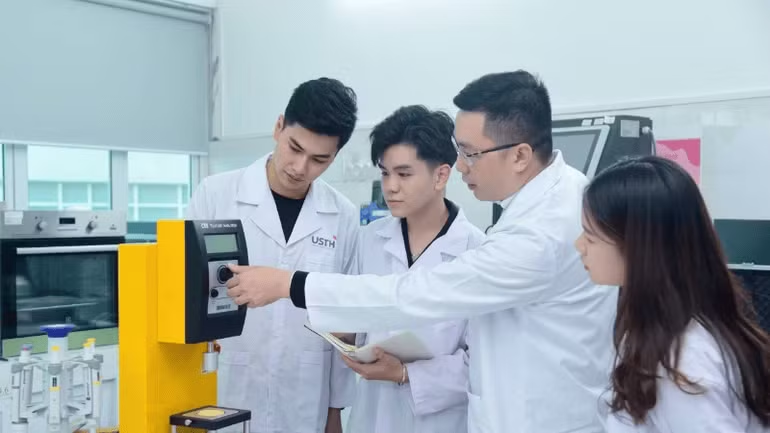
Together with businesses and several localities, the Academy is researching and promoting the application of artificial intelligence and databases to optimise farming, reduce input costs, and increase added value per unit area. In livestock and aquaculture, biotechnology serving the development of veterinary vaccines, biological disease prevention products, and high-quality breeds are being implemented, aiming to both increase productivity and meet the food safety standards of major export markets. These are things that science can do immediately and create the most practical impact on the people.
Connected with the tropical forest ecosystem, Viet Nam is shifting its thinking from planting forests to increase forest cover to smart and sustainable forest exploitation. With 14.8 million hectares of forest and one of the highest levels of biodiversity in the world, we focus on exploiting the value of native medicinal plants.
For example, the Red Pine tree in Lam Dong Province contains the active ingredient Paclitaxel (trade name Taxol), one of the most effective chemotherapy drugs currently available for treating ovarian, breast, and lung cancer. If we can master the technology of extraction, semi-synthesis, and targeted nano-technology formulation, the value generated from the same raw material could be 50 to 100 times greater. We have proposed establishing a biomedical centre in Lam Dong to implement a complete chain from indigenous raw materials to finished pharmaceuticals, creating sustainable livelihoods for people connected to the forest.
In addition, over 1.5 million hectares of bamboo are a tropical biomass source that we are aiming to industrialise towards high value. The technology of extracting cellulose from bamboo to produce viscose fibres can partially replace imported cotton for the textile industry and meet the demand for green raw materials from major export markets. Bamboo fibres and powder are also superior reinforcing materials for polymer composites used in construction and drone components, with a potential value increase of 20 to 30 times compared to raw bamboo. This is a direct link between forests, agriculture, and industry, creating a value chain where each link benefits.
Regarding mineral resources, Viet Nam possesses vast mineral resources with over 5,000 mines belonging to 60 different types. Neodymium, praseodymium, and dysprosium are the core components of NdFeB magnets, which are indispensable in high-efficiency electric vehicle motors and wind turbines. We are researching and mastering the entire technology chain from ore processing to finished magnet manufacturing, which could increase the value of the same ton of ore by 30 to 50 times. During the processing of bauxite from the Central Highlands, gallium, a strategic semiconductor raw material, can also be recovered, with a value 500 to 1,000 times higher than alumina. We are ready to cooperate with the Viet Nam Coal and Mineral Corporation to immediately implement pilot projects at existing plants.
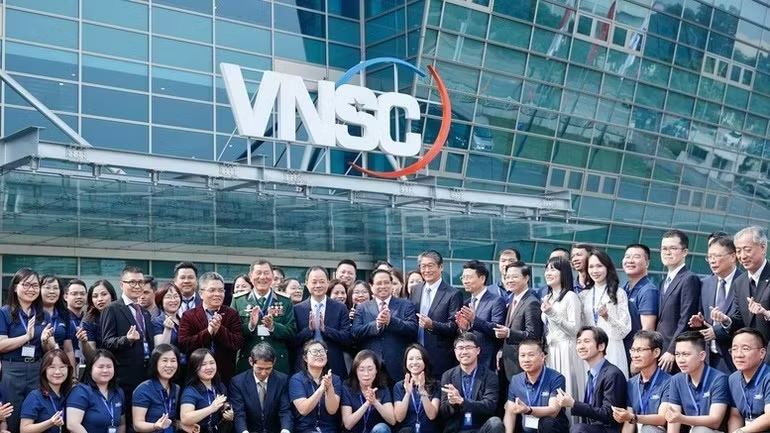
Regarding space technology, the Viet Nam Space Centre in Hoa Lac High-Tech Park, inaugurated in March 2026, is the first national space infrastructure operated entirely by Vietnamese engineers and scientists, with the support of Japan through JAXA and JICA for nearly two decades. The LOTUSat-1 satellite, soon to be launched into orbit, will provide observational data for resource management, disaster monitoring, and the protection of maritime sovereignty. The low-altitude flight economy is booming globally with thousands of applications ranging from unmanned logistics and smart agriculture to disaster response; We aim to master the production line for dual-use UAVs within the next five years, achieving a localisation rate close to 90%, combined with mastering the production of semiconductor chips using processes exceeding 90nm.
I also want to mention a very real and relevant problem: construction sand for expressways in the Mekong Delta. The demand is approximately 39 million cubic meters of sand for embankment construction, while river sand only provides about 20 million cubic meters. The estimated reserves of nearly 150 billion cubic meters of coastal sand could be the solution.
We are currently researching methods for treating saline-contaminated sand using cement blending, geotechnical reinforcement, and salt content control to meet project technical requirements. In addition, the development of an AI-integrated intelligent flood warning system and technology consulting for urban underground spaces in Ha Noi and Ho Chi Minh City are also problems that the academy can immediately address using its existing capabilities.
Q: Following the 2nd Plenum of the 14th Central Committee of the Communist Party of Viet Nam, the Central Committee unanimously agreed on the policy of transforming the Viet Nam Academy of Social Sciences into a public service unit directly under the Central Committee of the Communist Party of Viet Nam. Professor, could you please explain how this transformation will impact the strategic direction, operational mechanisms, and position of the academy? Furthermore, what preparations does the academy need to make to effectively adapt and continue to play a core role in basic research and high-tech development?
A: To understand the true meaning of this decision, we must first consider the overall picture. The 2nd Plenum of the 14th Central Committee unanimously agreed on the policy of transforming five agencies — Viet Nam Television, Radio the Voice of Viet Nam, Viet Nam News Agency, Viet Nam Academy of Social Sciences, and Viet Nam Academy of Science and Technology — into public service units under the Party Central Committee.
The five agencies represent the three fundamental pillars of national strength in the new era: ideological guidance through the media system; social knowledge through social sciences and humanities research; and scientific and technological knowledge through natural sciences and engineering research. The Party’s placement of all three pillars under its direct leadership at the highest level demonstrates a clear understanding that, in this breakthrough period, areas crucial to the nation's destiny cannot be led indirectly.
Specifically for the Viet Nam Academy of Science and Technology, this is the first time in history that a natural science and technology research organisation has been placed directly under the leadership of the Party at the highest level. This shows that the Party considers science and technology not as a purely technical field but as a strategic issue and a matter of national importance. This message is entirely consistent with the spirit of Resolution 57-NQ/TW on breakthroughs in the development of science, technology, innovation, and digital transformation of the nation, and with the aspiration to propel the country forward in the new era through science and technology, innovation, and digital transformation, as General Secretary To Lam has repeatedly emphasised.
Regarding the impact on strategic direction, this new position places higher demands but also opens broader opportunities. The academy not only performs its professional duties but also directly participates in strategic consulting, providing scientific arguments to support the Party's leadership.
Research results must reach the most important decision-making bodies in a more substantive and timely manner. This new status allows the academy to advise on the formation of specific scientific policies and resolve the institutional obstacles we have been advocating for many years.
Regarding operational mechanisms, this new status opens opportunities to design financial mechanisms for scientific research based on scientific logic, not the logic of conventional administrative management. The investment lifecycle for basic research can be extended to align with the laws of knowledge accumulation. Mechanisms for attracting and retaining scientific talent can be designed more flexibly to compete with the private sector and the international community. These are fundamental adjustments that this new status facilitates.
Regarding preparation, we are focusing on three parallel approaches:
First, streamlining the organisation to concentrate on strategic priority research areas, aligned with the 11 national strategic technology groups.
Second, rebuilding the science strategy based on the principle: from basic research to mastering and developing Vietnamese technology and products to serve key economic sectors.
Third, advising on the formation of specific policies to attract scientific talent, including Vietnamese experts working abroad, creating conditions for them to return and contribute in a worthy environment.
The worthiest answer to the trust the Central Committee has placed in us lies not in promises nor declarations but in actual scientific quality, concrete products, and an honest and dedicated team. Every officer and scientist at the academy understands this.
Q: One frequently mentioned issue is the significant gap between scientific research and practical application. Professor, what are the most important institutional bottlenecks hindering the transformation of scientific knowledge into a driving force for socio-economic development? What solutions has the Academy implemented to promote the transfer of research results into production and daily life?
A: Before discussing necessary actions, I would like to acknowledge an important fact: the institutional landscape has changed very positively recently. The Law on Science, Technology and Innovation No. 93/2025/QH15, effective from October 2025, is a real breakthrough in legal terms.
The law has shifted the management model from pre-approval to post-approval, granting science and technology organisations the right to self-determination regarding research direction, personnel, and financial allocation, while establishing a legal basis for commercialising research results and distributing benefits according to the level of contribution. This is a good legal foundation for us to expand more strongly.
Based on that, we have identified three key areas of action to bridge the gap between research and application.
Firstly, we are proactively building a truly functioning technology market, because having a good legal framework does not automatically mean having a technology market. What the law cannot create immediately is a professional team of technology brokers, a transparent mechanism for valuing intellectual property, and mutual trust between scientists and businesses, which have very different cultures and languages. All of these must be formed through practical operation.
Therefore, we have signed strategic cooperation agreements with several large domestic corporations to receive research orders based on actual needs, instead of waiting for businesses to approach us, while gradually building a team of intermediaries connecting the two sides.
Secondly, we are proposing a medium-term budget mechanism of three to five years for strategic science programs, freeing them from the constraints of the usual budget cycle. The reason is very specific: basic research requires ten to twenty years to produce applied results; this is the rule of science, not a unique characteristic of Viet Nam. Without long-term resources, sustainable strategic technology cannot be developed. In our new position under the Central Committee, we have more opportunities for this proposal to be considered more thoroughly, and this will be one of our priorities in the coming period.
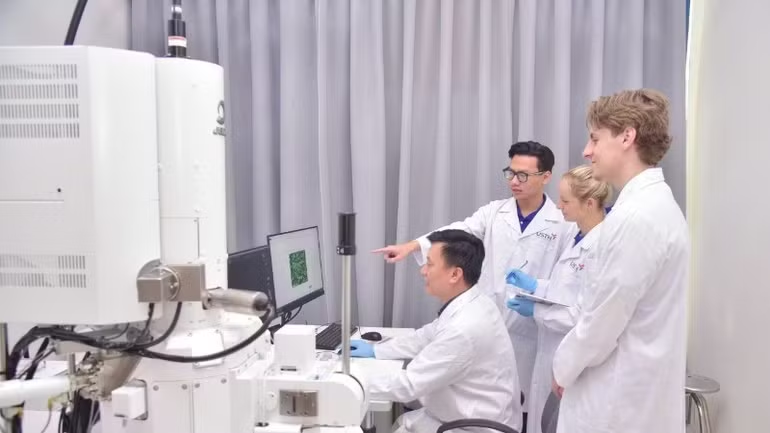
Third, and most importantly, we identify the academy as the central hub for forming an ecosystem connecting four elements: state management agencies, research institutes and universities, businesses, and localities. Without one element, or if all four are not interconnected, even the greatest scientific potential cannot be transformed into economic strength. This is a systemic problem, and we are not waiting for it to solve itself. We are reorienting the Academy of Science and Technology and the Hanoi University of Science and Technology to train directly in line with specific research tasks, creating a generation of scientists with both a strong theoretical foundation and practical skills, and committed to producing measurable results in each priority field, not just international publications.
Ensuring a Solid Scientific Foundation for the Development of Strategic Technologies
Q: In the context of international cooperation playing an increasingly crucial role, the Academy of Sciences advocates not only receiving complete technologies but also actively participating in the process of forming knowledge and scientific foundations. According to you, what strategic benefits does this approach bring, and how has the academy implemented it in practice?
A: In traditional international cooperation thinking, integration is often understood as receiving — receiving technology, receiving funding, and receiving standards from developed countries. That approach is not wrong, but it has an inherent limitation in that the recipient will always lag behind the creator.
We are shifting to a different philosophy, which is to cooperate with domestic and foreign experts to develop technology into Vietnamese technology and Vietnamese products, instead of simply being consumers of technology created by others.
This difference is a deeply strategic issue. When Vietnamese scientists participate from the basic research stage with international partners, they understand the essence of the technology from within, and can adapt, improve, and develop it into a Vietnamese-branded product serving Vietnamese needs. This is the difference between genuine technological capability and assembly capability. For a nation aiming for strategic self-reliance in science and technology, only the former has lasting value.
In practice, we are implementing this philosophy through specific, tested models. With Japan, the cooperation in the space sector, the most tangible result of which is the Viet Nam Space Centre and the LOTUSat-1 satellite mentioned above, goes beyond technology transfer. For nearly two decades, Vietnamese engineers and scientists have jointly designed, carried out technical tasks, and shared responsibility for the results. This is not a project built by Japan for Viet Nam, but a joint project created by both sides, with the Vietnamese team holding all the operational capabilities.
For France, the Ha Noi University of Science and Technology, after nearly two decades of operation, is a testament to a different model: truly collaborative training and research, where faculty from both sides supervise doctoral students and jointly sign international publications from laboratories located in Ha Noi.
It's not about importing textbooks or sending students abroad, but about building research capacity right here in Viet Nam with international standards. With many multilateral organisations and other partners in the region, we participate in global research networks as equal members, asking research questions that originate from the Vietnamese context but have universal value for the international scientific community.
The strategic benefits of this approach are not only technology but also human resources. Scientists who have co-authored with leading research groups worldwide will never revert to a passive role. They know they can ask questions on equal footing, engage in critical analysis, and lead. No nation is truly strong in science and technology without a scientific workforce confident enough to stand on equal footing with the world and produce its own products. Building that workforce is what we are doing, and that is why basic research cannot be considered a luxury at this stage.
Q: The prime minister’s Decision 1131/QD-TTg clearly identifies 11 strategic technology groups with 35 key products, ranging from artificial intelligence and blockchain to new materials, renewable energy, and space technology, requiring a solid foundation in basic science and long-term knowledge accumulation. From a management perspective, Professor, what kind of roadmap should be developed to ensure effective development that is consistent with reality?
A: Decision 1131/QD-TTg demonstrates a clear strategic mindset, and for the first time, we have a specific list of priority technologies, creating a basis for focusing resources. From the perspective of researchers, we see this as an opportunity for the academy to fulfil its role as the scientific foundation for that group of technologies, while proactively incorporating into the roadmap applications linked to Viet Nam’s unique resource and ecological advantages, developing Vietnamese technologies and products to serve daily life and export.
From a management perspective, I believe the roadmap needs to be built with a clear phased approach, with each stage having its own logic and key tasks. In the next one to three years, the top priority should be to immediately apply the accumulated basic research results in institutes and universities to practical applications, transforming them into technologies and products serving key economic sectors, without waiting for new research. The accumulated knowledge base is vast and requires mechanisms and bridges to bring it to life. State budget allocation for science and technology in this period should prioritise the exploitation and commercialisation of existing knowledge, while simultaneously continuing to invest in new research.
In the next one to five years, the focus will shift to mastering and developing technologies linked to the country's long-term structural advantages. In addition to universal areas such as artificial intelligence and semiconductors, the academy will concentrate on mastering the deep processing chain of rare earth and strategic minerals; developing space technology and UAVs to serve national sovereignty protection and resource management; researching biomedicine and indigenous medicinal plants; applying high technology to agriculture, livestock, and aquaculture; and developing technologies serving forest livelihoods and sustainable forest economics. By 2030, the academy aims to become a leading institution in Asia in several priority research areas, focusing on creating truly cutting-edge fields.
Over the next five to ten years, in-depth investment in basic research is needed, providing the resources for a real breakthrough in the next decade. No country truly strong in science and technology can afford to neglect this foundation. Looking towards 2045, when Viet Nam aims to become a developed nation, Vietnamese science must not only absorb and apply global knowledge but also contribute to that knowledge base. The current generation of young scientists must be properly trained, empowered, and trusted to take the lead in the next 10 to 15 years. This must be done today, because science can only develop sustainably when each generation lays the foundation for the next.
The role of the academy in this roadmap is to be the pillar of basic research and the leading force in mastering and developing technology, ensuring a solid scientific foundation for all strategic technological directions, and simultaneously acting as a bridge between academic knowledge and practical application needs. The prerequisite for achieving that is a genuine coordination mechanism between ministries and agencies, between the state, universities, localities, and businesses. The academy is ready to be the focal point of that coordination mechanism.
Thank you very much!
Author: NDO
RECOMMENDED TOPICS