VN
VN
 EN
EN
06/07/2026, 02:00
Business economics
Taking advantages of supply chain
With its available potential, Viet Nam needs not only to exploit rare earth element intelligently but also to build a transparent supply chain that fully capitalises on its resource advantages.
At the recent scientific conference titled “Semiconductor chip production – From raw materials to finished products,” many experts said that Viet Nam should invest in research projects with high application potential based on fundamental research, while immediately deploying pre-application research and advanced technologies with high competitiveness in the short term.
At the same time, the semiconductor and artificial intelligence (AI) boom is opening opportunities for Viet Nam to escape the middle-income trap. Rare earths are becoming a “chip” for Viet Nam to bargain in international negotiations. Instead of playing a role of being an assembly and processing hub with low added value, possessing critical input materials enables Viet Nam to negotiate technology transfer and deeper investment commitments from foreign partners. To narrow the trade surplus gap, Viet Nam could also strengthen cooperation in resource extraction with major countries while importing machinery and equipment from them.
Viet Nam’s advantage in rare earth resources is evident, but it will become even more significant if the country proactively builds an image as a reliable and transparent supplier with a roadmap for emissions control, waste management, and traceability that meets increasingly stringent market standards. At the same time, mastering appropriate rare earth separation technologies would create momentum for accelerating the semiconductor industry that the government has prioritised for development. According to energy expert Khuong Quang Dong, this is a crucial period requiring strong determination to rapidly establish a fully fledged semiconductor industry.
Viet Nam is currently cooperating with the US and the Republic of Korea (RoK) on a scientific research programme on rare earths. This is not a fragmented cooperation, but is designed along the entire supply chain, from sampling, characterisation, and enrichment to separation, process standardisation, and the development of domestic capabilities. Within the emerging supply chain structure, Viet Nam is regarded as a country with favourable geological foundations and significant potential in rare earths and other minerals associated with green energy.
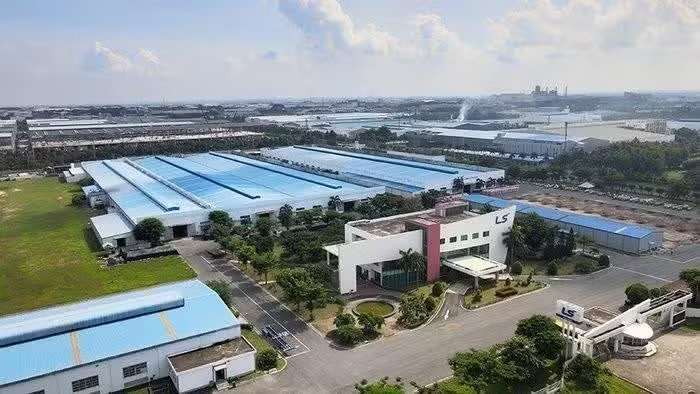
Viet Nam and the Republic of Korea are expected to establish the Korea–Viet Nam Strategic Minerals Supply Chain Centre and put it into operation in 2026. The goal is to combine Viet Nam’s resource strengths with the Republic of Korea’s advanced processing and refining technologies to provide stable, high-quality materials for the international market. Major Korean corporations such as LS Eco Energy and Posco International have already begun cooperating with Vietnamese enterprises. Several import contracts for rare earth oxides, including neodymium and dysprosium, have been signed to support the production of permanent magnets for the electronics and electric vehicle industries.
In the future, as Viet Nam secures its place on the global map of strategic materials and high-tech component suppliers, factories producing magnets or electric vehicle motors will help ensure raw material security for domestic spearhead industries, promote gross domestic product (GDP) growth, and increase state budget revenues from products with high intellectual value.
Author: NDO
RECOMMENDED TOPICS