VN
VN
 EN
EN
26/07/2026, 02:38
Business economics
Thanks to timely intervention, the domestic exchange rate has enough room for flexible developments
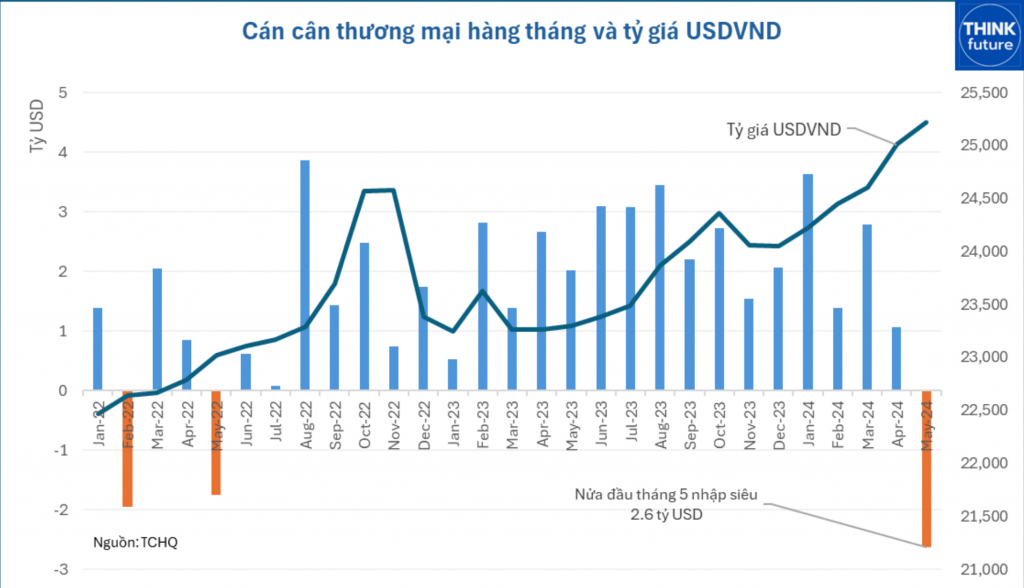
Unlike 2022 and 2023, the exchange rate has been hot since the beginning of 2024. Right after the early- months, the exchange rate has increased by 4.6%, a 3.4 % increase compared to the devaluation of the whole year 2022.
 |
|
Reduced trade surplus and low interest rate environment will create pressure on foreign currency supply and demand. Chart: Think Future Consultancy |
Foreign currency supply and demand puts pressure on exchange rates
According to a report by Think Future Consultancy, in addition to the USD rising globally, each country also has its own factors that further impact the exchange rate.
Along with that, according to many opinions, the exchange rate is continuously affected by the high inflation in the US which and forced the the US Federal Reserve (Fed) to constantly adjust forecast and delay the expected date to reduce interest rates. This change, along with increasing geopolitical tensions in some territories, caused the international USD to increase in value, at one point the USD index (DXY) increased by 5% compared to the beginning of 2024, creating devaluation pressure to other currencies, including VND.
While the US continues to keep USD interest rates at a high level, VND interest rates are lower than international USD interest rates, causing the interest rate difference between the two currencies to be negative, thereby negatively impacting on the balance of foreign currency supply and demand in the short term and putting pressure on exchange rates.
In addition, according to data from the General Department of Customs, from the beginning of the year to mid-May 2024, Vietnam's imports were estimated to reach 132.23 billion USD, an increase of 19.7 billion USD (up 17.5%) compared to the same period in 2023, followed by more demands to buy foreign currency, especially the need for foreign currency to pay for the import of essential raw materials and fuel to serve domestic production.
 |
|
The foreign exchange market and domestic exchange rates are under pressure. Photo: Internet |
However, the above developments have caused false rumors, affecting market psychology and expectations.
Discussing this issue, Mr. Pham Chi Quang, Director of the Monetary Policy Department, State Bank (SBV) said that the foreign exchange market and domestic exchange rates are under pressure from unpredictable fluctuations of global financial market, resonating with challenges and difficulties in the domestic market recently.
Therefore, from the beginning of 2024 until now, VND has depreciated by about 5% compared to USD, similar to the devaluation trend of currencies in the region: Taiwan-China Dollar (-5.06%); Thai Baht (-6.31%); Korean Won (-5.66%); Japanese Yen (-10.87%); Indonesian Rupiah (-3.87%); Philippine Peso (-4.82%); Chinese Yuan (-2.04%).
Information about changes in exchange rate management by the State Bank is inaccurate
However, Mr. Pham Chi Quang affirmed that all difficulties and challenges of the domestic foreign currency market are only short-term, because in the coming time, with the positive recovery of exports, the market's foreign currency supply will be more feasible. Moreover, the recent more demands of foreign currency of businesses will cool the demand for foreign currency in the future, thereby the balance of foreign currency supply and demand is likely to be positively improved.
At the same time, this person also said that the international financial community maintains the view that it is likely that the Fed will cut interest rates by the end of 2024, thereby reducing the pressure on devaluation of currencies around the world, including VND.
Experts from MBS Securities Company predict that the exchange rate will fluctuate between 25,100-25,300 VND/USD in the second quarter of this year, due to positive macroeconomic factors such as trade surplus and foreign reserves. Foreign exchange is still at a good level and is expected to reach 110 billion USD in 2024, realized FDI capital flows and tourism have recovered strongly. According to MBS, the stability of the macro environment is likely to be maintained and further improved, which will be the basis for stabilizing the exchange rate in 2024.
The representative of the State Bank also said that in recent times, the State Bank has managed the exchange rate flexibly, in accordance with market conditions, and absorbed external shocks. At the same time, to support the stabilization of the foreign currency market, ease the pressure on the exchange rate in the context of relatively excess VND liquidity of credit institutions, narrow the negative interest rate difference in the interbank market. As mentioned above, the State Bank has issued bills with appropriate terms and volumes to regulate the excess amount of VND and limit factors that increase pressure on the exchange rate.
From April 19, 2024, the State Bank also sold foreign currency to intervene to support market liquidity to serve the legitimate foreign currency needs of the economy, while stabilizing market psychology, thereby contributing to stabilizing the economy. macroeconomic stability and inflation control.
The Director of the Monetary Policy Department stated clearly that the solution to regulate liquidity and sell foreign currency intervention implemented by the State Bank above is similar to the solutions implemented by central banks in the region recently.
"The recent depreciation of VND can be considered to be an average level compared to other currencies in the region and the world. With the central exchange rate management mechanism and the current /-5% margin, the market exchange rate has enough room for flexible developments. Thus, some recent information about changes in exchange rate management by the State Bank is inaccurate and inconsistent with the goal of stabilizing the market. The Government's macroeconomic stability creates psychological instability in the market. Therefore, businesses and people need to be cautious about rumors," Mr. Pham Chi Quang emphasized.
According to economist Nguyen Duc Hung Linh, founder of Think Future Consultancy, controlling the level of VND depreciation still needs to be a priority in macroeconomic stability. Because stable exchange rate management requires flexibility, recent solutions such as attracting liquidity or selling foreign exchange reserves will not be enough to continue stabilizing the exchange rate in the long term, so interest rates will be the most effective way to control the VND.
| In the coming time, the State Bank said it will manage the exchange rate flexibly, in accordance with market developments by continuing to synchronously combine monetary policy tools with the sale of foreign currency to intervene to support liquidity, thereby serving the legitimate foreign currency needs of the economy, contributing to stabilizing market psychology, stabilizing the macro-economy and controlling inflation. |
Author: Customsnews
RECOMMENDED TOPICS