VN
VN
 EN
EN
26/07/2026, 02:38
Business economics
USD/VND rate could stabilize in the medium run despite short-term pressure
The US Dollar Index (DXY) fell to 98.92 as of 9:00 PM on March 23 (GMT7), marking a potential second consecutive session below the 100 threshold after two weeks of steady gains.
In recent weeks, the dollar strengthened significantly amid escalating tensions in the Middle East. The closure of the Strait of Hormuz, which disrupts around 20% of global oil supply flows, has driven oil prices sharply higher. Contrary to typical safe-haven dynamics, gold prices have declined for eight consecutive sessions, recording their largest weekly drop since 1983. As Brent crude traded around $114 per barrel and US WTI rose above $100.45 per barrel, safe-haven demand has largely shifted toward the US dollar.
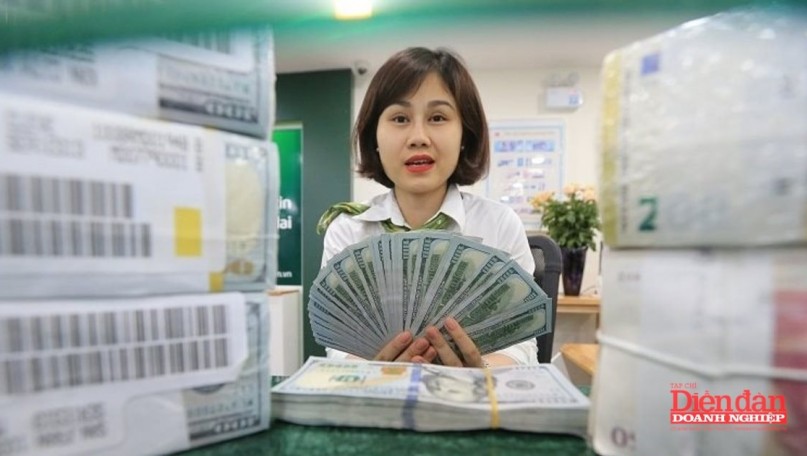
The USD/VND exchange rate is expected to remain volatile in the third quarter before easing and stabilizing toward year-end.
Amid continued uncertainty over geopolitical developments in the Middle East, the US dollar has strengthened as a relatively low-risk asset. In the short term, Mr. Suan Teck Kin, CFA, Chief Economist at UOB (Singapore), expects the dollar to remain firm. This outlook is supported by expectations that the US Federal Reserve will either hold interest rates steady or implement only minimal rate cuts—currently projected at just one cut this year.
However, following key central bank meetings last week, the dollar index temporarily retreated below the 100 level. Specifically, DXY declined 0.71% week-on-week to 99.65, ending a two-week rally. The Federal Reserve held rates at 3.50%–3.75% and signaled a more cautious stance amid rising inflation risks linked to energy prices, effectively dampening expectations for early rate cuts. The Bank of Japan kept rates unchanged at 0.75% but warned that rising oil costs could push core inflation higher. The European Central Bank maintained rates at 2.0% while highlighting risks of weaker growth and higher inflation due to energy shocks. Meanwhile, the Bank of England also held rates at 3.75%, adopting a more hawkish tone than expected.
The broadly cautious stance of major central banks supported relative recoveries in the euro, pound sterling, and Japanese yen against the dollar, contributing to DXY’s decline despite elevated global risk conditions.
Domestically, the USD/VND exchange rate edged higher despite the global dollar’s correction. By the end of the week, the central rate stood at VND 25,085 per USD, up 0.08% week-on-week. Commercial bank rates rose to VND 26,069/26,339 (buy/sell), also up 0.08%.
More notably, the parallel market exchange rate surged to VND 27,700 per USD, up 2.03% week-on-week, indicating that pressure in the unofficial market is building much faster than in the formal banking system.
At the start of this week, the State Bank of Vietnam raised the central rate to VND 25,090 per USD, up 5 dong from the previous session. Selling prices at major commercial banks also increased, with the highest level reaching VND 26,344 per USD. On the parallel market, the dollar traded around VND 27,900–27,950 on the morning of March 23.
“Overall, the USD/VND exchange rate will continue to face pressure amid the risk of further escalation in the Middle East. The parallel market is likely to remain more sensitive, especially given the persistent gap between domestic and global gold prices and ongoing volatility in global gold markets,” said Nguyen The Minh, an analyst at YSVN.
With system liquidity remaining stable, the State Bank of Vietnam conducted net withdrawals of approximately VND 84 trillion in the week ending March 20. However, interbank interest rates have shown signs of edging higher, reflecting funding demand in the primary market and potentially adding pressure on both exchange rates and interest rates.
The Vietnamese dong has partially reversed gains recorded in January 2026 amid rising geopolitical tensions. UOB economists note that, in line with broader regional trends, global risk-off sentiment is likely to continue weighing on the VND in the short term. However, downside risks are seen as limited, as the exchange rate is already approaching the lower bound of the State Bank’s policy band.
In the medium term, analysts expect the US dollar to remain relatively supported against most G10 currencies in the second quarter of 2026 before resuming a broader weakening trend as geopolitical risks ease and monetary policy factors regain prominence. Against this backdrop, USD/VND is expected to remain broadly stable, supported by underlying fundamentals.
Author: LE MY - TRUONG DANG
RELATED TOPICS
RECOMMENDED TOPICS