VN
VN
 EN
EN
06/07/2026, 02:00
Business economics
Reining in the exchange rate
According to MSc. Truong Hoang Diep Huong, financial expert at the Banking Research Institute, unpredictable fluctuations in the U.S. dollar require flexible exchange-rate management, while businesses must strengthen risk governance to protect profit margins and cash flow.
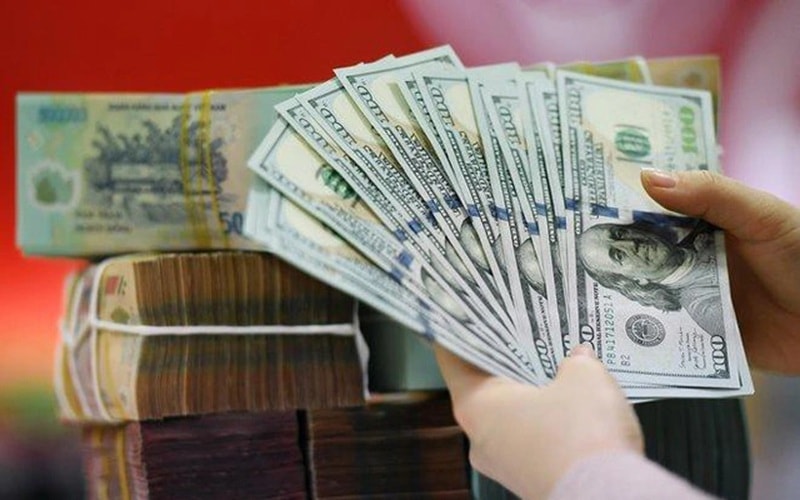
The Federal Reserve may ease monetary policy more slowly than expected in 2026, keeping global financial conditions relatively tight. This could accelerate capital flows and heighten exchange-rate volatility in emerging markets.
A Flexible U.S. Dollar
In practice, the Fed has consistently emphasized a “data-dependent” approach. Although it cut interest rates in late 2025, it is likely to carefully assess economic prospects before taking further steps. This suggests that the pace of easing will probably be gradual and closely aligned with inflation and growth trends.
In a scenario where the Fed loosens policy more slowly in 2026, the U.S. dollar would receive relative support but fluctuate flexibly in response to U.S. economic data and global risk appetite. Movements would be more clearly reflected in trade-weighted measures such as the Nominal Broad U.S. Dollar Index.
If the dollar maintains relative strength this year, pressure on the USD/VND exchange rate will initially stem from external factors. However, the actual level of stress will depend heavily on domestic conditions, including foreign-currency supply and demand, interest-rate differentials, import dynamics, and market expectations.
Regarding policy space, the State Bank of Vietnam (SBV) currently has a relatively comprehensive framework and toolkit to respond to various volatility scenarios. The central exchange-rate mechanism, combined with a trading band, allows the exchange rate to move flexibly in line with market signals, absorbing part of external shocks. At the same time, monetary and foreign-exchange instruments can be deployed flexibly to stabilize liquidity, meet legitimate foreign-currency demand, and curb speculative fluctuations.
The “Safety Boundary” for the Exchange Rate
In 2026, the choice should not be framed as “a weaker VND to support exports” versus “stabilizing the exchange rate at all costs.” Rather, it is a matter of flexible, controlled management that balances multiple objectives simultaneously.
The “safety boundary” for the exchange rate consists of stable macroeconomic conditions that allow the currency to flexibly absorb shocks. However, when instability emerges, macroeconomic stability and inflation control must remain the top priorities.
The impact of exchange-rate movements on businesses should be assessed based on their net foreign-currency position and profit-margin structure, rather than assuming that a weaker VND automatically benefits exporters.
Firms that stand to gain most are typically exporters with high domestic value-added content, whose costs are largely denominated in VND while revenues are earned in USD (or other strong currencies), and who possess sufficient pricing power to adjust selling prices.
Conversely, many exporters derive limited benefit if they rely heavily on imported raw materials and components paid in USD. In such cases, gains from foreign-currency revenues may be largely offset by rising input costs—especially when prices are locked in under long-term contracts or competitive pressures prevent price adjustments.
The most vulnerable group tends to be net importers—companies generating revenue in VND but bearing costs or debt in USD, or those operating with thin margins and limited pricing flexibility. The risk does not stem solely from the size of foreign-currency debt but also from cash-flow mismatches, which can quickly escalate into liquidity risks when exchange rates move unfavorably.
Strengthening Corporate Hedging
In 2026, exchange-rate hedging should be regarded as an essential capability, particularly for businesses with regular foreign-currency cash flows, outstanding foreign-currency debt, or significant import requirements.
A common mistake among import-export firms is confusing hedging with market forecasting. Instead of measuring net foreign-currency exposure by maturity and managing it based on cash flows, some attempt to “time” exchange-rate peaks and troughs. When markets become volatile, reactions are often delayed, and hedging costs increase.
Additionally, some companies hedge the wrong risks, overlooking cash-flow mismatches and lacking governance discipline—from risk limits and instrument selection (forwards, options, etc.) to coordination among departments—thereby increasing both costs and exposure.
In summary, businesses need to shift from a mindset of “predicting exchange rates” to one of managing volatility. This means budgeting based on scenarios, defining risk tolerance thresholds, hedging according to cash flows, and treating exchange-rate hedging as a tool to safeguard profit margins and liquidity—not as a vehicle for speculative gains.
Author: TRUONG DANG
RELATED TOPICS
RECOMMENDED TOPICS