VN
VN
 EN
EN
26/07/2026, 02:38
Business economics
Vietnamese agriculture after 40 years of Doi Moi: From food shortages to a pillar of the economy
After forty years of Doi Moi (Renewal), Vietnamese agriculture has risen from a state of food shortages to become a solid pillar of the national economy, placing the country among the world’s leading exporters of food and agricultural products. Across today’s fields, that powerful foundation is being continuously renewed through science and technology, digital transformation, and the journey toward green agriculture and high-tech farming in a new era of development.
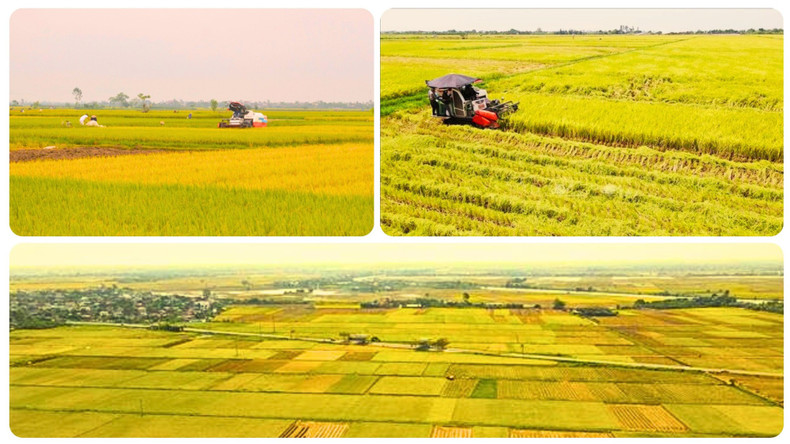
Enduring vitality across the fields
One late afternoon at year’s end, in the fields of Dong Hung Commune, Hung Yen Province, veteran farmer Nguyen Van Ma leans on his hoe, gazing at a rice plot marked with a production-area sign and traceability codes. In the distance, a combine harvester stands ready, while a drone has just landed after a flight inspecting pests and diseases.
“In the past, even farming on vast open fields wasn’t enough to eat. Now when growing rice, people ask what production process we follow and what our emissions are like,” he says with a slow smile. “A farmer like me never thought our rice grains would travel this far.”
Before 1986, Vietnamese agriculture operated under a centralised, bureaucratic, subsidised model. Cooperatives played the dominant role, but rigid management mechanisms stifled labour incentives. Land was collectively owned, products were distributed based on work points, and farmers had no right to decide on crop varieties, cropping seasons, or market outlets. The saying common at the time — “What belongs to everyone is cared for by no one” — accurately reflected stagnant production and low productivity.
Ma recalls the late 1970s and early 1980s, when the whole village went to the fields together and returned together, yet after harvest the shared rice was still insufficient. In some years, bowls of rice mixed with sweet potatoes or cassava became an everyday reality. At that time, the national poverty rate reached nearly 70%, and Viet Nam had to import millions of tons of food each year to avert hunger. Agriculture — the livelihood of the majority of the population — became the biggest bottleneck of the economy.
The turning point came with grassroots experiments in “informal contracting,” followed by Directive 100 in 1981 and culminating in Contract 10 (Resolution 10) in 1988. For the first time, farm households were recognised as autonomous economic units and granted long-term land-use rights and decision-making rights in production. For Ma, it was a life-changing moment: “The land was truly ours — work more, earn more. That was when we first believed farming had a future.”
Productive capacity was unleashed almost immediately. Just one year after the implementation of Resolution 10, Viet Nam shifted from a food-deficit country to a rice exporter — a historic turning point. From then on, agriculture became the foundation ensuring food security and social stability throughout the Doi Moi process.
A solid “pillar” and the status of an agricultural powerhouse
Over the past forty years, Vietnamese agriculture has maintained stable growth and strong resilience amid volatility. On average during 2011–2022, agricultural GDP grew by about 2.84% annually — not high compared with industry, but sufficient to uphold its role as a “pillar” whenever the economy faces turbulence.
During financial crises, economic downturns, or pandemics, when many sectors stalled, fields still entered new seasons, barns remained active, and food supplies were not disrupted. Agriculture not only feeds more than 100 million people, but also maintains social stability, provides livelihoods for most rural residents, and supplies inputs for processing industries and exports.
The figures clearly demonstrate this vitality. In 1986, agricultural export turnover was just USD 486 million; by 2000 it reached USD 4.2 billion; in 2023 it climbed to USD 53 billion — nearly 110 times higher after almost four decades. In 2024, exports of agriculture, forestry, and fisheries set a record of USD 62.5 billion, the highest growth rate in over 20 years. In 2025, amid a volatile global economy, export turnover still exceeded USD 70 billion, continuing to serve as a key support for the trade balance.
Alongside growth came profound social changes. Thanks to stable agricultural development, the national multidimensional poverty rate fell from 9.15% in 2016 to 3.37% in 2023; in rural areas alone, it declined from 11.83% to 4.77%. Rice grains not only feed the domestic population but also contribute to global food security.
A new generation of farmers and the trend toward greening and digitalisation
Former Minister of Agriculture and Rural Development Nguyen Xuan Cuong affirms that the “three rural issues” (agriculture, farmers, rural areas) have always held a strategic position in the Party’s orientation. From the milestone of Contract 10 that liberated productive forces, to the Resolution of the 7th Plenum of the 10th Party Central Committee, and most recently the Resolution of the 5th Plenum of the 13th Party Central Committee, modernising agriculture and rural areas has consistently been identified as a top priority in the country’s industrialisation process.
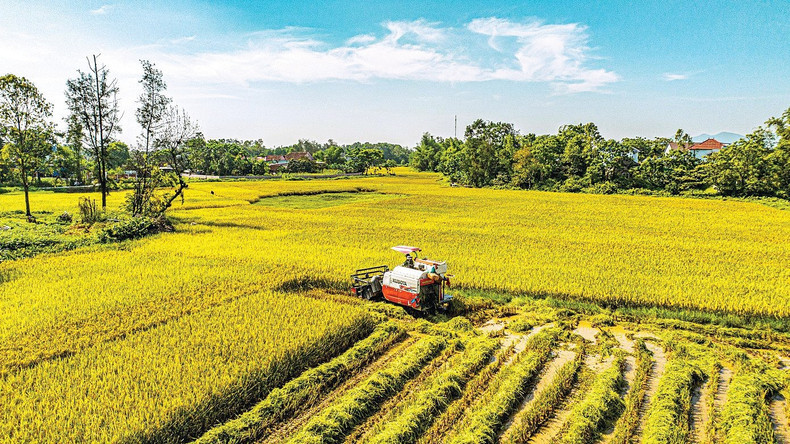
From fragmented small plots, Vietnamese agriculture has moved into a phase of value-chain organisation, improved quality, and brand building. Rice is no longer merely cheap white rice but features fragrant and specialty varieties; fruit is no longer sold only fresh, and is accompanied by growing-area codes, environmental standards, and social responsibility requirements.
Dang Phuc Nguyen, Secretary General of the Viet Nam Fruit and Vegetable Association, believes: “This is the second transformation of Vietnamese agriculture. The first stage focused on ensuring output. The next stage is positioning Vietnamese products on the quality map. In the past, selling products was enough; now it’s about supply chains, traceability, and export contracts.”
That transformation has emerged from fields and orchards — where farmers must change if they do not want to be left behind. Ma clearly remembers the days of “everyone farming their own way.” Each household had a few small plots, different seed varieties everywhere; a good harvest meant falling prices, a poor harvest meant total loss. But over the past decade or so, in many places land is no longer fragmented. Fields have been consolidated, with unified varieties, cropping calendars, and cultivation processes. Enterprises come directly to communes to sign purchase contracts. Rice is not only weighed, but also tested for moisture, residues, and production zones.
According to Bui Ba Bong, former Deputy Minister of Agriculture and Rural Development, it is precisely quality, technology, and new varieties that have driven this transformation. These are the key forces enabling Vietnamese rice to enter a new era — one with lower emissions, higher value, and the formation of global value chains.
In practice, in areas adopting green production processes, rice prices are higher than the market by 500–700 VND per kilogram, enterprises offer stable purchasing, and products can access demanding markets such as Japan and the EU.
Prime Minister Pham Minh Chinh has repeatedly affirmed that “agriculture, farmers, and rural areas are the pillar of the economy” and a “bright spot” of the country amid global economic volatility. However, he emphasises that in the new era, agriculture must achieve stronger breakthroughs based on science and technology, innovation, and digital transformation, not only to be sustainable but also to break through alongside the broader economy.
Responding to expectations for such breakthroughs, the breath of the digital revolution has begun to reach the hands of farmers working the land. In the rice fields of Dong Thap, Nguyen Van Tu no longer goes to the fields with just a conical hat and a hoe. In his pocket is a smartphone — an indispensable item for a tech-era farmer. On the small screen, he tracks drone spraying schedules, hourly weather forecasts, and even information about rice shipments from his cooperative awaiting export.
He shares: “Nowadays, if you farm without understanding technology and markets, you lose. You don’t just watch the weather, you must watch the rules of the global game.”
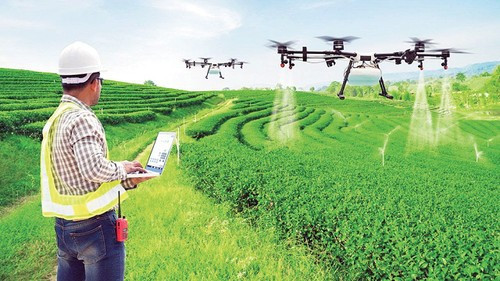
The technological revolution is now clearly visible in the fields. Crop-spraying drones have become familiar in Dong Thap and An Giang, reducing water use by up to 90% and plant-protection chemicals by 30%, addressing labour shortages and protecting farmers’ health. AI has begun to be applied to monitor pests and diseases, optimise irrigation, and move toward precision agriculture.
High-tech agriculture has also opened a new “field”: carbon credits. Viet Nam is estimated to be able to generate around 57 million carbon credits per year from agriculture. The project to develop one million hectares of high-quality, low-emission rice in the Mekong Delta is helping farmers reduce costs, increase profits, and participate in the global carbon market — something that just a few years ago was beyond the imagination of rice growers.
According to the World Bank, in 2023 Viet Nam’s agricultural GDP reached approximately USD 22.3 billion, ranking fifth globally. Viet Nam currently ranks first worldwide in pepper production; second in coffee; third in rubber and cashew nuts; and fifth in rice. In terms of exports, many products account for large shares of global trade, including cashew nuts (60%), forest products (59.3%), pepper (32.2%), and fisheries (nearly 30%).
Author: NDO
RECOMMENDED TOPICS