VN
VN
 EN
EN
21/07/2026, 02:38
Business economics
What to make of the SBV’s latest FX intervention?
The State Bank of Vietnam (SBV) has announced a new foreign exchange (FX) intervention measure, offering 180-day USD forward contracts with a cancellation option at 26,850 VND/USD, compared with the spot rate of 26,360 VND/USD.
The move, announced on March 24, 2026, comes amid renewed pressure on the Vietnamese dong (down 1.2% month-to-date), driven by a stronger US dollar (2.1% month-to-date) and rising geopolitical risks. These factors have heightened inflation concerns and weakened expectations for interest rate cuts by the US Federal Reserve.
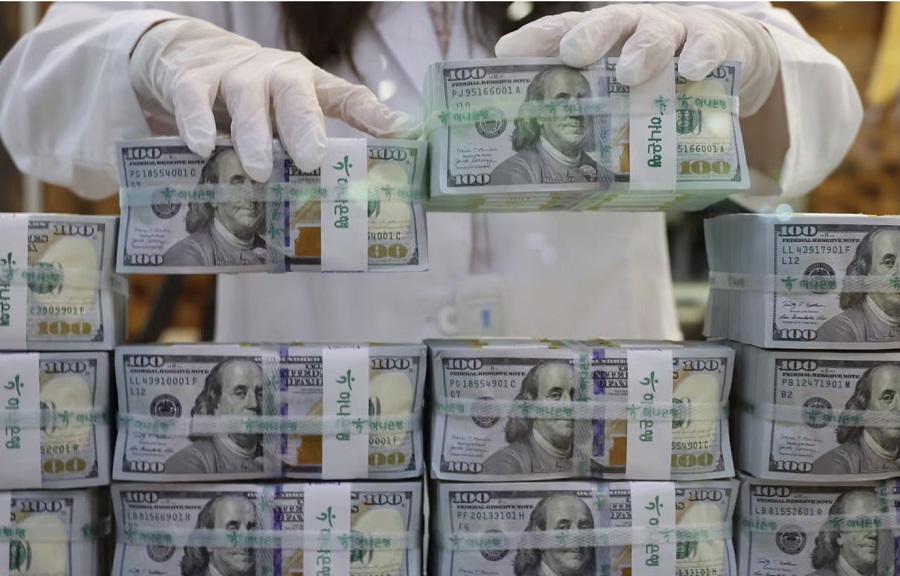
USD interbank rates increased marginally by 0.01 percentage points for overnight tenors, remained unchanged at one month.
According to analysts, tariff policies could prolong inflation in the United States and delay the pace of rate cuts. Persistently high USD interest rates will continue to exert pressure on central banks globally in maintaining exchange rate stability.
With limited foreign exchange reserves—equivalent to roughly two months of imports—the SBV is unlikely to conduct large-scale USD sales upon maturity, according to an updated analysis by Maybank Securities (MSVN).
Instead, MSVN views this measure primarily as a market-stabilizing signal. The recent increase in deposit rates by state-owned banks suggests that the SBV is more willing to tolerate a higher interest rate environment to defend the VND.
“Unlike the seasonal tightening at the end of 2025, the current rate increases are externally driven—reflecting similar pressures seen in 2022, when a strong USD and inflation risks forced comparable policy responses.
We therefore see the SBV’s FX intervention as an appropriate ‘tactical measure’ to stabilize the VND amid global volatility. By combining forward contracts with higher interest rates, the SBV can safeguard currency stability without depleting reserves, although the trade-off may be tighter domestic liquidity and higher borrowing costs,” MSVN analysts noted.
In practice, overnight VND interbank rates surged to 8.8% on March 25, up 3.4 percentage points from the previous day.
Earlier, on March 23, average VND interbank rates rose by 0.4–1.2 percentage points across all tenors of one month or less compared with the previous weekend. Specifically, overnight rates stood at 5.4%, one-week at 6.15%, two-week at 7.5%, and one-month at 7.8%.
Meanwhile, USD interbank rates increased marginally by 0.01 percentage points for overnight tenors, remained unchanged at one month, and declined by 0.01–0.03 percentage points across other maturities. Overnight rates stood at 3.61%, one-week at 3.68%, two-week at 3.7%, and one-month at 3.75%.
On global markets, as of early morning March 25 (Vietnam time), Brent crude futures rose 4.55% to $104.49 per barrel, while WTI crude increased 4.79% to $92.35 per barrel. The US Dollar Index (DXY) edged up to 99.94, reflecting a rebound in the dollar amid escalating geopolitical tensions in the Middle East.
Overall, recent geopolitical developments are increasing uncertainty and could trigger abnormal exchange rate volatility. This requires flexible policy responses from the monetary authority, with priority placed on stabilizing the exchange rate to anchor market confidence and the broader economy, while buying time and policy space to maintain lending rates at levels supportive of businesses for as long as possible—albeit at the cost of adding inflationary pressure.
Author: LE MY - TRUONG DANG
RELATED TOPICS
RECOMMENDED TOPICS