VN
VN
 EN
EN
16/07/2026, 02:00
Business economics
Applying science and technology to marine aquaculture
Viet Nam holds significant advantages in marine aquaculture, yet this economic sector has so far developed below its potential. One of the key reasons for this situation is the slow and insufficiently coordinated application of science and technology.
Under Decision No. 1664/QĐ-TTg dated October 4, 2021, the Prime Minister approved the Scheme on the Development of Marine Aquaculture to 2030, with a vision to 2045. The Scheme sets out the target that, by 2030, the country will reach 300,000ha of aquaculture area, 12 million cubic metres of cages, and 1.45 million tonnes of output. It orients marine aquaculture towards becoming a large-scale, industrialised, synchronised, safe, efficient and sustainable commodity-producing sector that protects the ecological environment; produces branded products meeting domestic and export market demands; and generates employment, improves socio-economic conditions and raises incomes.
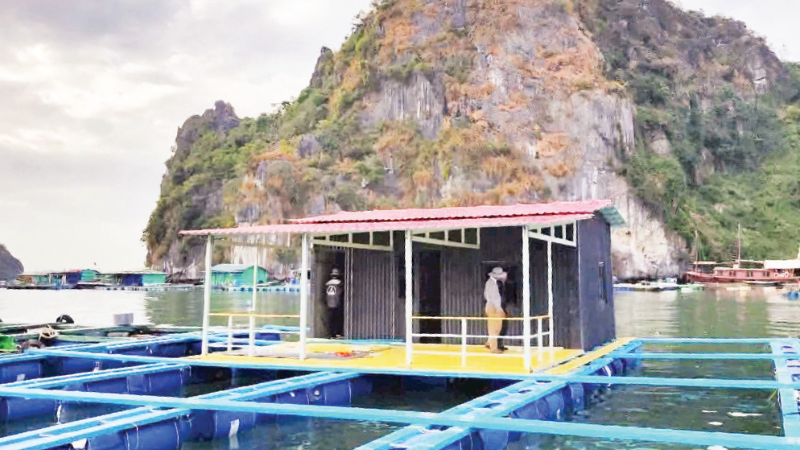
According to the Ministry of Agriculture and Environment, Viet Nam currently has nearly 10,000 marine aquaculture establishments, most of which are located in nearshore waters (within three nautical miles). The main farmed species include fish, shrimp and molluscs. The prevailing farming methods largely rely on outdated technologies, with little to no application of advanced science and technology. This presents notable limitations for the sector in meeting the targets set under Decision No. 1664. Nonetheless, Viet Nam has mastered broodstock production technologies for several key, high-value aquatic species; and has advanced research and development in farming, harvesting, preservation, processing and feed formulation. Recently, several pilot models, such as recirculating aquaculture systems (RAS), integrated multi-trophic aquaculture (IMTA), and HDPE cage technology, have yielded promising results and may be widely applied across Viet Nam’s marine regions.
In addition, in recent years, several enterprises operating in waters beyond the three-nautical-mile boundary have recorded encouraging results. This demonstrates that Viet Nam’s marine aquaculture sector has the potential to reach an export value of 2 billion USD by 2030.
However, the slow adoption of advanced production technologies may be a barrier preventing the sector from achieving its objectives. In Quang Ninh Province, one of the leading localities in marine aquaculture, 45,146ha of marine areas have been zoned, of which 1,493.52ha have been allocated to 26 organisations. The allocation is intended to support large-scale marine farming. Yet, the fact that nearly 465ha have been distributed among 755 individuals indicates a fragmented, short-term approach, which limits the creation of high-value chains in the marine economy and heightens the risks of environmental pollution and disease outbreaks.
Globally, particularly in countries with advanced marine aquaculture sectors such as China, Japan, the US, Norway and Chile, technology application and the development of supporting industries have transformed marine aquaculture into a high-value component of the circular economy.
Associate Professor Dr Thai Thanh Binh of the College of Economics, Technology and Fisheries notes that countries around the world employ numerous advanced technologies in marine aquaculture. These include: deep-sea and semi-submersible cages designed with materials capable of withstanding typhoon-force winds, coupled with advanced mooring systems; semi-closed containment systems (SCCS), which are environmentally friendly, low-cost and capable of reusing waste; AI-enabled smart farms integrating the Internet of Things (AIoT) to enhance efficiency, sustainability and environmental protection; and the use of robots, autonomous vehicles, drones and automation to reduce costs and improve safety.
Research by the Research Institute for Aquaculture No. I indicates that Viet Nam’s marine areas are well-suited for IMTA technology— a sustainable, circular farming model based on the trophic chain. The principle of IMTA lies in resource extraction and conversion through species diversification. This technology helps reduce costs, utilise waste, minimise environmental impacts and lower risks for marine farmers.
However, to ensure efficiency, especially in offshore areas, adequate energy supply and green infrastructure are essential. With the growth of marine renewable energy, harnessing such energy sources has become an increasingly viable solution. Additionally, sustainable feed solutions, biotechnology and blockchain technology are important factors that can raise the success rate of marine aquaculture.
Marine aquaculture in Viet Nam remains spontaneous and small-scale, with little or no adoption of advanced technologies. Supporting solutions have not been synchronised, and farmers lack appropriate training. Without a comprehensive and coordinated strategy, it will be difficult for marine aquaculture to develop sustainably and become a large-scale commodity-producing sector as expected.
Associate Professor Dr Nguyen Huu Dung,
Chairman of the Viet Nam Marine Aquaculture Association
According to Associate Professor Dr Nguyen Huu Dung, Chairman of the Viet Nam Marine Aquaculture Association, marine aquaculture in Viet Nam remains spontaneous and small-scale, with little or no adoption of advanced technologies. Supporting solutions have not been synchronised, and farmers lack appropriate training. Without a comprehensive and coordinated strategy, it will be difficult for marine aquaculture to develop sustainably and become a large-scale commodity-producing sector as expected.
Based on this, Associate Professor Dr Nguyen Huu Dung recommends that management authorities and policymakers soon develop marine and coastal spatial planning for aquaculture development, particularly industrial, large-scale farming; enhance the application of new science and technology and digital transformation; promote administrative reform; consider long-term allocation of marine areas to organisations and enterprises; organise individual farmers into collective entities such as cooperatives; strengthen state management; and accelerate the development and integration of supporting industries.
Author: NDO
RECOMMENDED TOPICS