VN
VN
 EN
EN
26/07/2026, 02:38
Business economics
Cashew enterprises expand value chains to capture a new growth cycle
Seizing fresh opportunities from recovering global demand and the shift toward greener consumption, Vietnam’s cashew industry is reshaping its strategy to enhance export value and reinforce its position in international markets.
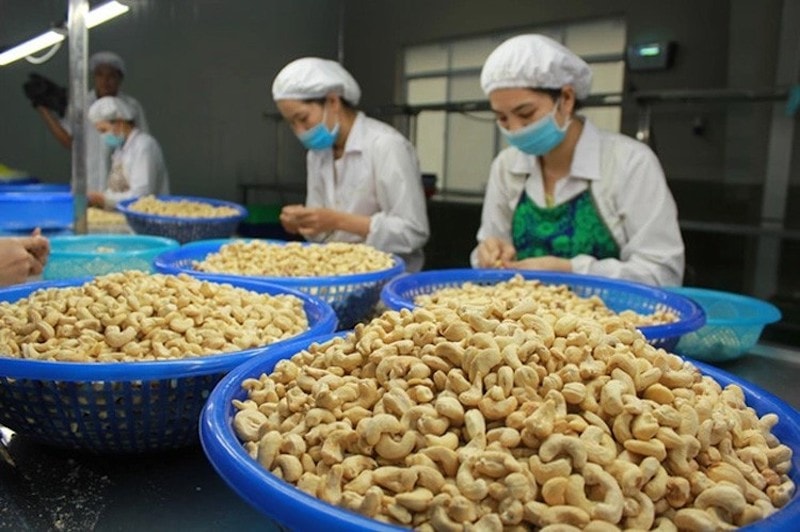
In January 2026, the average export price stood at $6,841 per ton, up 0.3% from December 2025 and 0.8% year-on-year.
According to Vietnam Customs, in January 2026 the country exported 50,600 tons of cashew nuts worth $34.7 million. Compared with December 2025, export volume fell 25.7% and value declined 25.5%. However, compared with January 2025, volume rose 35% and export value increased 36.1%.
Earlier, in 2025, cashew exports reached 766,500 tons with a total value of $5.22 billion, reaffirming the sector’s role as one of Vietnam’s key agricultural export industries.
In January 2026, the average export price stood at $6,841 per ton, up 0.3% from December 2025 and 0.8% year-on-year.
Market-driven momentum
The United States and China remained the two largest export markets, accounting for 37.48% of total export volume in January. Compared with January 2025, exports to all major markets increased, with many recording double-digit growth, including the U.S., China, Germany, Canada, the U.K., Thailand and Japan.
According to the Vietnam Cashew Association (VINACAS), ensuring long-term growth requires prioritizing domestic raw material development and deep processing. The goal is not only to maintain global leadership in volume and export turnover, but also to improve efficiency, profitability and sustainability.
In 2026, exports are expected to continue rising as global demand improves, particularly in China, Japan, South Korea, Russia, the Nordic region and ASEAN. Among younger consumers, demand for processed cashew products such as cashew butter and plant-based milk is emerging as a new growth driver.
China is poised to become a key growth driver for Vietnam’s cashew sector. The country’s rapidly expanding middle class and rising demand for plant-based protein in major urban centers are reshaping consumption patterns. Confectionery factories, snack producers and plant-based beverage manufacturers consume large volumes of broken kernels, medium-sized nuts and seasoned roasted products.
Exports to China exceeded $1.1 billion in 2025. Orders surged ahead of the Lunar New Year, when demand for premium food gifts increases. Vietnamese companies have adjusted product portfolios to suit Chinese preferences, focusing on premium packaging, consistent quality standards and fast delivery via land and sea logistics routes.
Europe continues to serve as a hub for high-value cashew consumption. The Netherlands functions as a key distribution gateway for agricultural products across the European Union.
Major supermarket chains impose stringent requirements on traceability, forest protection, carbon reduction and sustainable agriculture certification. The EU’s anti-deforestation regulation, set for full implementation in 2026, will require geolocation data for each production plot associated with export consignments.
In response, Vietnamese exporters are investing in digital agricultural data systems, satellite mapping and electronic farm records. Procurement processes linking farmers in Binh Phuoc, Dong Nai and the Central Highlands are beginning to integrate traceability technologies to meet premium market requirements.
The Middle East is emerging as an attractive outlet for value-added products. Consumers in the region favor salted roasted nuts, premium boxed assortments and luxury packaging suitable for gifting.
Retail chains in Dubai, Riyadh and Doha are seeking stable suppliers from large-scale Asian factories. Vietnamese enterprises are expanding roasting and flavoring lines, introducing honey-coated, buttered, saffron-infused and Middle Eastern chili variants. Transparent PET packaging enhances shelf appeal in supermarkets. Higher retail prices improve profit margins compared with exporting raw kernels.
Reshaping the value ecosystem
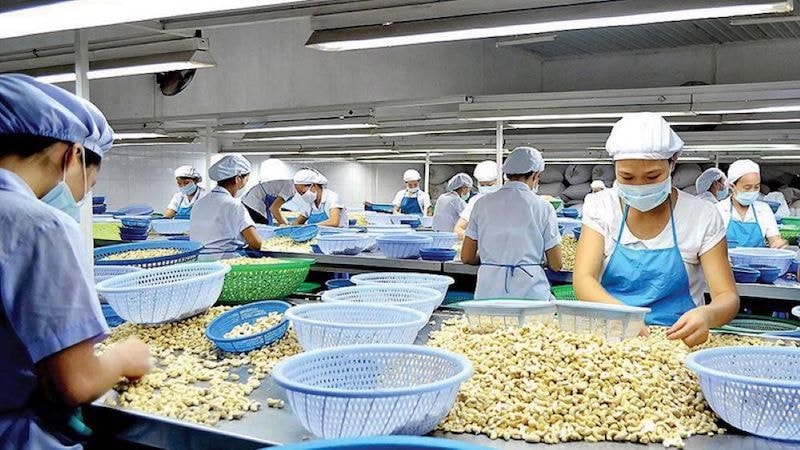
The sector’s 2026–2030 development strategy focuses on shifting from large-volume contract processing to a high-value-added ecosystem. Industry experts emphasize investment in deep processing technologies, including cashew butter, cashew milk, plant protein and functional food ingredients to diversify revenue streams.
Circular economy practices are gaining traction. Cashew shells are used for biomass fuel production, cashew shell oil serves the chemical industry, and by-products are processed into animal feed. A fully integrated value chain enhances overall economic efficiency.
Associate Professor Nguyen Dinh Tho of the Institute of Strategy and Policy on Agriculture and Environment noted that achieving the target of $10.5 billion in export turnover by 2030 requires coordinated strategies among enterprises, farmers, regulators and financial institutions.
Replanting high-yield, climate-resilient varieties, improving water management and strengthening digital agricultural data systems will be essential to monitor productivity, pests and kernel quality. International trade networks will continue expanding across the Middle East, East Asia and Europe.
Vietnam’s cashew industry is entering a new development cycle built on technology adoption, supply chain transparency and deep processing. Existing industrial capacity and decades of international trade experience provide a solid foundation for the next growth phase.
The 2026–2030 period calls for a comprehensive strategic transformation. The traditional model reliant on exporting large volumes of low-cost raw materials is gradually losing its advantage in the evolving global trade environment.
“Enterprises are moving toward deep-processed products, proprietary brands, transparent supply chains and digital applications in agriculture. Overseas investment systems are being developed to secure stable raw material supplies. Circular economy practices aim to utilize all by-products from cashew processing. Logistics infrastructure and financial support will underpin the next stage of Vietnam’s cashew industry development in the global market,” Associate Professor Nguyen Dinh Tho emphasized.
Author: THY HANG - TRUONG DANG
RELATED TOPICS
RECOMMENDED TOPICS