VN
VN
 EN
EN
26/07/2026, 02:38
Business economics
Bac Ninh Business Consultancy and Support Center: When technology becomes the key to unlock reform and investor confidence
The Bac Ninh Business Consultancy and Support Center is increasingly asserting its role as a “core driver” in the province’s ecosystem of administrative reform, digital transformation, and investment promotion.

Mr. Duong Thanh Son, Director of the Bac Ninh Business Consultancy and Support Center
A reporter from Business Forum Magazine had a conversation with Mr. Duong Thanh Son, Director of the Bac Ninh Business Consultancy and Support Center, and a strategic consulting expert, on how technology has become the “key” to greater transparency and breakthrough progress.
– Sir, has the deployment of the software system for evaluating the competitiveness of departments, agencies and localities (DDCI) in Bac Ninh demonstrated a more transparent way of reflecting investors’ voices?
That assessment is entirely accurate. In essence, DDCI is a “sensor system” that measures the health of the administrative apparatus through the lens of businesses. DDCI is not merely about digitization; it is a modern governance tool that enables the authorities to truly “hear the authentic voice” of the business and investor community.
In Bac Ninh, the DDCI software platform developed by the provincial Business Consultancy and Support Center has marked a very important shift. The entire process, from distributing questionnaires and collecting data to scoring and consolidating results, has been fully automated, with no human intervention. The system also integrates security and anti-fraud mechanisms to ensure absolute protection of the identities of organizations and individuals participating in the evaluation.
It is precisely this factor that has helped build trust. Since 2021, the business community has become increasingly proactive in taking part, viewing DDCI as an official channel through which to express opinions, reflect realities, and convey recommendations directly to the authorities. As a result, the “voice” of businesses is no longer subjective, but quantified into objective data that can be measured and compared.
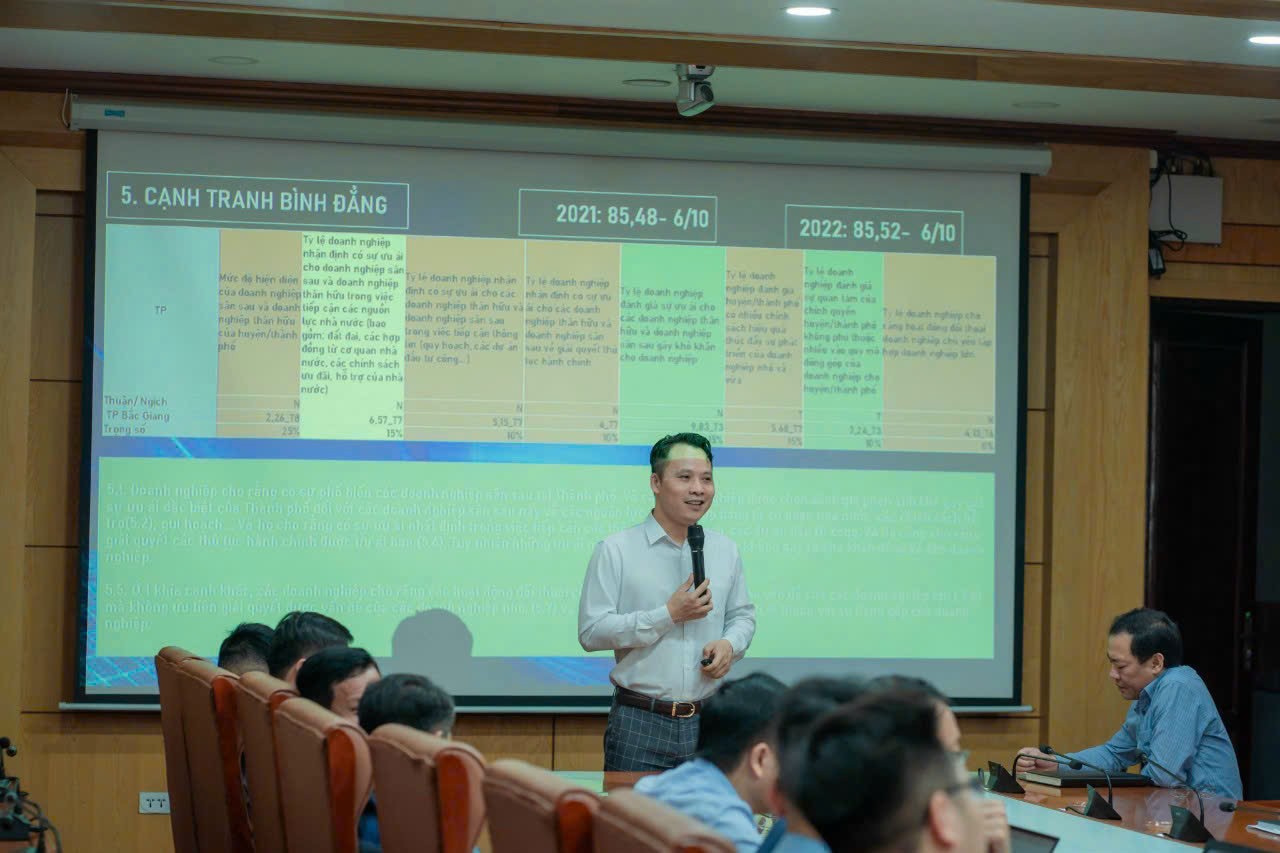
Alongside the evaluation activities, the Center has also organized training programs, assessments, and contests on understanding DDCI through digital platforms, attracting hundreds of thousands of participants. This has raised awareness across both the government system and the business community about the significance of DDCI, thereby creating broad consensus in the implementation process.
Most importantly, once the results are available, the data do not simply “remain on paper.” The Center works directly with each department, agency, and locality to conduct in-depth analysis of every component index, clearly identifying strengths, weaknesses, and specific causes. This gives each unit a solid basis for developing substantive improvement plans instead of merely formalistic solutions.
In particular, thanks to its technological advantage, the Center has accompanied local authorities in improving the transparency and information access index, a foundational indicator within DDCI. By reviewing and upgrading electronic information portals, supplementing data on planning, procedures, legal documents, and optimizing user experience, the level of openness and transparency has been significantly improved.
When information is transparent, businesses no longer have to “ask around” or seek unofficial channels to obtain it. This helps reduce informal costs, limit negative practices, and improve related indices such as legal institutions and business support. More importantly, businesses can clearly feel the support and partnership of the authorities.
Practical results show that, when compared with Bac Ninh’s PCI results, including the former Bac Giang area, there is a synchronized improvement between PCI and DDCI indicators. This reflects the reliability of DDCI data and confirms that businesses’ feedback has genuinely been translated into concrete reform actions, strongly affirming the vision of a “service-oriented government.”
– In your role as a digital transformation consultant and AI trainer, how do you assess the readiness of the local business community?
Bac Ninh is emerging as a “high-tech and semiconductor industrial hub.” However, from the perspective of digital transformation and AI application in enterprises, the readiness of the local business community remains clearly uneven.
FDI enterprises and large companies already operate according to international standards, with relatively complete governance and technology systems. Meanwhile, domestic private enterprises, especially small and medium-sized enterprises (SMEs), are still at an early stage of transformation. Most businesses are aware of the role of technology, but they still lack an approach, suitable personnel, and a clear starting point for effective implementation.
One of the greatest challenges for SMEs is cost. In reality, AI is only one part of the broader digital transformation process, but to implement it effectively, enterprises must invest comprehensively in infrastructure, software, people, and processes. For large enterprises or FDI firms, this cost accounts for only a small proportion of total operating expenses. By contrast, for SMEs, which make up more than 95% of all enterprises, digital transformation costs become a relatively heavy burden, making it difficult for them to carry out such transformation in a systematic manner even if they want to.
In this context, the role of the provincial government is extremely important. In recent years, Bac Ninh has not only stopped at issuing policy directions, but has gradually developed concrete support mechanisms by “commissioning” intermediary units such as the Business Consultancy and Support Center, while closely coordinating with the provincial Business Association to implement training, consulting, and tool provision programs for enterprises.
Activities such as digital transformation and AI training courses, as well as expert advisory connections, have created a relatively synchronized support ecosystem. However, to accelerate progress more strongly in the coming period, there is still a need for direct support policies for SMEs, especially support for training, consulting, and the implementation of digital and AI solutions in a practical, hands-on manner, along with model cases that can be replicated.
In addition to my role as Center Director, I also serve as Vice President of ABM Academy, an AI training institution with an established brand. We always strive to update and convey knowledge on technology and AI to the community in a practical, accessible, and applicable way.
In the long term, enhancing digital capacity and popularizing AI for the business community, especially the SME sector, will be a decisive factor in building a sustainable development ecosystem where domestic enterprises can participate more deeply in global value chains.
– Could you share Bac Ninh provincial leaders’ commitment to building an index and software system for assessing anti-corruption efforts? How has the participation of the provincial Business Association in monitoring and social feedback helped ensure that this software system remains objective and closely aligned with the realities of business operations?
First of all, it must be affirmed that the development of the index set and software system for assessing perceptions of anti-corruption and anti-negative practices (DC-CMPI) is a very methodical direction, grounded in scientific principles, and one that Bac Ninh province has paid attention to and directed from a very early stage.
As a provincial-level scientific research project chaired by Nguyen Van Cu Political School, it has been officially accepted and received positive assessments from competent bodies. The scientific council concluded that, if implemented in practice, DC-CMPI could become a highly effective “diagnostic tool” for the public administration system, helping identify governance bottlenecks and thereby substantively improve the investment and business environment.
The essence of this system is that it uses direct perceptions from citizens and businesses, those who have actual interactions with state agencies, as input data. The entire process of survey design, data collection, and data processing is built on the principles of objectivity, scientific rigor, transparency, and verifiability.
During the pilot phase, the system was deployed in several localities and attracted the participation of the business community. The software operates entirely on a digital platform, automating the process and enabling the aggregation and ranking of results.
The provincial Business Association participated by mobilizing enterprises and providing social feedback, thereby helping ensure that the data more accurately reflected actual production and business activities.
In the future, if the system continues to be studied, refined, and gradually applied, it could be upgraded to integrate artificial intelligence for trend analysis, risk identification, and decision-making support.
I believe that, if implemented appropriately, DC-CMPI will help enhance transparency and strengthen the confidence of the business community in the business environment.
– Thank you very much.
Author: KIM DUNG - VU PHUONG (Dang Truong translates)
RELATED TOPICS
RECOMMENDED TOPICS