VN
VN
 EN
EN
15/07/2026, 11:10
Business economics
Broad cuts in deposit rates following SBV’s directives
As per the directives issued by the State Bank of Vietnam (SBV), a substantial number of commercial banks implemented reductions in deposit interest rates over the past time.

Transactions at MB
After a substantial net withdrawal of approximately VND 114.6 trillion in March, the SBV quickly reversed course in the first week of April, injecting a net VND 110.2 trillion to support the banking system. As a result, the overnight rate fell sharply from 9.3% at the end of March to a more-than-one-month low of 3.75% on 24 April. This easing was supported by both the SBV’s liquidity injection and the end of seasonal credit expansion typically seen at quarter-end.
However, liquidity pressure re-emerged toward the end of the month due to increased cash demand from households ahead of the public holiday. Consequently, the overnight rate climbed back to 6.3% by the end of April. Meanwhile, one-week to one-month rates fluctuated between 6.5% and 6.8%, and the six-month rate hovered at 7.7%.
Throughout April, the SBV conducted net liquidity injections via open market operations (OMO), pumping over VND 350.1 trillion (with maturities of 7 - 56 days at an interest rate of 4.5%). With VND 330.6 trillion in maturing OMO bills, the SBV recorded a net injection of VND19.5 trillion for the month. This brought the total outstanding OMO balance to VND309.6 trillion (-36.7% from its early-February peak). 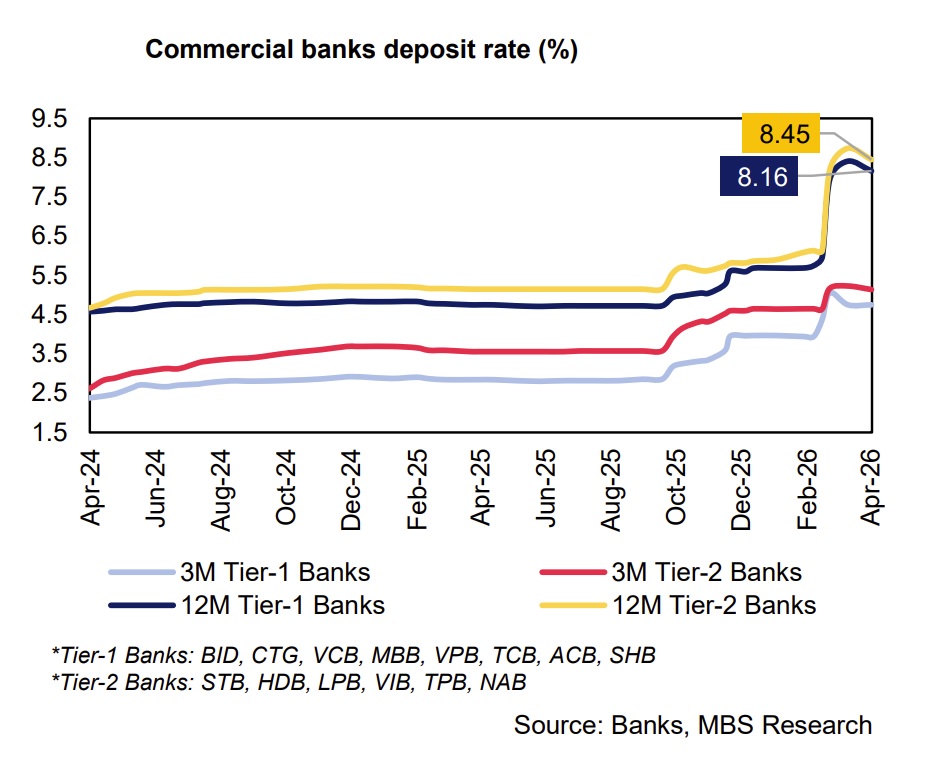
Against the backdrop of rapidly rising deposit rates in the first quarter, the SBV convened a meeting with commercial banks on 9 April to discuss banking operations. Shortly afterwards, several major banks, including VCB, VPB, and LPB, announced cuts in deposit rates, reducing them by 0.2 to 0.5 percentage points, primarily for tenors of six months and longer. The swift response from banks signals a strong consensus within the banking system to support the SBV’s policy direction of lowering interest rates to stimulate economic growth.
Based on actual survey data, by the end of April, the rate for tenors under 12 months stood at 8.7% per annum. For the 12-month tenor, Vikki Bank and NAB offered the highest rate at 8.8% per annum. The average 12-month deposit rate for Tier-1 banks fell to 8.16% per annum (down 25 basis points from pre-directive levels), while Tier-2 banks recorded an average of 8.45% per annum (down 29 basis points).
Overall, the average 12-month deposit rate across commercial banks stood at 8.31% per annum at the end of April (2.53 percentage points YTD). Although banks implemented widespread rate cuts in April, deposit rates remain elevated due to the sharp increases seen earlier in Q1.
Author: NGOC ANH
RECOMMENDED TOPICS