VN
VN
 EN
EN
26/07/2026, 02:38
Business economics
Building products to national criteria: A foundation for elevating the Viet Nam National Brand
The Viet Nam National Brand is no longer merely a title of recognition; it is increasingly becoming a benchmark for the quality, innovation capacity and competitiveness of Vietnamese enterprises.
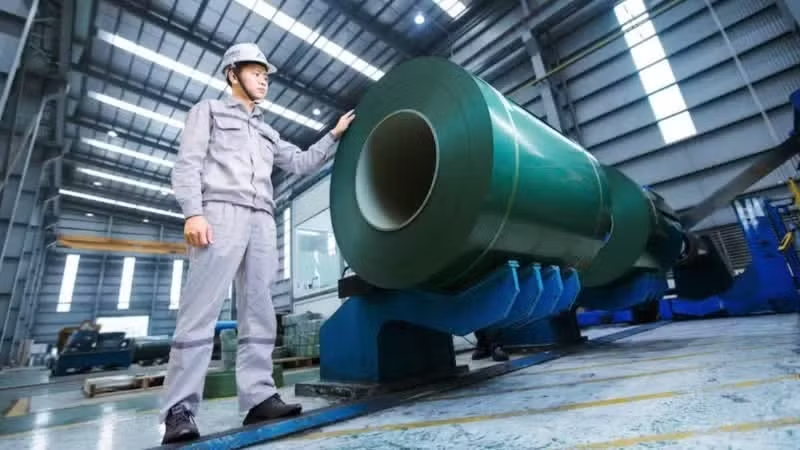
Behind every product bearing the national brand emblem lies a comprehensive process of mindset transformation, criteria standardisation, and systematic investment, all geared towards sustainable values.
Three pillars of quality, innovation and pioneering
Launched in 2003, the Viet Nam National Brand Programme has created an important reference framework, shaping how businesses develop products and build their brands. According to Vu Ba Phu, Director of the Trade Promotion Agency under the Ministry of Industry and Trade, the programme aims to promote high-quality products and services, thereby affirming Viet Nam’s reputation on the international stage.
As the global economy shifts towards digitalisation and green transformation, the national brand development strategy is also evolving, placing science and technology, innovation, and digital transformation at its core. This means that businesses can no longer stop at merely achieving the title but must continuously raise product standards in line with increasingly stringent criteria.
In practice, the value of the Viet Nam National Brand has recorded impressive growth in recent years. However, challenges related to innovation and sustainability continue to pose urgent requirements: Vietnamese products must not only be good, but also distinctive, transparent, and capable of conquering global markets.
From a business perspective, Le Hong Quang, Chief Executive Officer of MISA Joint Stock Company, noted that achieving National Brand certification has brought clear improvements in market positioning, particularly in strengthening trust among customers and partners.
Beyond that, the title opens opportunities to access international markets through trade promotion activities, while enhancing brand value with state-backed promotion. “To maintain and build on the title, businesses must remain steadfast in three core pillars: quality, innovation, and pioneering capability,” Quang emphasised.

In the field of information technology, MISA identifies product quality as its foundation, reflected in the practical effectiveness, safety, and value delivered to users. At the same time, the company is accelerating innovation, particularly in the application of artificial intelligence and the development of self-operating enterprise models that combine human resources with digital labour.
Notably, the application of AI has significantly boosted productivity, enabling a streamlined workforce to deliver substantial results. This demonstrates how Vietnamese enterprises are transforming National Brand criteria into intrinsic capabilities.
Enhancing Vietnamese agricultural products through transparent value chains
If, in the technology sector, national criteria are closely linked with innovation, in agriculture, particularly coffee, the focus shifts to quality and transparency. Thai Nhu Hiep, Chairman and Chief Executive Officer of Vinh Hiep Company, observed that the National Brand has encouraged businesses to move away from volume-based competition towards a stronger emphasis on quality and brand value.
Accordingly, to meet national criteria, the company must build transparent production ecosystems, from raw material areas and crop varieties to processing procedures and traceability. This is not only a technical requirement, but also acts as a passport for products to enter international markets with a stronger position.
Amid rapidly expanding digital trade, the application of technology, especially traceability and digital transformation, has become a key factor in enhancing competitiveness. When products meet national standards and approach international benchmarks, businesses can not only sell goods, but also take a more proactive role in pricing and asserting their position within global value chains.
In the industrial sector, the task of building products to national criteria is clearly reflected in a steadfast commitment to quality and credibility. Tran Dinh Tai, Acting Deputy Chief Executive Officer of Hoa Sen Group, stated that the company consistently places honesty and quality at the forefront throughout its development.
Every product must meet high standards before being brought to market, complying with both domestic and international requirements. This is not merely a technical obligation, but also a commitment to brand credibility.

In an increasingly competitive environment, enterprises are compelled to invest heavily in technology, improve products, and enhance both quality and design. At the same time, the refinement of customer service, after-sales support, and brand development has become an indispensable part of the overall strategy.
According to Tai, achieving National Brand status is not only a recognition, but also a driving force for businesses to further elevate product standards, thereby building lasting consumer trust.
Towards a sustainable brand ecosystem
A common feature among enterprises achieving National Brand recognition is that they do not regard the title as a final destination, but rather as the starting point of a journey towards comprehensive upgrading. From technology and agriculture to industry, building products in line with national criteria is becoming a long-term development strategy.
In the coming period, as digital transformation, innovation, and green growth become key pillars of the economy, the National Brand will continue to serve as a compass to guide enterprises. Beyond producing high-quality goods, Vietnamese businesses must integrate cultural values, social responsibility, and sustainability into every product and service. This is also the path for Vietnamese goods not only to be present but to assert their position on the global economic map through their intrinsic value and distinctive identity.
Author: NDO
RECOMMENDED TOPICS