VN
VN
 EN
EN
26/07/2026, 02:38
Business economics
Curbing decline in export prices of agricultural products
In the first quarter of 2026, the country’s export turnover of agriculture, forestry, and fishery products reached 16.69 billion USD, up 5.9% compared with the same period in 2025. However, many export items increased in volume but not in value proportionately, and in some cases even declined due to falling export prices.
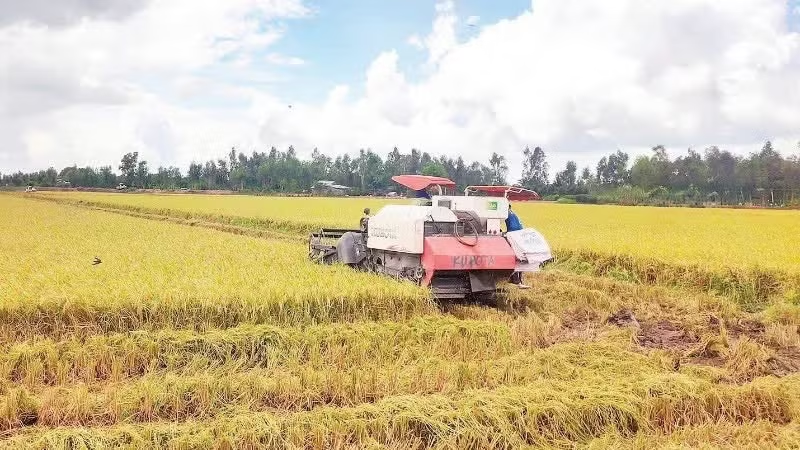
Restructuring products and shifting strongly towards high-quality markets are necessary to prevent the price decline and ensure profits for farmers and businesses.
Tran Gia Long, Deputy Head of the Planning and Finance Department under the Ministry of Agriculture and Environment, said that the most notable price decline was seen in the coffee sector, where the average export price dropped to around 4,697 USD per tonne, down nearly 17% year-on-year, leading to a 6.4% decrease in value despite a 12.6% increase in export volume. Following is rice, with export volume rising slightly by 0.2% but value falling by 7.8% due to an 8% drop in average prices. Other items such as rubber and pepper recorded growth in volume but also faced downward price pressure, with rubber prices falling by 5.1% and pepper by 5.9%. Cashew nuts saw slight declines in both volume and value as export prices fell by 0.8% compared with the same period.
The cause of this situation lies in the general downward trend in global markets, while competition among exporting countries of similar products has become increasingly intense. Falling export prices of agricultural products have directly impacted the domestic market, affecting farmers’ incomes and their ability to reinvest. Since early March, coffee prices in the Central Highlands provinces have fallen by about 3,200–3,800 VND/kg, to just over 90,000 VND/kg. Similarly, winter-spring rice prices have continued to decline, especially during the peak harvest period, with an average drop of about 500 VND/kg. For pepper, domestic prices have mainly declined due to a sharp increase in supply during the main harvest season, while purchasing power has not improved accordingly. By the end of March, pepper prices in key growing areas had fallen by 7,500–8,500 VND/kg compared with the end of February, fluctuating around 139,000–140,500 VND/kg depending on the locality. These developments show that when export prices fall, the domestic market has almost no “buffer” to stabilise prices, immediately affecting production. This also reflects the heavy dependence of many products on raw material markets, where prices fluctuate mainly according to global supply and demand.
Looking at the coffee sector, Viet Nam still mainly exports Robusta coffee as raw materials, resulting in limited added value. As global supply improves, Robusta prices on the world market continue to face downward pressure, dragging export prices down. According to the Import-Export Department under the Ministry of Industry and Trade, by early March 2026, inventories of certified Robusta coffee on the ICE London coffee exchange have risen to their highest level in over three months. Meanwhile, data from the International Coffee Organisation (ICO) show that global Robusta coffee exports from October 2025 to January 2026 increased sharply thanks to supply recovery from major producing countries such as Viet Nam, Brazil, and Indonesia, thereby intensifying downward price pressure.
However, while Robusta continues to face oversupply pressure, Arabica coffee—whose quality and standards are more clearly defined—has shown a price increase due to stable demand in the premium segment. This difference clearly highlights that prices are closely linked to the level of production standardisation and product value. According to Nguyen Nam Hai, Chairman of the Viet Nam Coffee Cocoa Association, promoting deep processing is an urgent requirement to enhance the value of exported coffee. In the long term, it is necessary to build a clear system of standards for Robusta coffee, along with a national promotion strategy, including product positioning, brand identity, and origin storytelling, in order to gradually improve its position and establish better pricing in international markets.
For rice, exports are still largely based on high volumes to traditional markets, making prices easily influenced by common market levels, especially amid increasing global supply. Nguyen Chanh Trung, Director of Hung Viet Rice Co., Ltd., said that it is necessary to shift towards higher-value products such as small-packaged rice, building proprietary brands, and distributing according to specific market segments. This approach not only increases product value but also reduces dependence on general price fluctuations. In practice, specialty rice, fragrant rice, and low-emission “green” rice of Viet Nam, when exported to high-quality markets such as the US, Japan, and the EU, have maintained good prices and are less affected by fluctuations of the global rice market.
In addition to coffee and rice, pepper is in a similar situation, with raw, unprocessed exports accounting for 82.3% of total export volume in the first two months of the year, clearly showing heavy dependence on raw material markets and resulting in volatile export prices. It can be seen that curbing the decline in export prices of agricultural products cannot rely solely on global market developments, but depends significantly on the ability of each agricultural sector to adjust itself. When products are standardised in quality, targeted at clearly defined customer segments, and shifted towards high-value markets, export prices can be stabilised, enabling each sector to gradually take control of price movements in the global agricultural market.
Author: NDO
RECOMMENDED TOPICS