VN
VN
 EN
EN
20/07/2026, 11:00
Business economics
Digital agriculture paves the way for green growth towards Net Zero
Beyond optimising productivity and conserving resources, digital platforms also help businesses and farmers manage greenhouse gas emissions, improve ESG data transparency, gradually meet global market requirements and realise the goal of achieving net-zero emissions by 2050.
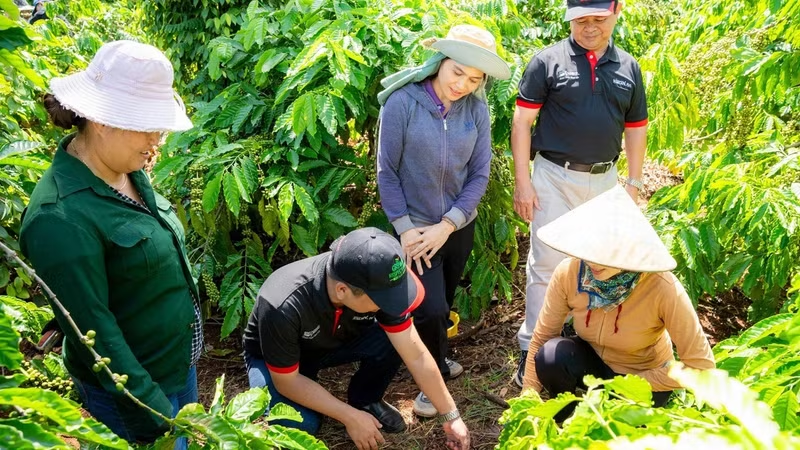
Resolution No. 57-NQ/TW of the Politburo sets the goal of achieving breakthroughs in science, technology and digital transformation, identifying these as important drivers of higher productivity, quality and economic competitiveness. In agriculture, digital transformation is opening up opportunities for a comprehensive change in production methods. Digital agriculture is not simply about bringing modern machinery into the fields, but about managing the entire value chain through data, from raw material areas, cultivation, harvesting and processing to logistics and consumption.
When all activities are digitalised and connected, businesses can better control the use of land, irrigation water, fertilisers and energy, as well as the greenhouse gas emissions generated at each stage. As “green barriers” increasingly become mandatory conditions for exports, data-driven management is emerging as a new competitive advantage for Viet Nam’s agricultural sector.
Digital transformation lays the foundation for low-emission agriculture
Under the Ministry of Agriculture and Environment’s project on emission reduction in crop production for the 2025-2035 period, with a vision to 2050, a number of sectors, including rice, coffee, sugarcane, cassava and bananas, have been identified as having considerable potential for reducing greenhouse gas emissions. However, to realise this goal, alongside changes in farming practices, agriculture needs a modern management platform based on digital data.
Luong Quang Huy, Head of the Greenhouse Gas Emissions Management and Ozone Layer Protection Division under the Department of Climate Change at the Ministry of Agriculture and Environment, said Viet Nam is gradually improving its policy framework on greenhouse gas emissions management while developing a national database and online management system for emissions inventories, reporting, monitoring and verification.
According to Huy, emissions management is not only a requirement for regulatory compliance but also helps businesses improve governance capacity, use energy more efficiently and enhance their competitiveness in the face of increasingly stringent international market requirements. Notably, alongside efforts to complete the legal framework, Viet Nam is also implementing a roadmap for the development of a domestic carbon market. This is regarded as an important driver encouraging businesses to invest in green technologies, reduce emissions and gradually participate in global value chains.
Experts say data is the key factor in ensuring the effective operation of the carbon market. Only when emissions are accurately measured, transparently recorded and regularly updated through digital platforms can businesses develop emission-reduction roadmaps and participate in carbon credit trading in the future.
From “selling agricultural products” to “selling transparent data”
In practice, many agricultural businesses have begun shifting their development models towards digitalisation and emissions management. According to Nguyen Duc Hung Linh, Deputy General Director in charge of investment at AgriS Group, competition in international markets is no longer merely about price. “Partners no longer ask about price first; they ask whether our products are sustainable,” Linh said. In response, AgriS has identified ESG as a pillar of its development strategy. The company has developed a data management system for traceability, farming management and the implementation of international sustainability standards.
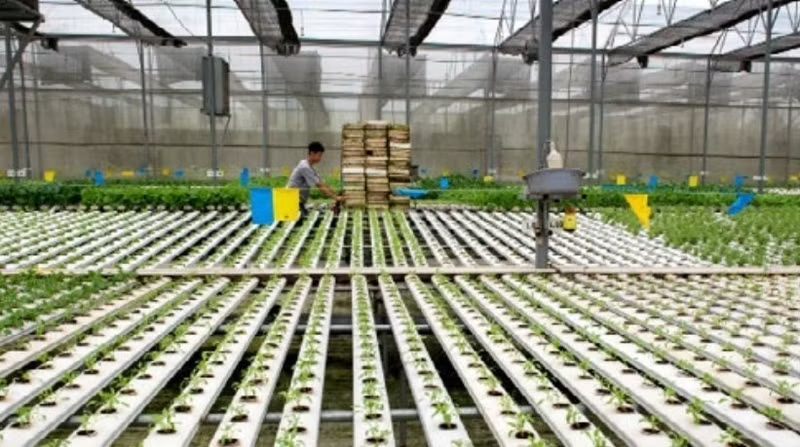
Digitalising the entire production chain not only helps businesses provide transparent information to customers but also optimises resource use. Through digital management tools, businesses can monitor water, fertiliser and energy consumption, thereby reducing greenhouse gas emissions during production. The benefits are evident. While the average sugarcane yield among farmers is only about 50-60 tonnes per hectare, precision farming based on data has enabled many AgriS raw material areas to achieve yields of 70-80 tonnes per hectare. In addition to higher output, the quality of raw materials has also improved, with sugar content increasing from about 9.1% to more than 10% after several years of technological application.
More importantly, production data also enables businesses to forecast market demand, develop appropriate planting plans and reduce supply surpluses or shortages, thereby improving economic efficiency and limiting resource waste.
As major markets such as the European Union, the US and Japan increasingly require transparency regarding carbon footprints, traceability and sustainable development, data is becoming a new form of “asset” for agricultural businesses. Businesses must not only sell products but also demonstrate the entire green production journey of those products through reliable data.
Digital data – the “key” to regenerative agriculture
While digital transformation helps businesses manage production chains more effectively, regenerative agriculture is opening up a new approach to reducing emissions, restoring ecosystems and increasing the value of agricultural products. Experts say regenerative agriculture not only aims to reduce greenhouse gas emissions but also helps restore soil, conserve biodiversity, use water resources efficiently and improve the carbon absorption capacity of ecosystems. It is also one of the important solutions enabling the agricultural sector to fulfil Viet Nam’s commitments made at COP26.
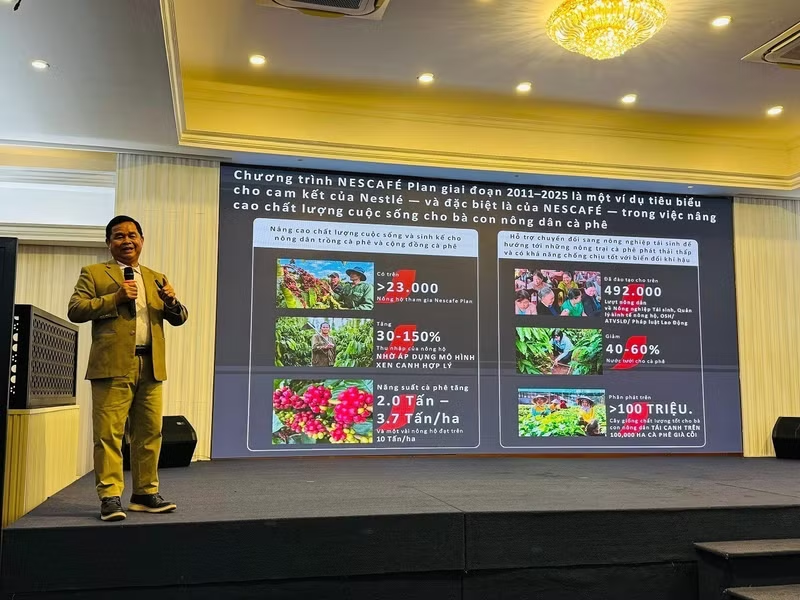
Wouter Melis Van Ravenhorst, Director of Control Union Viet Nam, said that amid the rise of “green barriers”, regenerative agriculture is no longer an optional trend but is gradually becoming an essential requirement in global agricultural supply chains.
Sharing this view, Hoang Thi Thu Huong, Senior Project Officer at GIZ, said the core principle of regenerative agriculture is to restore natural resources rather than focus solely on maximising productivity. The model not only helps meet new regulations such as the European Union Deforestation Regulation (EUDR), but also opens up opportunities to participate in the carbon credit market, potentially generating additional income for producers in the future.
However, accurately measuring emission reductions, carbon sequestration and compliance with international standards requires a comprehensive, precise and continuously updated data system.
This demonstrates that regenerative agriculture and digital transformation are not separate processes, but mutually reinforcing ones. Green agriculture can develop sustainably only when all production activities are digitalised and managed through data. A notable example is the NESCAFÉ Plan, implemented by Nestlé Viet Nam since 2011. By guiding farmers in regenerative practices relating to soil, water and biodiversity, combined with data-driven farm management tools, many coffee-growing areas have recorded positive results.
The use of chemical fertilisers has fallen by 20-40%, while irrigation water has been reduced from around 700-1,000 litres to about 400 litres per coffee tree without affecting productivity. At the same time, intercropping fruit trees and pepper, together with ground-cover systems, has improved moisture retention, enhanced biodiversity and reduced emissions.
According to Pham Phu Ngoc, Head of Nestlé Viet Nam’s Central Highlands Branch and Director of the Agricultural Development Programme, the greatest value of regenerative agriculture lies not only in environmental indicators but also in economic efficiency. Farmers’ incomes can increase by 30-150% through lower input costs, more diversified income sources and improved agricultural product quality. These results show that green development does not mean sacrificing profits. On the contrary, through technology adoption and data-driven management, businesses and farmers can simultaneously increase productivity, reduce costs and cut emissions.
Author: NDO
RECOMMENDED TOPICS