VN
VN
 EN
EN
10/07/2026, 02:38
Business economics
Effective support for household businesses
According to the Viet Nam Private Economy Report 2025, the country currently has around 6.1 million household businesses, creating jobs for approximately 10 million workers. Of these, more than 81.5% of surveyed households said their revenue declined in 2025, 73.7% earned only small profits, and nearly one quarter broke even or suffered losses.
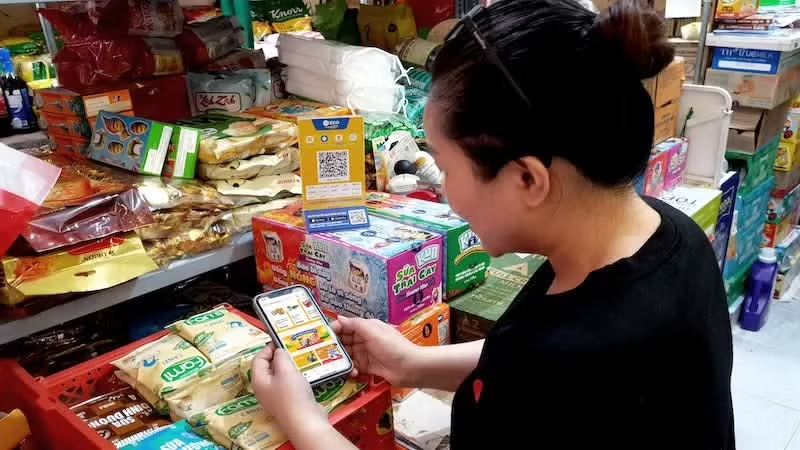
These figures reveal the worrying condition of an economic sector that may be small in scale but is deeply rooted in social life.
Household businesses have long been considered the flexible part of the economy. With just a breakfast stall, grocery shop or market stand, although they may not generate large figures in economic reports, they support many families, maintain consumption rhythms in residential areas and create jobs for a considerable number of workers.
However, their small scale, limited capital and experience-based operations make them vulnerable to market fluctuations and increasingly stringent management requirements. More worrying is that current pressure also comes from compliance costs, which are becoming an “invisible cost” but a very heavy one.
About 73% of household businesses believe that legal difficulties and the time spent complying with regulations have a very significant impact. It must still be affirmed that business transparency, data-based tax management and the implementation of electronic invoices are correct policies.
However, if implementation methods are not suited to reality and exceed the capabilities of those involved, they can easily become compliance burdens, because most small household businesses do not have accounting expertise, legal departments or personnel knowledgeable about technology; for them, hesitation about transformation sometimes begins with the fear of making mistakes in clicking, declaring incorrectly and then being wrongly penalised.
Therefore, the fact that only 15.6% of households intend to convert into enterprises within the next two years is not simply due to fear of expansion but also stems from a very practical calculation: What will they gain, what will they lose, whether they can cope, and whether risks will increase.
Therefore, encouraging household businesses to convert into enterprises should not simply be understood as a way to achieve the target of 2 million enterprises by 2030 under Resolution No. 68-NQ/TW on private economic development. If we focus only on quantity, we may create a business community that is “large in number but not strong”, carrying the name of enterprises while still remaining weak in capital, governance, markets and resilience.
What needs to change first is the mindset towards transformation. Household businesses will only dare to grow when they see a path ahead with fewer risks and clearer benefits. It is not possible merely to increase requirements on taxes, invoices and bookkeeping while expecting small businesses to professionalise themselves.
Household businesses will only dare to grow when they see a path ahead with fewer risks and clearer benefits. It is not possible merely to increase requirements on taxes, invoices and bookkeeping while expecting small businesses to professionalise themselves.
A sufficiently long transition roadmap is needed, along with simple procedures, easy-to-understand forms, user-friendly software and direct advisory points at wards, communes, markets and business neighbourhoods.
More importantly, transformation must come with tangible benefits through streamlined administrative procedures, a favourable and open business environment and more effective access to resources; most importantly, they need support in basic accounting operations, reduced compliance costs and limitations on overlapping inspections and examinations.
When the benefits are sufficiently clear, household businesses will themselves consider the next step instead of remaining outside the process out of concern that transformation only means more paperwork, more costs and greater risks. Only then can private economic development truly become sustainable and effective, measured by the vitality of each entity after entering the formal sector.
Author: NDO
RECOMMENDED TOPICS