VN
VN
 EN
EN
22/07/2026, 02:38
Investment
Foreign investors propose solutions to develop capital market and attract high-quality FDI
Foreign investors expressed their support for Resolution No. 10/NQ-TW, while proposing a series of solutions aimed at attracting high-quality FDI inflows and enhancing Vietnam's competitiveness.
On the morning of June 30, the Politburo organized a nationwide conference to study, learn, grasp, and implement Resolution No. 10-NQ/TW dated June 8, 2026, on the development of the foreign-invested economic sector.
Great Confidence for the Foreign Investors Community
At the conference, representatives from the leadership of Ho Chi Minh City, Hanoi, Da Nang, and various FDI enterprises presented speeches outlining solutions to implement the resolution within their respective localities and units. Notably, representatives of foreign-invested enterprises highly appreciated Vietnam's numerous incentive policies to attract investment. They emphasized that Vietnam remains a safe, stable investment destination with a favorable socio-political environment, an increasingly high-quality workforce, and a strong determination to reform institutions and improve the investment and business environment.
They affirmed that Resolution No. 10/NQ-TW has built strong confidence within the FDI business community regarding Vietnam's long-term development vision. It reflects a consistent commitment from the Party and State to accompany and guarantee a transparent, stable, competitive, and predictable investment environment. This opens up many new opportunities for enterprises to expand their investments, develop large-scale projects, apply high technology, and integrate more deeply into the domestic economy.
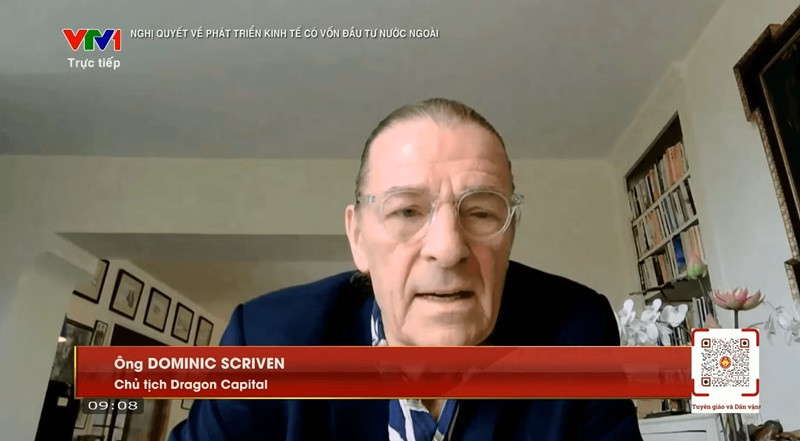
Mr. Dominic Scriven, Chairman of Dragon Capital. (Photo: VTV)
Mr. Dominic Scriven, Chairman of Dragon Capital, delivered a speech congratulating Vietnam on issuing Resolution 10, evaluating it as a resolution of special significance to the foreign investor community.
According to him, first, Resolution No. 10/NQ-TW affirms that the foreign-invested economic sector (FDI) is an inseparable part of Vietnam's economy. This demonstrates a commitment to treating foreign investors equally, fostering immense trust within the FDI business community.
Second, the Resolution No. 10/NQ-TW emphasizes that Vietnam is not merely attracting capital for its own sake but is targeting high-quality inflows tied to technology transfer, innovation, and advanced management practices.
Third, the Resolution clearly states that attracting FDI must not come at the expense of the environment, natural resources, or the social welfare system.
Finally, the Chairman of Dragon Capital particularly welcomed the fact that Resolution No. 10/NQ-TW affirms the vital role of capital market investors in the development of the economy.
Accelerate the MSCI Upgrade Process Before 2030
From Dragon Capital’s perspective, Mr. Dominic Scriven proposed several recommendations to support Vietnam's growth objectives and boost investment attraction efficiency.
According to him, the current challenge lies not only in the scale of capital but also in the cost of capital. He pointed out that while the Government can issue 10-year bonds at an interest rate of around 4% per year, businesses face difficulties issuing 5-year bonds; even if they issue 3-year bonds, they must accept high interest rates ranging from 10% to 12% per year. This gap is excessively wide and requires solutions to close it.
Therefore, the first recommendation is to establish a mechanism that encourages FDI enterprises to retain profits in Vietnam instead of remitting them entirely abroad. Accordingly, Vietnam should study a mechanism to pay interest on USD deposits held by FDI enterprises within the Vietnamese banking system.
The second recommendation, according to Mr. Dominic Scriven, is to continue accelerating the upgrading process of the Vietnamese stock market, aiming to become an emerging market before 2030. Alongside the efforts of the State Securities Commission and the Ministry of Finance in deploying the Central Counterparty (CCP) mechanism, the Chairman of Dragon Capital suggested that the Government focus on resolving two additional issues: reviewing and relaxing foreign ownership limits in industries and enterprises unrelated to national security, and perfecting the foreign exchange transaction mechanism for foreign investors.
Third, he recommended reviewing and amending the listing regulations on the stock market. Currently, besides the rule that loss-making enterprises cannot list, there is also a regulation that enterprises with accumulated losses are ineligible. According to him, this is a major barrier for technology, digital economy, and AI companies, as these businesses usually have to accept losses in their early stages before generating profits.
Fourth, there is a need to accelerate the construction of international financial centers in Da Nang and Ho Chi Minh City. According to the Chairman of Dragon Capital, this presents an opportunity for Vietnam to develop a private placement mechanism dedicated to professional foreign institutional investors.
The final recommendation is to strongly promote the development of domestic institutional investor networks. This will serve as a crucial foundation to help Vietnam's capital market develop stably and sustainably, reducing its dependence on short-term capital flows.
The leadership of Dragon Capital committed to continuing to accompany Vietnam in its capital market development process. Dragon Capital will continue to serve as a bridge between international capital sources and the Vietnamese capital market; continue to stand alongside the Ministry of Finance and the State Securities Commission in the stock market upgrading process; continue to prioritize investing in high-quality enterprises with transparent corporate governance, effective risk management, and compliance with ESG (Environmental, Social, and Governance) standards; and actively support the development of domestic institutional investor systems, contributing to building an increasingly deep, modern, and sustainable Vietnamese capital market.
Many Hundred-Billion-Dollar Funds Waiting to Pour Capital into Vietnam
Speaking at the conference, a representative from another reputable foreign fund management company operating in the market—Mr. Michael Kokalari, CFA, Chief Economist, Head of Macroeconomic Analysis and Market Research at VinaCapital—shared solutions to attract investment funds to encourage stable, long-term foreign capital flows into Vietnam.
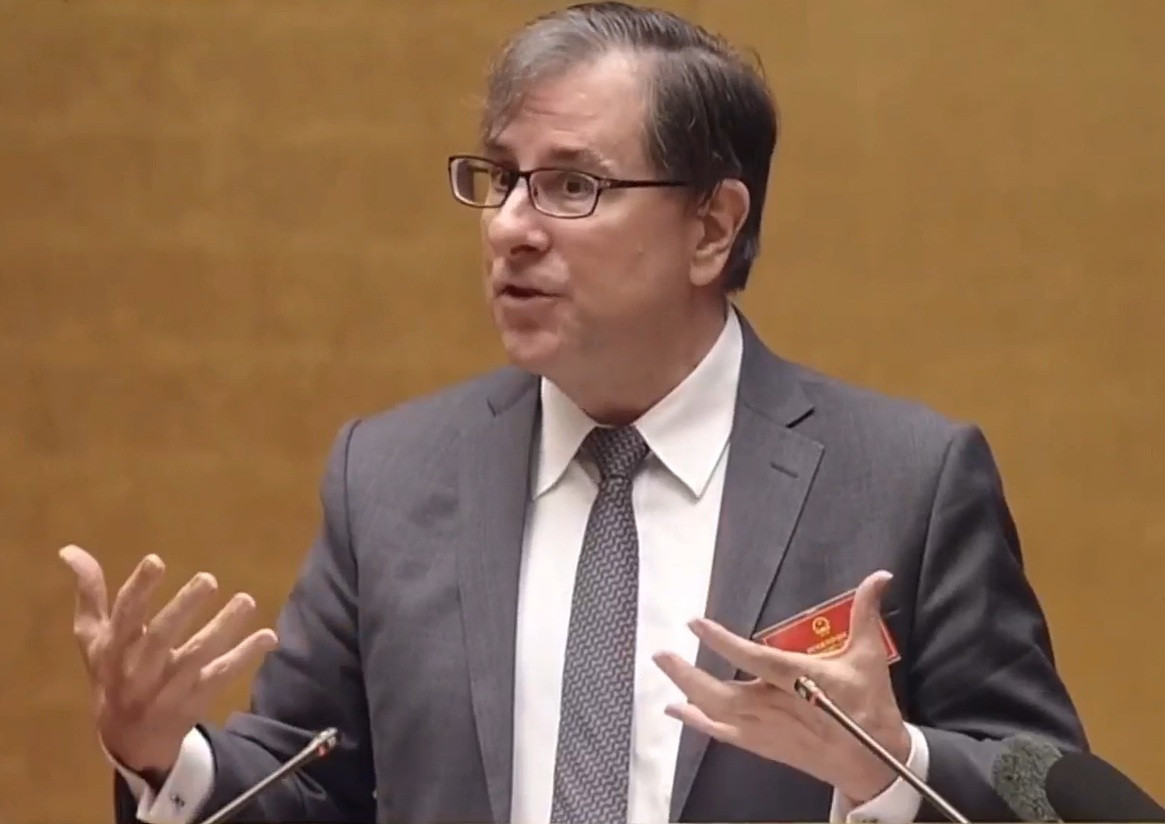
Mr. Michael Kokalari, CFA, Chief Economist, Head of Macroeconomic Analysis and Market Research, VinaCapital speaking at the Conference.
First and foremost, VinaCapital's representative highly praised Resolution No. 10/NQ-TW regarding the development of the foreign-invested economic sector. "Vietnam is already a very interesting and attractive destination for FDI investors. Resolution No. 10/NQ-TW, with its goal of further strengthening the links between FDI enterprises and domestic enterprises, will bring even greater advantages to Vietnam's economy and make Vietnam an even more attractive destination for foreign investment in the future," he stated.
Mr. Michael Kokalari outlined several proposals and recommendations for Vietnam to continue attracting investment capital and remain a highly appealing destination for foreign investors ahead:
First, Vietnam should continue its ambitious infrastructure development projects. "However, executing these projects will be very costly, and that is where VinaCapital and investors can support Vietnam."
For a developing country at Vietnam's economic stage, utilizing foreign investment capital is nothing unusual. Even the United States in the 1800s leveraged foreign investment, particularly from London (UK), to build its infrastructure, especially its railway network.
"VinaCapital is a financial investment group with 20 years of operating experience, and we possess a very deep network connecting with global financial hubs from London to New York, Singapore, and beyond. We are uniquely positioned to help everyone understand the enthusiasm of foreign investors looking to participate in the Vietnamese market," he expressed.
Second, Vietnam needs to prioritize getting upgraded to an emerging market by Morgan Stanley (MSCI, the global equity index provider), following its upgrade by FTSE last year.
Third, Vietnam should quickly be upgraded to an investment-grade destination by S&P, Moody's, or other global rating agencies.
Fourth, and more importantly, Vietnam needs to operationalize its international financial centers to soon attract international cash flows.
To achieve an MSCI upgrade, Vietnam should address several issues, such as deploying the central counterparty mechanism, allowing the implementation of exchange rate risk hedging tools for indirect investment, relaxing foreign investor ownership limits, and adopting certain standards related to transparency and governance, according to the VinaCapital representative.
"I must say that there are many investment funds worldwide worth hundreds of billions of dollars ready to participate in the Vietnamese market and prepared to disburse funds once Vietnam meets these standards and is upgraded by MSCI," Michael Kokalari emphasized. The Chief Economist of VinaCapital also expressed to the Conference, "I would like to reaffirm my deep love for Vietnam, where I have lived for the past 20 years, and I hope to continue witnessing Vietnam's development steps over the next 20 years."
Author: LE MY - TRUONG DANG
RELATED TOPICS
RECOMMENDED TOPICS