VN
VN
 EN
EN
21/07/2026, 10:30
Investment
Will the AI boom give a boost to the US dollar?
In many respects, the AI boom is mimicking the dot.com boom of 25-30 years ago. Back then the US dollar soared. Will it be a repeat performance this time?
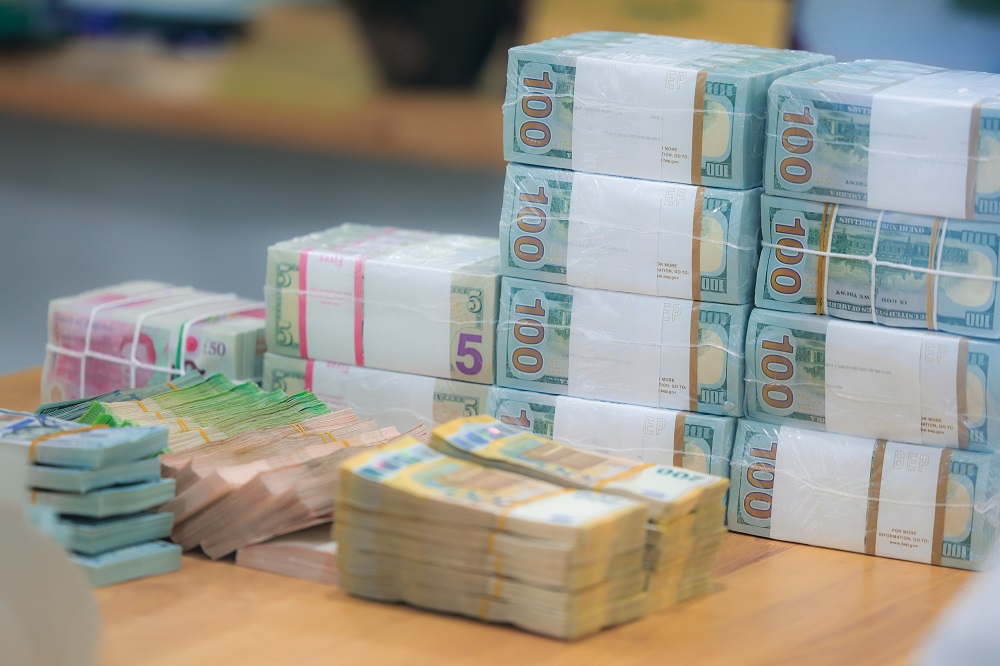
The US dollar may go up amid the AI boom. Photo: Quoc Tuan
For those that were not around, the dot.com boom of the mid-late 1990s was arguably the last time that a major technological breakthrough brought with it hopes for a massive rise in productivity. Technology stocks surged sixfold in anticipation of increased profitability from the sector between the end of 1994 and early 2000 and the Federal Reserve, under the stewardship of Chair Greenspan refused to spoil the party by hiking rates aggressively. But, almost inevitably, the party did end and stocks endured a dramatic collapse starting in March 2000.
In the following two years, or so the NASDAQ gave back close to 90% of the dot.com rally. A productivity boom did develop as the optimists speculated. At the end of 1994 annual productivity growth was a paltry 0.5% but it improved rapidly and, by the end of 1999 was above 4%.
What happened to the dollar through all this? It rallied. In trade-weighted terms it was close to 15% higher by the start of 2000 compared to the start of 1995 and, at one stage it was up nearly 33%. Even the bursting of the equity bubble in 2000 failed to dent the dollar initially, but it did eventually succumb, from 2002 and spent the next decade giving back all its gains and more.
Is there anything to be learned from this? You will have heard us argue before that citing historical precedent as a guide to future fortune is fraught with danger, and so it is here. However, we need to be clear about what's different this time. What is not different is the rally in technology stocks through this AI-related surge. Will the rally also blow itself out in a spectacular way, just like March 2000? Most probably.
However, Steven Barrow, head strategist of the Standard Bank, said the problem, of course, is determining when this is likely and we are not sure that we are close to this point yet and that's despite the chip-related carnage that we have seen in the Korean stock market recently and the wobble in the Nasdaq. Something that's likely to be the same as the dot.com boom is the impact on productivity growth. Of course, it is early days yet, but we'd expect the technology to lift productivity growth noticeably. However, it may be here where the similarities end.
For a start, the dot.com boom occurred in a period when inflation was relatively becalmed. But now it is not just that inflation seems more problematic; it is that the technology itself may be adding to price pressure because AI-related datacentre construction is lifting some prices, notably electricity. This sort of pressure never happened during the dot.com boom as there was little new infrastructure that was needed. Higher price pressure now could mean higher policy rates and a higher dollar.
But returning to the similarities between today's AI boom and the dot.com boom, it does seem clear that new Fed Chair Warsh will push to convince FOMC members that AI has the capacity to lift productivity and so keep inflation down in the same way as Greenspan did during the dot.com boom. He might prove to be correct, but he might also be wrong and, if that happens, a misstep on monetary policy could prove costly for the dollar.
“Another point of difference between now and 25-30 years ago is that the dollar is quite strong now and has been mostly rising for over a decade, albeit with bouts of weakness on some occasions. In contrast, the dollar came into the dot.com boom after a decade-long decline and hence it was seen as a weak and undervalued currency. The dot.com boom not only seemed to convince investors that this new technology could lift stocks dramatically but also it could also cause a recovery in the beleaguered dollar. Fast-forward to today and the dollar is not undervalued; perhaps quite the opposite”, said Steven Barrow.
Indeed, there does seem a sense that overseas investors who want to participate in the AI gold rush in stocks are opting to give the dollar a wide berth. Steven Barrow thinks this will persist and hence the AI boom won't be the rocket fuel for the dollar that the dot.com boom seemed to be in the 1990s.
Author: NGOC ANH
RECOMMENDED TOPICS