VN
VN
 EN
EN
26/07/2026, 02:38
Business economics
Fuel prices test resilience of agricultural sector
Rising fuel prices are emerging as a key test of the resilience and durability of Viet Nam’s agricultural sector, as well as the organisational capacity of its production system.
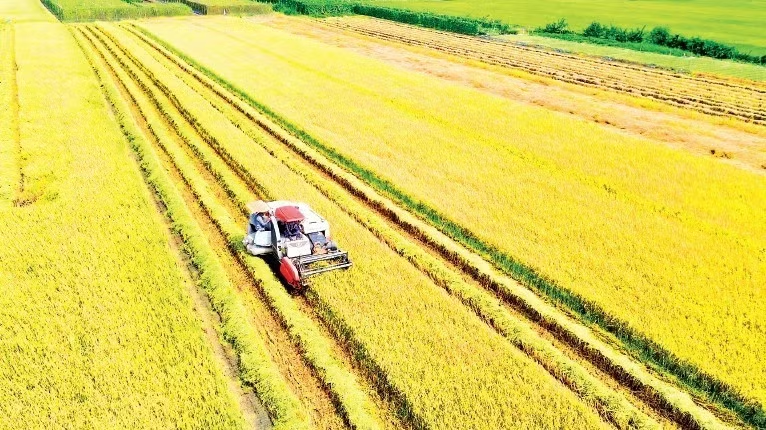
Observations from large-scale rice production areas, where hundreds of thousands of hectares are cultivated annually, show that the impact of fuel prices extends beyond individual cost items, creating system-wide pressure.
Fuel should no longer be viewed merely as a direct input. In practice, it functions as the energy infrastructure of agriculture, embedded throughout the entire production chain, from land preparation, sowing, fertilising to harvesting and transportation.
As fuel prices increase, production costs across all stages are driven up, with no segment unaffected.
Data from production activities in Dong Thap Province show that land preparation costs have increased by between 300,000 VND and 600,000 VND per hectare, harvesting costs have gone up by 200,000–500,000 VND per hectare, and irrigation costs have risen by around 40,000 VND per hectare, while transportation costs have also increased per sack of rice.
Individually, these increases may appear modest, but when accumulated across the entire production process, fuel has become a foundational cost factor directly affecting production efficiency.
Even technologies expected to reduce costs, such as unmanned aerial vehicles (UAVs), are not immune to rising fuel prices. This indicates that the issue lies not in specific technologies but in the high level of dependence of agricultural production on energy.
Amid simultaneous increase in input costs, a paradox has become increasingly evident. In the 2025–2026 winter-spring crop, although the total cultivated area nationwide decreased by more than 58,000 hectares year-on-year, output still rose by approximately 12,000 tonnes.
This reflects that production capacity remains stable and even shows signs of growth. However, rice prices declined by 15–18% compared to the 2025 crop, leading to a corresponding drop in farmers’ profits.
This highlights a key bottleneck in the agricultural sector: output increases, but value retained by producers does not.
Farmers have no control over selling prices, while input costs—from fuel to agricultural materials—are largely market-driven. This gap does not self-adjust and instead directly erodes profit margins.
Across the value chain, farmers bear the majority of cost shocks.
This is not only an economic issue but also a structural one. In practice, price management measures may help ease pressure in the short term but cannot address the root cause.
The core issue lies in the high energy intensity of agricultural production. As long as the production structure remains unchanged, fluctuations in energy prices will continue to translate directly into cost volatility.
Even if fuel prices decline temporarily, the risks remain and will re-emerge when market conditions change. If this is treated as a short-term issue, the solutions will remain reactive.
In this context, the focus should not be on reducing individual cost items but on reorganising production.
Current practices show that many stages of agricultural production remain fragmented and poorly coordinated, leading to repeated machinery use and unnecessary fuel consumption.
By restructuring cropping schedules, consolidating production stages and optimising operations, costs could be reduced without cutting inputs. More importantly, production scale and spatial organisation play a decisive role. Fragmented production increases costs related to transportation, mechanisation and services.
Conversely, the development of concentrated production areas would enable more efficient use of fuel and resources.
This suggests that the issue is not a lack of effort by farmers but limitations in production organisation. In this context, cooperatives continue to be identified as a key solution.
However, if they continue to operate in a formalistic manner without substantive functions, they will not effectively address cost challenges. Properly functioning cooperatives should act as economic entities capable of organising services, coordinating production, optimising the use of machinery and synchronising processes to reduce fuel consumption.
Otherwise, farmers will continue to bear costs individually in a market where they remain at a disadvantage, and cost reduction efforts will not achieve sector-wide impact.
A notable consequence has begun to emerge. As costs rise while returns remain unstable, many farmers are considering switching to higher-value crops.
At the household level, this is a rational response to protect income. However, at the system level, it serves as a warning signal. Spontaneous shifts could disrupt production planning, create imbalances and introduce long-term risks.
It is clear that rising fuel prices are only a triggering factor. The core issue lies in a production model that remains energy-intensive, heavily dependent on inputs, while generating insufficient added value.
If this model is not reformed, costs will continue to rise, profits will be further eroded, and farmers will remain the most vulnerable group.
Conversely, if viewed as a catalyst for restructuring—from reorganising production and strengthening cooperatives to optimising value chains and reducing energy dependence—current pressures could become a driver for transformation.
In that context, the key question is no longer whether fuel prices will rise or fall, but whether the agricultural sector will remain reactive or proactively adapt towards sustainable development in an increasingly volatile environment.
Author: NDO
RECOMMENDED TOPICS