VN
VN
 EN
EN
26/07/2026, 02:38
Business economics
Ha Noi and Ho Chi Minh City remain as Viet Nam’s economic engines in first quarter
In the first quarter of 2026, economic growth across many localities was broadly positive, according to the National Statistics Office (NSO), with Ha Noi and Ho Chi Minh City maintaining their positions as the nation’s economic engines.
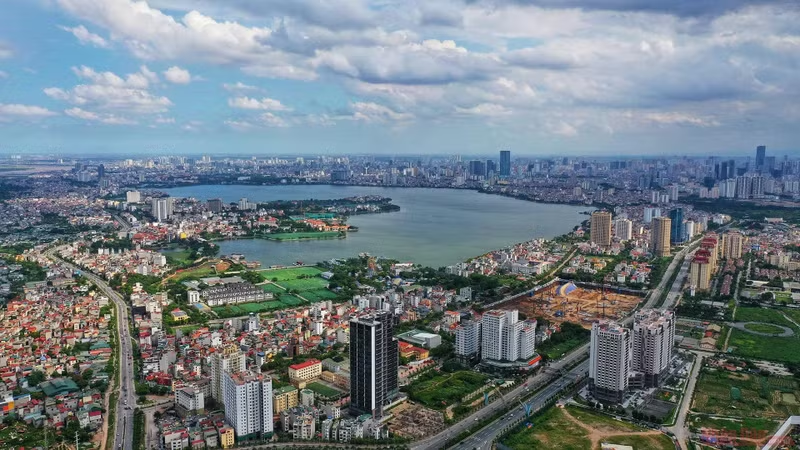
However, the NSO noted that economic growth remains uneven among localities, with strong performance recorded in provinces and cities with advantages in manufacturing, export-oriented industries and tourism.
Meanwhile, provinces with lower growth rates are largely those dependent on agriculture and hampered by rising input costs and weak market demand.
Uneven economic growth across provinces and cities
Preliminary estimates for economic growth in the first quarter of 2026 show that four out of 34 provinces and cities recorded growth rates above 10%: Ha Tinh (12.42%), Ninh Binh (11.63%), Hai Phong (11.21%) and Hung Yen (10.43%).
The five localities with the largest shares of the national GDP are Ho Chi Minh City (24.15%), Ha Noi (12.38%), Hai Phong (5.97%), Dong Nai (5.37%) and Bac Ninh (3.82%).
The five localities contributing most to national economic growth are Ho Chi Minh City (22.94%), Ha Noi (11.40%), Hai Phong (7.89%), Dong Nai (6.16%) and Bac Ninh (4.77%).
Notably, several provinces and cities stood out as tourism bright spots in the first quarter of 2026, including Bac Ninh, Hai Phong, Ninh Binh, Thanh Hoa, Quang Tri, Lam Dong and Hue.
Meanwhile, some provinces achieved high growth thanks to expanded production capacity. In Ha Tinh, this included the Vung Ang 2 Thermal Power Plant, VinFast automotive plant, and VinES battery factory.
In Ninh Binh, growth was supported by facilities such as the sock manufacturing plant of Great Market Global Viet Nam Co., Ltd., the Seasunsport Nam Dinh factory, and the Jinyoung G&T Viet Nam plant.
In Hai Phong, Three Color Stone Co., Ltd. contributed to this growth, while in Bac Ninh, Amkor Technology Viet Nam Co., Ltd. drove expansion through a large-scale semiconductor manufacturing, assembly and testing project.
In addition, statistics show that five provinces recorded growth rates ranging from 5.3% to 7.05%. These localities rely primarily on agriculture, forestry, and fisheries – sector that are vulnerable to weather conditions, as well as fluctuations in transport costs and commodity prices across both domestic and international markets.
Their industrial sectors lack large-scale investment projects, remain dependent on conventional export-processing industries, and face supply chain disruptions and rising shipping costs stemming from geopolitical tensions in the Middle East.
Infrastructure projects have also faced difficulties due to rising construction material prices, raw material shortages, and delays in site clearance, dampening spillover effects to other sectors of the economy.
Four provinces and cities achieve double-digit growth
Ha Tinh recorded growth of 12.42%, contributing 1.41% to national economic growth and ranking first among the 34 provinces and cities. Its strong performance was driven primarily by industry and construction, with significant increases in both manufacturing and electricity production and distribution.
This reflects a solid industrial and services base, supported by proactive investment promotion strategies, modern and well-integrated infrastructure, strong transport connectivity, and an improved investment environment that has attracted both domestic and foreign capital.
Ninh Binh’s economy grew by 11.63%, contributing 3.77% to overall growth. The industry and construction sector expanded by 16.19%, accounting for 64.85% of the province’s growth and serving as the primary engine of its economic expansion.
With a favourable geographic location, modern and well-integrated infrastructure, and a business-friendly investment climate, Ninh Binh has successfully attracted numerous manufacturing and export enterprises, driving its strong growth.
Hai Phong posted economic growth of 11.21%, contributing 7.89% to national growth. This was driven primarily by industry and construction, with manufacturing rising by 14.45% and accounting for 59.49% of overall growth.
The construction sector expanded by 9.68%, supported by several major projects and increased public investment. Transport and warehousing also rose by 12.38%, contributing 14.90% of growth, reflecting the city’s advantages as a major seaport and a key northern trade gateway.
Hung Yen ranked fourth among localities with double-digit growth in the first quarter of 2026, at 10.43%. The industry and construction sector grew by 13.11%, contributing 70.67% to the province’s total growth.
Hung Yen has emerged as a dynamic industrial hub, with many industrial zones attracting new investment projects thanks to an improved business environment. Alongside industry and construction, the services sector also grew by more than 9%, driven by a vibrant consumer market and buoyant trade activity.
Ha Noi and Ho Chi Minh City maintain strong growth momentum
Ha Noi recorded steady growth of 7.87%, contributing 11.40% to national economic growth.
In the first quarter of 2026, Ha Noi’s growth was driven mainly by the services sector, while industry and construction showed a steady recovery. Services grew by 8.21%, contributing 80.08% of total growth, underpinned by strengths across trade, transport, tourism, finance, the digital economy, logistics, education, and healthcare.
Industry and construction expanded by 7.55%, reflecting a sustained recovery in production and investment activity.
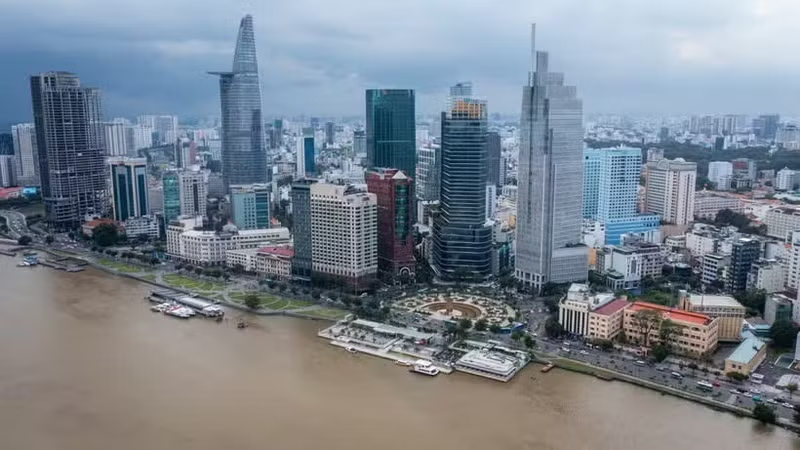
Meanwhile, Ho Chi Minh City’s economy grew by an estimated 8.27% year-on-year in the first quarter of 2026, making the largest contribution to national growth at 22.94%, drive primarily by the services sector.
The city’s expanded development space and significant advantages in market size, infrastructure, high-quality human resources, finance, trade, and services continue to underpin its growth. The services sector expanded by 8.91%, contributing 62.82% of the city’s total growth, reaffirming its status as the primary driver of Ho Chi Minh City’s economy.
The industry and construction sector maintained solid growth of 7.73%, with manufacturing continuing to play a central role.
Author: NDO
RECOMMENDED TOPICS