VN
VN
 EN
EN
26/07/2026, 02:38
Business economics
Upgrading infrastructure and services to shape a “green airport” future
According to results recently announced by the international aviation consultancy and rating organisation Skytrax, Viet Nam’s airport system has simultaneously achieved impressive rankings, marking significant success from the investment and infrastructure–service upgrade strategy of Airports Corporation of Viet Nam (ACV).
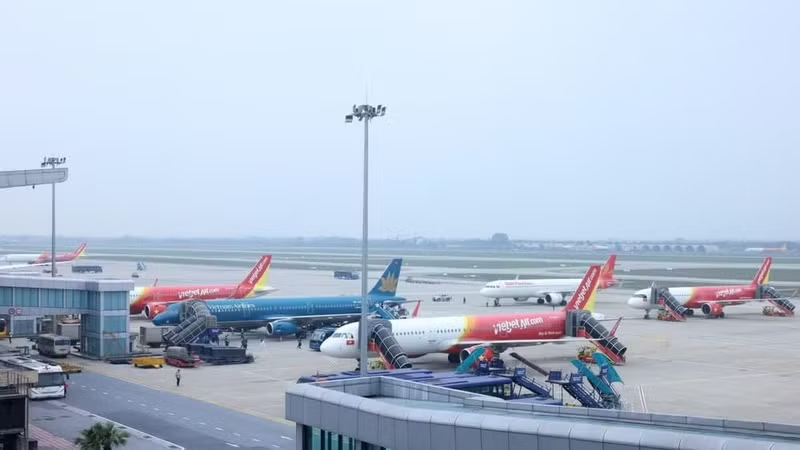
These results are based on objective evaluations from millions of passengers worldwide, measured against stringent criteria on service quality, convenience and operational processes.
A “leap forward” for Noi Bai International Airport
In 2026, Noi Bai International Airport rose from 79th place the previous year to 71st, considered a “leap forward” with an 8-place climb in the Top 100 Best Airports in the World. It also earned a place among the Top 10 Best Airports globally in the 30–40 million passenger capacity category.
This ranking not only reflects significant progress but also affirms sustained stability, marking the eighth time the capital’s aviation gateway has been listed among the world’s top 100 airports. Maintaining this presence for eight consecutive years demonstrates Noi Bai’s persistent efforts to enhance Viet Nam’s aviation image on the global stage.
The 2026 rise in rankings is closely linked to comprehensive infrastructure improvements. The airport has focused on renovating and expanding check-in areas across both passenger terminals, optimising space and significantly increasing operational capacity, ensuring smooth operations even during peak periods.
Alongside expanded space, smart equipment systems have been synchronously upgraded. From check-in counters and security screening to baggage handling systems, modern technologies have been integrated to reduce waiting times and maximise passenger convenience.
Passenger amenities and the airport’s landscape have also been upgraded in line with “green airport” standards, creating a modern and environmentally friendly travel environment from the moment passengers arrive at the capital’s gateway.
The expansion project of Terminal T2, with a total investment of nearly 5 trillion VND (190 million USD) was inaugurated on December 19, 2025, two months ahead of schedule. The project increased terminal capacity from 10 million to 15 million passengers per year, helping ease infrastructure pressure.
To Tu Ha, Director of Noi Bai International Airport, stated that the project has increased the terminal’s total floor area from over 139,200 m² to nearly 200,200 m². The check-in area expanded from 96 counters to 144, including 24 self-service baggage drop counters. A technological highlight of Terminal T2 is its smart security control system, featuring six next-generation 3D scanners integrated with automatic tray return and multi-dimensional imaging technology.
The passenger security screening area is equipped with three of the most advanced TSA-standard body scanners, using millimetre-wave technology that is entirely safe (non-ionising radiation, safe for pregnant women and pacemaker users). These devices scan within seconds, accurately detect both metallic and non-metallic objects, and ensure maximum privacy through neutral avatar-style imaging.
Momentum for continued innovation
Noi Bai International Airport’s continued recognition in the World Airport Awards 2026 not only reinforces the aviation sector’s international standing but also enhances the image of Ha Noi. This achievement serves as motivation for ongoing innovation and upgrades, ensuring that every journey through the capital’s gateway is complete and memorable. Notably, for the first time in its history, Noi Bai has entered the Top 10 airports worldwide in the 30–40 million passenger category, standing alongside leading international airports.
Beyond physical infrastructure, Noi Bai has also gained recognition through a comprehensive digital transformation strategy. The implementation of Airport Collaborative Decision Making (A-CDM) has improved operational efficiency, helping airlines save fuel, improve on-time performance and reduce environmental emissions.
The strong rise in rankings of airports in 2026 reflects the effectiveness of ACV’s synchronised infrastructure investment policies. In recent years, ACV has undertaken comprehensive upgrades and expansions of check-in areas at major airports, meeting the demanding requirements of high-traffic hubs. Equipment systems — from security screening to baggage handling — have been upgraded to optimise space and minimise waiting times.
ACV’s service quality standardisation strategy has also gained international recognition, as Cam Ranh International Airport ranked 6th in the “World’s Cleanest Airports 2026” category for airports handling under 30 million passengers annually. This impressive result stems from ACV’s rigorous “green airport” development strategy across its network. It marks a notable progression after the airport previously ranked in the Top 10 in 2025 and has consistently been recognised for service quality, environmental standards and passenger experience.
Located as a direct gateway to the tourist hub of Nha Trang, Cam Ranh Airport plays a key role in attracting international visitors. In 2025, it welcomed nearly 4.7 million international passengers and is expected to serve more than 5.2 million this year.
Skytrax reports highlight clear improvements, particularly in facilities, dining areas, children’s play zones, smoking areas and restroom quality — all contributing to maintaining its “cleanest airport” status globally. The organisation also praised the bright, spacious architecture and engaging passenger experience of Cam Ranh’s international terminal, which has achieved four-star standards across most touchpoints and is approaching five-star level.
ACV has focused on optimising environmental sanitation processes, applying modern cleaning technologies and maintaining ecological landscapes, creating a relaxing, fresh and passenger-friendly environment. At the same time, the corporation has strongly applied technology in management and expanded automated service ecosystems. Coordination among state management agencies and functional forces has been streamlined towards standardising every “touchpoint”, realising the philosophy of “putting passengers at the centre”.
These achievements provide strong momentum for ACV to continue investing in comprehensive infrastructure upgrades and standardising service quality across its entire network.
Author: NDO
RECOMMENDED TOPICS