VN
VN
 EN
EN
26/07/2026, 02:38
Business economics
Oil and gas industry affirms its position in marine economic development
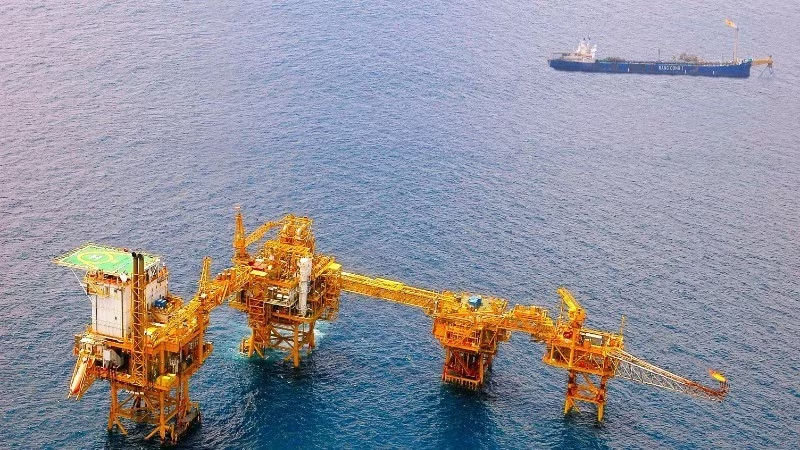
After nearly eight years of implementing Resolution No. 36/NQ-TW on the strategy for sustainable development of Viet Nam's marine economy to 2030, with a vision to 2045, the oil and gas industry has achieved a production output of over 155.2 million tons, with total revenue of 6.3 quadrillion VND, thereby continuing to affirm its leading position in marine economic development.

To maximise development potential, in addition to the self-reliance of enterprises, the state needs to soon complete legal institutions to create conditions for enterprises to confidently invest and develop.
Outstanding results
Le Manh Cuong, General Director of Viet Nam National Industry – Energy Group (Petrovietnam) said that the total oil and gas production of the unit in the 2018-2025 period reached over 155.2 million tons. The group also supplied 37.2 billion cubic metres of dry gas for electricity production, generating over 53 billion kWh/year, equivalent to 33% of the national electricity output, meeting 60% of domestic gasoline and diesel demand and 70% of fertiliser demand nationwide.
These positive results helped the unit's total revenue during this period reach 6.3 quadrillion VND, consolidated pre-tax profit of over 414.5 trillion VND; and contributed 1.08 quadrillion VND to the state budget. The total value of investment implemented over the past eight years reached 256 trillion VND, focusing on resolving difficulties for slow-progressing and inefficient projects. So far, four out of five projects have been removed from the list of 12 problematic projects in the industry and trade sector. National key projects such as the Lot B gas-electricity chain, Ca Voi Xanh, liquefied natural gas (LNG) Son My, and Long Phu 1 Thermal Power Plant are being actively implemented.
The group's units maintained operational efficiency, profitability, and year-on-year growth. The development of overseas services yielded many positive results.
The oil and gas engineering and industrial construction sectors completed many large-scale oil and gas engineering projects. Notably, Petrovietnam is gradually shifting towards sustainable development. Accordingly, the group is promoting offshore wind power projects with potential of tens of GW, developing LNG power plants, and researching carbon capture and storage technologies to reduce emissions. Additionally, offshore oil and gas operations continue to be stable, while also affirming the nation’s sovereignty at sea.
Following this success, the unit's production and business results in the first six months of the year exceeded planned targets by 5.0 to 23.1% compared to the same period last year. Notably, for the first time in 11 years (since 2015), crude oil production increased by 14.2% year-on-year, despite many fields entering a natural decline phase.
With these efforts, the group's financial indicators all exceeded targets and closely followed the government's double-digit growth target for 2026. Total revenue of the group in the past six months reached 734.7 trillion VND, a year-on-year increase of 49%; consolidated revenue reached 445.4 trillion VND, exceeding the plan by 22% and increasing by 39%; and budget contributions totalled 88.9 trillion VND, up 27%.
“In the coming period, the unit will continue to promote investment and development, creating new growth capacity, focusing on key projects such as oil and gas exploration and production, renewable energy, electricity, LNG, and petrochemical refining,” Cuong emphasised.
Expanding the value chain
Besides its achievements, the oil and gas industry is also facing many challenges as oil and gas reserves are naturally declining by 10 to 15% per year, extraction costs are increasing, while the development of new fields requires large resources and more flexible mechanisms.
Therefore, the state, ministries, and sectors need to promptly amend and supplement the mechanism for mobilising existing natural gas-fired power plants, the LNG pricing mechanism, and the allocation of common LNG to plants; complete the legal framework for new fields such as offshore wind power, hydrogen, nuclear power, and carbon capture, use, and storage (CCUS); as well as build incentive mechanisms for exploration and exploitation in deep-water offshore areas, small marginal fields, and offshore renewable energy.
The Ministry of Finance should consider issuing a specific financial mechanism for Petrovietnam as well as adjusting export value-added tax policies, import taxes on intermediate raw materials, and special taxes on Bach Ho crude oil to increase flexibility and efficiency in production and business operations of enterprises.
From a legislative perspective, Ta Dinh Thi, Deputy Chairman of the National Assembly's Committee on Science, Technology, and Environment, affirmed that perfecting the institutional framework is a crucial factor in creating new development space for the oil and gas-energy industry. Therefore, it is necessary to study flexible mechanisms, including controlled testing models (sandboxes), to both ensure risk management and create conditions for enterprises to test new investment models and technologies. Sandboxes can become an important tool to help management agencies and businesses evaluate practices together, towards perfecting policies prior to large-scale implementation.
"During the 16th National Assembly term, several important laws directly related to the energy sector will be revised, including the revised Law on Petroleum, the Law on Electricity, the Law on Environmental Protection, and many other legal documents. This is an important opportunity to improve the institutional framework, create an open legal environment, and promote the development of the energy sector based on new thinking," Thi emphasised.
During the 16th National Assembly term, several important laws directly related to the energy sector will be revised, including the revised Law on Petroleum, the Law on Electricity, the Law on Environmental Protection, and many other legal documents. This is an important opportunity to improve the institutional framework, create an open legal environment, and promote the development of the energy sector based on new thinking.
Ta Dinh Thi
Deputy Chairman of the National Assembly's Committee on Science, Technology, and Environment
According to Thi, alongside focusing on the traditional value chain from search, exploration, and exploitation to processing of oil and gas, the industry should expand into new energy sectors such as offshore wind power, gas-fired power, hydrogen, green ammonia, and other forms of clean energy. This is not only an expansion of investment areas but also a transformation of the development model. In the new energy economy, value lies not only in underground resources but also in technology, data, infrastructure, operational capabilities, and supply chain connectivity capacity.
In addition, the oil and gas industry possesses geological, geophysical, oceanographic, and marine data. If managed, shared, and utilised effectively, this data will not only support oil and gas operations but also contribute to the development of many other marine economic sectors.
Dr Nguyen Huu Luong, Senior Expert at the Viet Nam Petroleum Institute, added that oil and gas had previously been viewed mainly from the perspective of resource extraction. However, in the context of implementing Resolution No. 36-NQ/TW, the revised Petroleum Law should regard the industry as a driver of the marine economy development, closely linked to the effective use of marine space, and marine resources. Viet Nam has vast maritime areas with abundant potential for energy and natural resources, creating favourable conditions for developing marine industries such as offshore wind power, LNG, and marine technical services. Therefore, revising the Petroleum Law will provide a legal foundation for effectively connecting these sectors.
"With its industry advantages, together with decades of basic investigations, geological surveys, and marine resource assessments carried out by the oil and gas sector, a valuable database has been established that will support the development of the marine economy and provide the foundation for future marine energy industrial clusters," Luong affirmed.
Author: NDO
RECOMMENDED TOPICS