VN
VN
 EN
EN
26/07/2026, 02:38
Business economics
Vietnam’s economy in 1H2026: Growth rises in spite of headwinds
Vietnam’s economy has built a relatively favourable position in the first half of 2026. Growth remained strong, key drivers have operated in tandem, and a range of fundamental indicators point to better-than-expected resilience despite ongoing uncertainty around energy prices, geopolitics and global interest rates.
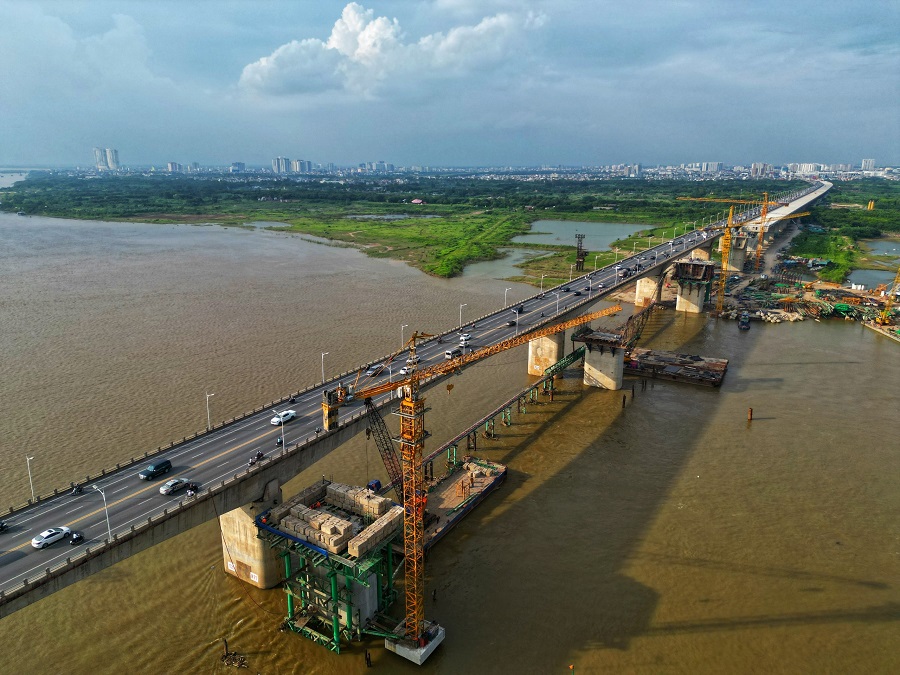
Public investment continued to play an important pillar role, especially in large-scale infrastructure projects. Photo: Quoc Tuan
Getting into gear early, building a solid lead
Q1 2026 closed with GDP growth of 7.83%, showing that the economy entered the new year more proactively, as an assured opening, especially given that the comparison base in the preceding quarters was already relatively high.
What stood out in the first quarter was not a single number, but the quality of the early momentum. The main growth drivers moved into gear quickly, from public investment and industrial production to consumption and services. Part of the foundation for this momentum came from what had been prepared in advance. Public investment continued to play an important pillar role, especially in large-scale infrastructure projects. With infrastructure spending accounting for around 6–7% of GDP - significantly higher than the regional average - Vietnam is using its fiscal space relatively effectively at a time when there is less room for monetary easing.
In short, Q1 showed that the economy did not enter the new year in a reactive stance, but in a proactive one.
Obstacle course
If Q1 2026 was all about getting into rhythm, Q2 2026 was the round that needs closer analysis since the obstacles in this period were driven largely by external rather than domestic factors.
Those were reflected in an environment of heightened uncertainty: geopolitical tensions, especially in the Middle East, kept oil and energy prices elevated; global growth prospects were revised down by many economic institutions; the US Federal Reserve’s (Fed) interest-rate path remained unclear; and global trade continued to be weighed down by high funding costs and cautious sentiment. For a highly open economy like Vietnam, these variables cannot be taken lightly.
Against that backdrop, GDP in Q2 2026 is estimated to have grown at 8.39%, taking first-half growth to 8.18% - well above the same period last year and the highest first-half rate in many years. Notably, the economy not only made it through a more difficult phase but also gained additional points even as global headwinds intensified.
This performance appears to reflect a more balanced growth mix than in previous cycles. Manufacturing and processing remained a key pillar with growth of 10.23% while total exports reached USD266.5bn, up 21%. Unlike periods when growth depended heavily on a single engine, domestic drivers are now contributing more visibly.
Infrastructure investment continued to have spill-over effects into construction and materials, lifting construction sector growth to 9.51%. Domestic consumption recovered in a quite substantive way, with total retail sales up 12.9%. Tourism remained a bright spot, with nearly 12.3 million international arrivals in the first half. When domestic drivers play a larger role, the economy gains additional buffers to absorb external shocks.
On the trade front, electronics exports remained a notable spot. Vietnam continues to expand its role in consumer electronics and technology assembly, while signaling an objective to move up into higher value-added segments. This shift is significant as it reflects not only greater export scale but also a stronger position within regional supply chains.
In terms of foreign direct investment (FDI), registered capital in the first half reached USD 34.65 billion, up 61%, while disbursed capital totaled USD 13.03 billion - the highest level in five years. Registered capital reflects expectations, but disbursement is the clearest expression of confidence, and an important indicator that Vietnam is not only growing fast but also maintaining its appeal to international investors. Even more striking, foreign investors’ capital contributions and share purchases rose by nearly 90%, suggesting that supply-chain relocation into Vietnam is entering a deeper phase: not only greenfield projects, but acquisitions, expansion and immediate utilisation of existing production capacity. This is a positive signal on several levels. First, foreign investors continue to see Vietnam’s medium-to-long term potential despite global uncertainty. Second, the FDI mix is showing more depth, rather than simply capacity expansion in breadth. Finally—and importantly—if absorbed well, these inflows could become a meaningful driver for upgrading production capabilities and improving growth quality in the years ahead.
Q3 will be a test of timing and policy discipline
If Q2 2026 was the test of external shocks, Q3 2026 is more likely to be a test of time pressure. In this stage, the question is no longer simply whether the economy still has momentum, but whether multiple macro pressures will converge at the same time.
On the exchange rate, seasonal pressure is likely to intensify in Q3 2026, as foreign-currency demand for importing inputs for the year-end production cycle is typically higher, and as many foreign-invested firms repatriate earnings. If the Fed continues to delay easing or oil prices remain elevated, the pressure may persist longer than expected.
On interest rates, a widening gap between credit growth and deposit growth would keep liquidity under pressure. With strong growth sustaining high funding demand, while inflation and the exchange rate are also under external pressure, the interest-rate environment will likely continue to reflect a ‘balance’ between supporting growth and preserving macro stability.
Q4 will be a story of confidence and market upgrade
If the first half was a story of growth and resilience, Q4 could be the phase where the decisive factor is confidence - confidence of market, investors and the corporate sector.
Toward year-end, seasonal tailwinds may become more supportive: exports enter a peak shipping period, tourism and remittances typically improve seasonally, and domestic goods supply may better support price-stability objectives. If these conditions align, pressure on the exchange rate and inflation could ease somewhat, making Q4 2026 a more positive finishing stretch for the economy.
In addition, in Q4 2026, a potential equity market upgrade could be seen as a star of hope. If the process remains on track in the coming months, the impact will not be confined to equity prices or short-term sentiment. More importantly, it carries structural significance: an upgraded market could broaden the investor pool able to access Vietnam, improve liquidity, enhance the quality of capital inflows, and strengthen the standing of Vietnamese assets in the eyes of international investors. At the same time, a market upgrade could help generate a more durable supply of foreign currency over the medium term, potentially easing exchange-rate pressures and creating additional room for policy management.
The decisive phase still lies ahead
Overall, the first half of 2026 suggests Vietnam’s economy has completed the first two racing rounds with a positive score. Growth has been broader-based, domestic drivers have contributed more clearly, FDI has continued to serve as an important ‘vote of confidence’, and resilience to external shocks has been more evident than in many prior periods.
However, that pace also makes macroeconomic balances more sensitive. Inflation is moving closer to the target threshold, interest rates remain elevated, and the exchange rate under pressure from both external and domestic factors remains a variable requiring close monitoring. In this context, structural drivers from public investment and higher-quality FDI to the market-upgrade process will be important pillars.
For Vietnam’s economy, the first half has demonstrated an ability to address difficult questions effectively. The rest of the year will require proving something even more important: not only growing fast but also finishing in balance.
Despite challenges, in many economists' opinion, Vietnam's economy is expected to reach double-digit growth in 2026.
Author: Minh Vu, CFA, Associate Director, FX Trading, Markets and Securities Services, HSBC Vietnam
RECOMMENDED TOPICS