VN
VN
 EN
EN
10/07/2026, 02:38
Business economics
Ha Noi promotes green transport through coordinated action
From investing in metro systems and electric buses to introducing support policies for residents, Ha Noi is implementing a series of measures to steer its transport sector towards a greener and more sustainable future.
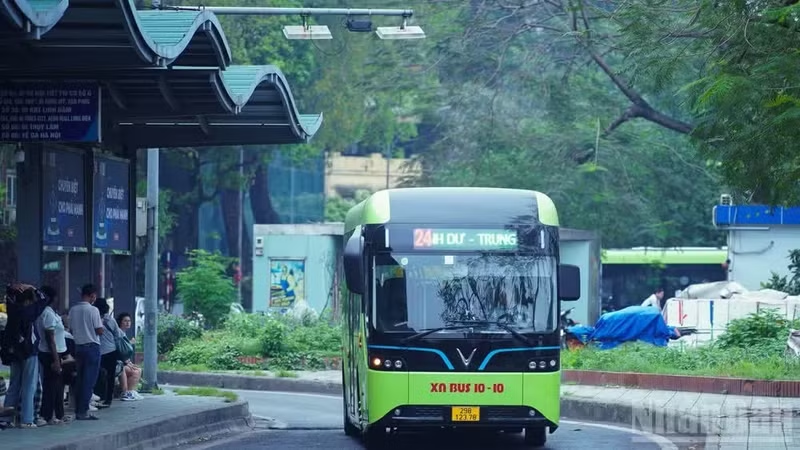
Public transport: the pillar of the green transition
Ha Noi is currently facing serious air pollution challenges, particularly in its inner-city areas. The city has more than eight million vehicles, including around 6.9 million motorbikes and over 1.1 million cars, yet public passenger transport meets only about 20% of travel demand.
The rapid increase in private vehicles has not only placed immense pressure on transport infrastructure but has also driven rising emissions of pollutants such as PM2.5 fine particulate matter, nitrogen oxides, carbon monoxide and greenhouse gases. At chronic congestion hotspots, exhaust fumes accumulate to harmful concentrations, directly affecting environmental quality and public health.
Against this backdrop, addressing emissions at their source has been identified as a fundamental and long-term solution. Experts note that developing green transport is not merely about switching to clean-energy vehicles; the key lies in building a public transport system attractive enough to change people’s travel habits.
Dao Ngoc Nghiem, Vice Chairman of the Viet Nam Urban Planning and Development Association, notes that urban transport challenges cannot be solved simply by widening roads. Instead, urban space must be reorganised to prioritise public transport and improve access to modern mobility options.
Recognising public transport as the backbone of urban development, the Ha Noi government has in recent years focused on developing a multimodal public transport system.
Urban rail services have marked a major turning point for the capital’s transport network. In addition to easing pressure on surface traffic, metro services significantly cut greenhouse gas emissions. Estimates suggest that a single electric train can move as many passengers as thousands of motorbikes, contributing to substantial energy savings.
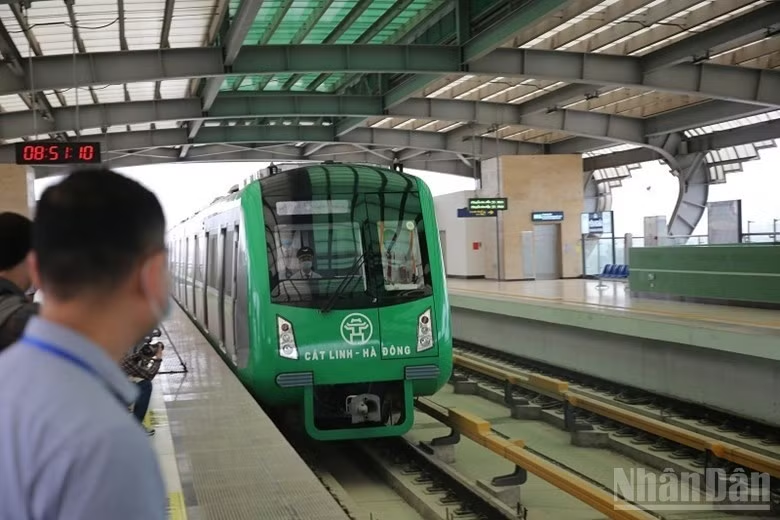
At the same time, the bus network is undergoing a significant green transition. Modern electric buses have been introduced on many routes, gradually replacing their diesel counterparts. Pilot low-emission zones are regarded as a practical measure to encourage residents to adopt more environmentally friendly modes of transport.
Lien Ninh has established itself as a pioneering bus operator, having completed the conversion of its entire fleet to electric buses – 111 vehicles across nine routes. Transerco, the largest public bus operator in Ha Noi, is also actively implementing its own transition roadmap in line with the city’s broader strategy.
Alongside electric buses, the metro system continues to consolidate its position as a leading mode of public transport. In 2025, Ha Noi’s two metro lines served more than 20.6 million passengers, exceeding the annual target by 7.13%. During the first four months of 2026, ridership reached nearly 6.6 million, up 3% year-on-year.
A representative of Ha Noi Metro stated that the goal is not only to increase passenger numbers but also to encourage residents to switch from private vehicles to public transport, a step the operator views as fundamental to reducing congestion and promoting sustainable urban development.
Rather than developing individual modes in isolation, Ha Noi is gradually building an integrated public transport network linking metro lines, electric buses, electric taxis and public bicycles. Public bicycles, in particular, play an important role in last-mile connectivity, improving access to the wider transport system.
Building momentum through policy support
To accelerate the transition, the city is developing and introducing a package of support measures designed to encourage the shift to cleaner transport.
Under a proposed support package for the transition to clean-energy vehicles, the city plans to allocate approximately 6.4 trillion VND (around 244 million USD) from the municipal budget to assist residents and businesses.

Specifically, residents living within the Ring Road 1 area and those meeting eligibility criteria who switch to electric vehicles would receive a subsidy equal to 20% of the vehicle’s value, capped at 5 million VND. Poor households would be eligible for support covering up to 100% of the vehicle cost, capped at 20 million VND, while near-poor households would receive 80% support, capped at 15 million VND. In addition, residents would receive support covering 50-100% of vehicle registration and licence plate fees.
Transport operators would also benefit from incentive schemes designed to accelerate fleet conversion and investment in the required infrastructure.
However, Hoang Duong Tung, Chairman of the Viet Nam Clean Air Association, cautions that the success of these policies will hinge on parallel investment in infrastructure, including charging stations, battery-swapping facilities, and park-and-ride sites, alongside practical financial support measures.
In practice, people are willing to give up private vehicles only when public transport is genuinely convenient, safe and affordable. Therefore, alongside investment in green vehicles, improving service quality, expanding network coverage and strengthening connectivity are equally essential.
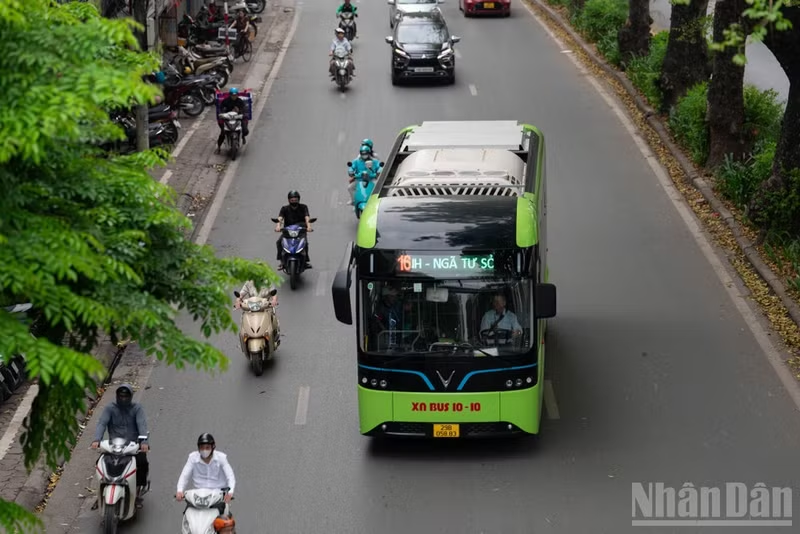
Under current plans, public passenger transport is expected to meet around 35-40% of travel demand in Ha Noi by 2030, a goal that goes beyond the transport sector to encompass controlling private vehicle growth, reducing congestion and improving the urban environment.
Addressing transport challenges is not simply about easing congestion, it also lays the foundation for improving quality of life, reducing pollution and protecting the environment for future generations. Through systematic, determined and coordinated action, Ha Noi is steadily moving toward its goal of becoming a green, liveable, modern and sustainable city.
Author: NDO
RECOMMENDED TOPICS