
 VN
VN
 EN
EN
25/04/2026, 02:38
How gold allocation is done in a portfolio
Experts recommend that, in the current context, investors should maintain gold at around 10–15% of their portfolios as a defensive asset, rather than continuing to raise its allocation excessively.
Gold Under Multiple Pressures
According to data from Kitco, global gold prices declined in the afternoon session of April 23 (Vietnam time), with spot prices at $4,705.6 per ounce, down 0.7% compared to the morning session. Converted at the listed exchange rate of Vietcombank (26,360 VND/USD), global gold prices are equivalent to approximately VND 149.5 million per tael, excluding taxes and fees.
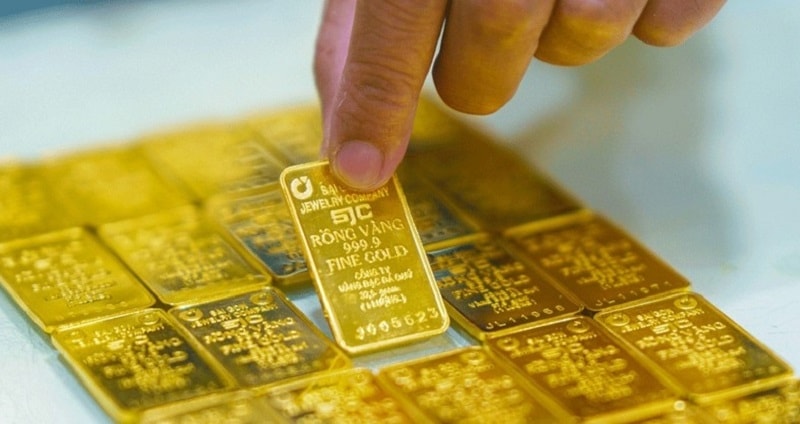
At one point in mid-February 2025, domestic gold prices exceeded VND 93 million per tael. On the afternoon of April 23, SJC gold bars traded in the range of VND 166.7–169.2 million per tael.
Domestically, at Saigon Jewelry Company (SJC), Doji, Phu Quy, PNJ, and other systems, SJC gold bar prices were commonly traded around VND 166.7–169.2 million per tael.
Forecasts for April 24 suggest that global gold prices may continue to edge lower due to the strengthening of the U.S. dollar. However, in the long term, the gold market still has significant supporting factors. According to the World Gold Council, central banks have been net buyers of gold for 23 consecutive months. Many countries, including Poland, Kazakhstan, Uzbekistan, and Malaysia, have increased their gold reserves since the beginning of 2026.
Ông Nguyễn Minh Tuấn, CEO AFA Capital, stated that gold prices are influenced by five main groups of factors.
First is market momentum. In Vietnam, there are currently no true gold ETFs, but globally, investors participate in the gold market mainly through ETFs or commodity exchanges such as COMEX. Therefore, capital flows from retail investors, investment funds, and trading orders all directly create momentum affecting gold prices.
Second is interest rates. When interest rates rise, the opportunity cost of holding gold also increases, as gold is an asset that does not generate cash flow or periodic returns. In principle, interest rates and gold prices often move in opposite directions.
Third is exchange rates, through the DXY index. Gold is priced in U.S. dollars, so when the dollar strengthens, gold prices tend to decline. This is also a fairly clear inverse relationship.
Fourth is geopolitical risk and uncertainty. When geopolitical tensions rise and systemic risk increases, gold typically benefits due to its role as a defensive asset. Therefore, this factor usually moves in the same direction as gold prices.
Fifth is economic growth. When economic growth is strong, demand for safe-haven assets such as gold tends to decline, so this factor usually moves inversely to gold prices.
The question is: from now until the end of 2026, and even into 2027, which factor will have the strongest impact on gold prices? Mr. Tuấn believes that investing in gold in Vietnam should not be about buying today and selling after one or two days. Gold should be viewed as a strategic asset within a portfolio.
Many believe that geopolitical risk will be the most important factor in the coming period, especially as global instability increases. That view has merit, but it is also necessary to assess whether such risks have already been fully priced into gold, or whether from this point onward, factors such as interest rates and exchange rates will become the main drivers.
“In reality, recently, whenever conflict in the Middle East escalates and oil prices surge, gold prices sometimes fall, and vice versa. A review of data correlations over the past 10 years shows that oil prices and global gold prices have often moved inversely in many periods, especially when rising oil prices drive expectations of higher interest rates. Similarly, the DXY and interest rates also show an inverse impact on gold. Therefore, if we want to assess gold prices from late 2026 into 2027, we must clarify the direction of U.S. monetary policy.
There are two key factors to watch: the possibility of a new Fed Chair, which could change policy direction; and the ability of the U.S. to control inflation. If inflation remains persistent, or the U.S. economy enters a state of both weakness and price pressure, the likelihood of interest rates remaining high is very strong, which would be unfavorable for gold,” Mr. Tuấn analyzed.
Looking at oil price forecasts, in a recent report, the International Monetary Fund outlined three scenarios: baseline, adverse, and severe. The scenario currently considered more likely is the adverse one, in which conflict continues through 2026 and gradually eases in 2027. Under this scenario, average oil prices in 2026 could be around $100 per barrel and fall to about $75 in 2027. If this occurs, inflation and interest rate pressures would make it difficult for gold to receive strong support as in previous periods.
Appropriate Asset Allocation
The CEO of AFA Capital also noted that, according to the analytical model of the World Gold Council, there is a notable pattern: gold prices surged in 2024, continued to rise in 2025, and still increased in 2026 but at a significantly slower pace, while in 2027 they may correct downward by an average of about 5.7%. After that, in 2028 and 2029, gold may return to an upward trend.
Gold prices have dropped sharply, from a peak of $3,400 per ounce to around $3,220 per ounce. Investors may maintain gold at around 10–15% of their portfolios as a defensive asset, rather than continuing to increase its allocation excessively.
If this scenario holds, based on proper portfolio management methods, investors do not necessarily need to sell all their gold but may instead stop new purchases and wait for correction phases to re-enter at more reasonable price levels.
However, a cautionary factor for domestic gold prices is the current gap with global prices, which typically ranges around VND 17–20 million per tael. This creates a double risk for gold investors in Vietnam. First, if global gold prices adjust due to interest rates and the U.S. dollar, the base price will face pressure. Second, if the domestic–global price gap narrows due to policy changes, domestic gold prices could face even stronger downward pressure.
“From a wealth management perspective, I believe gold should still be part of the portfolio as a long-term defensive asset. Over a 10- to 30-year horizon, gold still delivers relatively stable returns compared to the U.S. dollar, at around nearly 5% per year. This shows that gold still plays a strategic role. But a strategic role is different from chasing prices at any level.
In our latest wealth management strategy report, our view is that after a strong first quarter, gold is no longer as attractive in the second quarter as before. We recommend maintaining gold at around 10–15% of the portfolio as a defensive asset, rather than continuing to increase its allocation excessively.
For new capital flows, investors may prioritize more liquid assets such as deposits, certificates of deposit, or money market funds, especially in a context where interest rates are expected to remain higher.
The appropriate approach is not to follow the thinking that ‘gold always rises,’ but to place gold within a structured asset management framework—defining its role in the portfolio, controlling its allocation, reducing new purchases when short-term risks increase, and patiently waiting for more suitable correction periods to rebalance,” Mr. Tuấn recommended.
RELATED TOPICS
RECOMMENDED TOPICS