VN
VN
 EN
EN
11/07/2026, 07:27
Business economics
How is the USD/VND exchange rate responding to inflationary pressures?
Pressure on the exchange rate remains present amid continued volatility in the global economy, although the Vietnamese dong remains considerably more stable than many regional currencies.
VNDirect experts assessed the USD/VND exchange rate in the context of a widening trade deficit, inflationary pressure, and a persistently strong US dollar.
Exchange Rate Pressure Amid Inflation
In its May macroeconomic report, VNDirect forecast that the USD/VND interbank exchange rate could reach around 27,100 VND/USD by the end of 2026 and continue rising to approximately 27,778 VND/USD by the end of 2027.
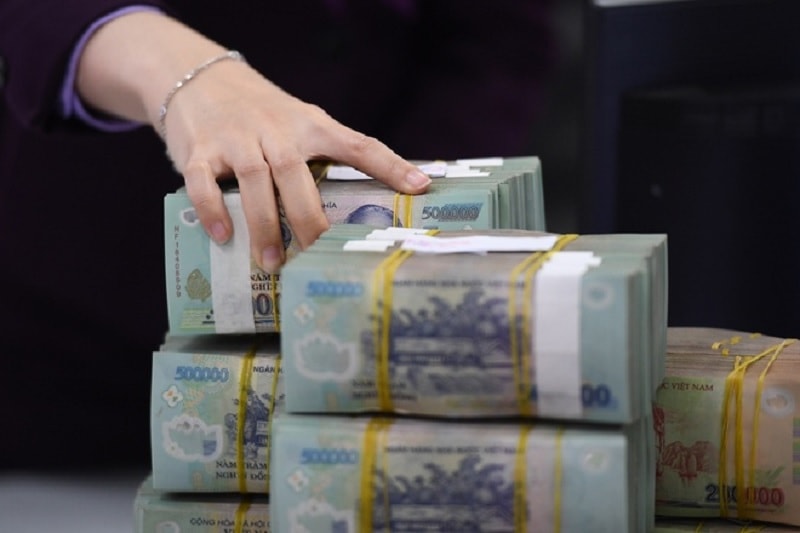
Exchange rate pressure persists amid ongoing volatility in the global economy. (Illustrative photo)
Experts noted that pressure on the exchange rate remains amid global uncertainty, although the Vietnamese dong has stayed significantly more stable than many currencies in the region.
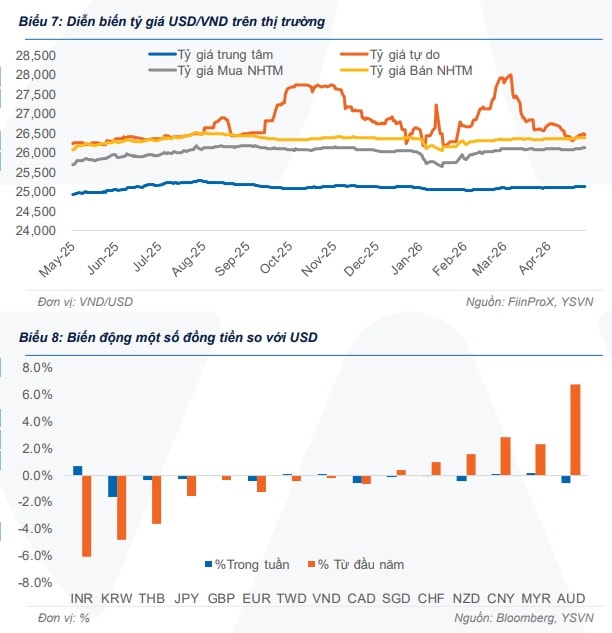
From mid-April to mid-May 2026, the USD/VND exchange rate mainly fluctuated around 26,340-26,350 VND/USD even as the DXY index declined from around 99 points to roughly 98 points.
As of May 15, the Vietnamese dong had depreciated by only around 0.22% against the US dollar, significantly lower than many other Asian currencies. During the same period, the Thai baht weakened by approximately 3.62%, while the Indonesian rupiah lost about 5.5% against the dollar. VNDirect said this indicates that exchange rate pressure in Vietnam is currently relatively lower than in many emerging markets in the region.
According to the report, the USD/VND exchange rate has mostly fluctuated within the 26,000-26,500 VND/USD range since the beginning of 2026, despite ongoing global market volatility driven by geopolitical tensions and expectations that US interest rates will remain elevated.
Experts said the relative stability of the dong has been supported by foreign currency inflows from foreign direct investment and export activity.
The securities firm noted that the USD/VND exchange rate is still under considerable pressure due to imbalances in domestic foreign currency supply and demand. In the first four months of 2026, imports rose 28.7%, significantly outpacing export growth of 19.7%, pushing the trade balance into a deficit of around US$6.8-7 billion. The sharp rise in imports reflects stronger demand for production inputs, particularly in the FDI sector, but also increases demand for US dollars in the market.
Inflationary pressure has also continued to weigh on the exchange rate. Vietnam’s CPI in April 2026 rose 5.46%, the highest level since 2020, while core inflation increased 4.66%. Notably, PMI data showed production input costs rising at the fastest pace in nearly 15 years due to persistently high fuel, logistics, and energy prices. Experts believe this could increase expectations of further dong depreciation in the short term.
Regarding external pressure, with conflicts in the Middle East showing no clear signs of easing, investors continue to seek refuge in the US dollar, especially as gold prices have yet to regain strong upward momentum. Higher US Treasury yields are supporting the dollar and putting pressure on Asian currencies, including the VND. According to VNDirect, foreign currency supply may improve further in the coming period thanks to strong FDI disbursement, a rebound in exports, and increased international borrowing by domestic enterprises. This could give the State Bank of Vietnam greater room to manage monetary policy flexibly, maintain reasonable interest rates, and support economic growth in the second half of 2026.
Another factor adding pressure to exchange rate management is Vietnam’s recent classification in the US Special 301 Report. The Office of the United States Trade Representative (USTR) placed Vietnam on the Priority Foreign Country (PFC) list, the highest warning category for countries accused of serious intellectual property violations. Concerns include weak enforcement against online copyright infringement, insufficient anti-counterfeit measures, unlicensed software use, and satellite signal piracy.
Analysts at SHS Securities said this poses a high-risk threat with potentially broad economic consequences. Beyond possible impacts on export sectors heavily dependent on the US market, such as wood products and textiles, some experts warned that without appropriate countermeasures, declining export turnover could weaken foreign currency inflows. Market psychology could also encourage USD hoarding.
However, experts also noted that Vietnam still has time to negotiate and implement corrective measures, which could ease pressure on the exchange rate while maintaining positive long-term prospects for exports and FDI in 2026.
Short-Term Exchange Rate Developments
During week 20 of 2026, from May 11-15, the USD/VND exchange rate edged up sharply as the US dollar rebounded significantly. Globally, the dollar strengthened amid new developments in Middle East geopolitical tensions and rising inflationary pressure caused by prolonged energy supply disruptions. This fueled expectations that the Federal Reserve would continue tightening monetary policy despite Kevin Warsh having just begun his term as Fed Chair.
In the domestic market, the interbank USD/VND exchange rate rose 0.16% during the week to 26,352 VND/USD, driven by the global dollar rally and continued net selling by foreign investors in Vietnam’s stock market.
Entering week 21, from May 18-22, the US Dollar Index was largely flat, slipping 0.05% week-on-week to 99.24 points after rising sharply the previous week. The dollar was also supported by elevated US Treasury yields and growing market expectations that the Fed may need to raise interest rates further. Minutes from the April FOMC meeting showed renewed consensus among policymakers that further tightening could become necessary if inflation remains above 2%.
The USD/VND exchange rate increased slightly in the official market. The central exchange rate ended the week at 25,134 VND/USD, up 0.01% week-on-week. Commercial bank buying and selling rates stood at 26,130 and 26,390 VND/USD, respectively, rising 0.09% and 0.01% week-on-week. Notably, according to Yuanta Vietnam data, the free-market exchange rate climbed to 26,480 VND/USD, up 0.46% week-on-week after several weeks of cooling.
“Overall, the USD/VND exchange rate increased slightly, especially in the free market, despite the DXY trending downward. This week, expectations of a possible peace agreement between the US and Iran may improve global market sentiment, thereby supporting greater stability in the USD/VND exchange rate,” Yuanta Vietnam experts commented regarding short-term exchange rate developments.
Author: LE MY - TRUONG DANG
RELATED TOPICS
RECOMMENDED TOPICS