VN
VN
 EN
EN
09/07/2026, 11:15
Investment
Hue City: New Status Opens Space for Breakthrough Development
Upon becoming a municipality (centrally-governed city), Hue embraces a new status, a new mission, and a new development aspiration.
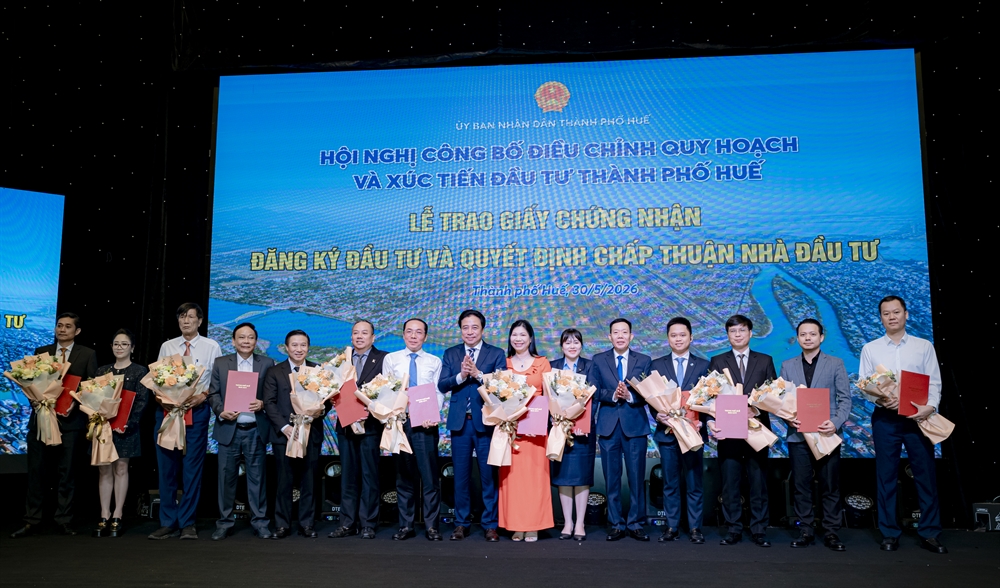
Hue city leaders present investment registration certificates and investment policy decisions for key projects. (Photo: Hue.gov.vn)
From this foundation, the city will continue to leverage the value of its imperial heritage and distinctive cultural identity, while advancing towards a cultural, heritage, ecological, landscape-oriented, eco-friendly, and smart urban area.
Shaping the Development Path with a Strategic Vision
This statement was made by Mr. Nguyen Khac Toan, Chairman of the Hue City People's Committee, during his address at the Conference on Announcing the Adjusted Hue City Master Plan for the 2021–2030 Period, with a Vision to 2050, and Investment Promotion 2026, held on May 30.
The event marks a major shift in development mindset, opening up new spaces, momentum, and breakthrough opportunities for the former imperial capital as it transforms powerfully within its status as a municipality.
The Chairman of the People's Committee emphasized that this adjustment not only establishes development spaces but also shapes the city's long-term development path with a strategic vision, breakthrough mindset, and persistent determination. The master plan clearly identifies spearhead economic sectors, growth-driving regions, and strategic breakthroughs to enable Hue to develop faster, deeper, and more sustainably. This orientation is built upon a harmonious combination of heritage conservation and value promotion with innovation; marine and lagoon potential with a green economy; and science-technology, digital transformation, and a highly competitive, modern growth model. The ultimate goal is to build Hue into a landmark urban area of Vietnam and the region.
A Heritage, Smart, and Ocean-Oriented Urban Area
According to Decision No. 756/QD-UBND dated February 28, 2026, issued by the Chairman of the City People's Committee approving the Adjusted Hue City Master Plan for the 2021–2030 Period, with a Vision to 2050, Hue strives to become a distinctive Festival city of Vietnam. It aims to be a major, unique Southeast Asian hub for culture, tourism, and specialized healthcare, as well as a key national center for science and technology, innovation, digital transformation, and high-quality education and training.
The city also aims to become a strong national marine economic center, developing a heritage economy and cultural industries on the foundation of a green and digital economy, while ensuring national defense and security, and improving citizens' quality of life. By 2050, Hue is envisioned to become a major urban center with a high level of economic development and a top-tier quality of life nationwide. It will serve as a hub for culture, tourism, education, science-technology, and specialized healthcare for both Vietnam and Asia, while standing out as a safe, friendly, and happy destination.
To realize these goals, the adjusted master plan incorporates numerous strategic components into its sectoral development orientations. Hue will focus on developing an international logistics hub and a Free Trade Zone linked to the Chan May Port and Phu Bai International Airport, while fostering digital tech, semiconductor, clean energy, and new materials industries. Within the economic structure, the marine and lagoon economy is identified as a critical growth engine, projected to contribute approximately 45–50% of the city’s GRDP, alongside cultural industries which are expected to account for around 10% of GRDP by 2030. In healthcare, education, science-technology, and innovation, the city prioritizes building a collaborative ecosystem connecting universities, research institutes, and enterprises, while accelerating digital transformation, AI application, and high-quality human resource development.
Regarding spatial organization, the adjusted master plan divides Hue into 6 development zones: the heritage zone, the central zone, the northern zone, the Chan May - Lang Co zone, the western ecological zone, and the western-southern ecological zone. Spatial connectivity is driven by two dynamic economic corridors: the North-South corridor along the eastern urban route and National Highway 1A, and the East-West corridor along National Highway 49, alongside other vital corridors including the coastal road and National Highway 14.
Hue's development model continues to be defined as a Class I urban area characterized by heritage, green growth, smart features, ocean orientation, and climate change resilience. Among these, three dynamic urban clusters—the central urban area, Phong Dien urban area, and Chan May urban area—will drive growth. The Chan May - Lang Co Economic Zone will remain a pivotal growth pole with an eco-friendly and sustainable development focus.
Concurrently, the city is studying the establishment of a high-tech zone, a concentrated digital tech park, and a science, technology, and innovation urban zone to attract high-value-added industries. This will be accompanied by plans to systematically complete technical and social infrastructure to meet modern urban development demands. These goals will be operationalized through 7 core groups of solutions, including perfecting mechanisms and policies, mobilizing investment resources, developing high-quality human resources, promoting science and technology, strengthening regional linkages, controlling urban-rural development, and improving implementation efficiency.
Realizing the Master Plan via Key Investment Projects
At the Conference, the Hue City People's Committee awarded Investment Registration Certificates and Decisions on Investor Approvals to 12 key projects with a total capital of over VND 18,400 billion. These projects focus on industrial park infrastructure, social housing, education, commerce, and tourism services.
Prominent among these are the VSIP Hue Industrial Park Project with an investment of VND 3,075 billion; industrial park and non-tariff zone infrastructure projects in the Chan May - Lang Co Economic Zone; along with various educational, tourism, and commercial projects. These ventures are expected to generate strong momentum for investment attraction and drive the city's socio-economic growth in the coming period.
The Chairman of the Hue City People's Committee, Nguyen Khac Toan, emphasized that announcing the adjusted master plan is not just about finalizing a development blueprint, but also about creating a solid foundation, momentum, and confidence for the city's new development chapter. In the coming time, the city will earnestly take into account the feedback of experts, scientists, businesses, and investors to continuously refine its development mindset.
He affirmed that the government will swiftly concretize the master plan into programs, projects, and action plans with clear timelines, responsibilities, and deliverables. The city will focus on mobilizing and efficiently utilizing resources, prioritizing spillover projects with high added value and the potential to generate new development momentum. It will also continue to improve the investment climate, standing side-by-side with enterprises and investors.
The Chairman expressed his firm confidence that, with the attention of the Central Government, the coordination of ministries, sectors, and localities, the partnership of the business community, and the consensus of the People, Hue City will step by step realize its development aspirations.
Author: Nguyet Ha
RECOMMENDED TOPICS