VN
VN
 EN
EN
08/07/2026, 02:38
Investment
KBC ahead of a new game
Industrial park (IP) real estate developers are standing before a new game that is reshaping foreign direct investment (FDI) inflows, with new prospects increasingly focusing on quality.
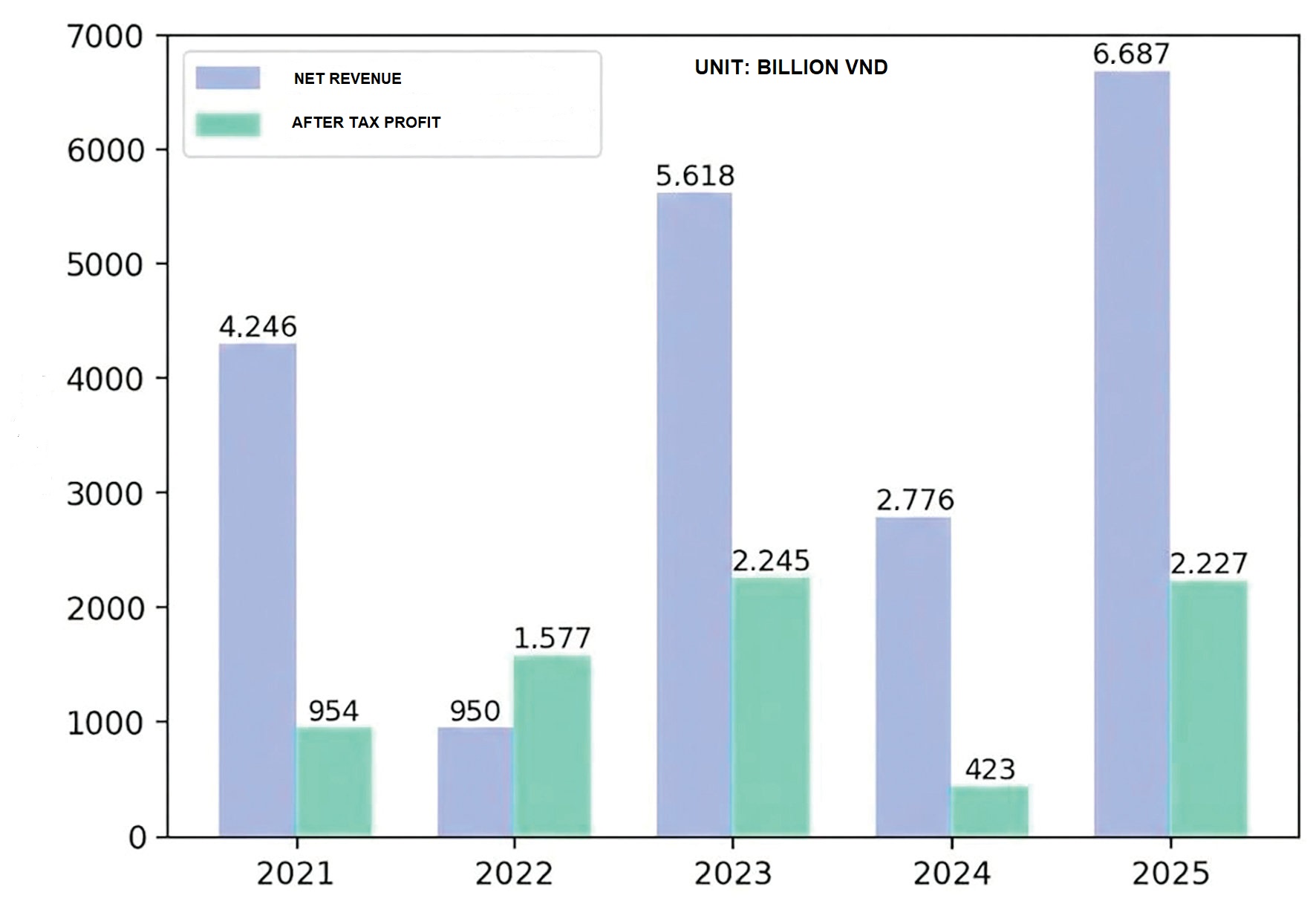
KBC's net revenue and profit over the years. Source: DNSE
The advantage belongs to industry leaders like Kinh Bac City Development Holding Corporation (HoSE: KBC), which owns projects in strategic locations across key industrial hubs in the North that attract major technology corporations.
Factors Reshaping FDI
According to analysts from SSV, FDI inflows are experiencing a shift in terms of geography, country of origin, and industry. Specifically, the migration from traditional industrial areas with excessively high occupancy rates (such as Bac Ninh, Hanoi, and Dong Nai) to provinces with abundant land funds like Thai Nguyen and Nghe An is becoming evident, driven by their ability to attract mega-projects in high-tech and energy sectors. Along with this, foreign capital is primarily led by Singapore and South Korea with breakthrough growth compared to the same period last year, while investment from traditional partners like China and Japan tends to weaken due to the impacts of global tariff policy changes.
In terms of industries, the 2022–2025 period marked a transition from labor-intensive sectors to high-value-added high-tech industries. The light industry and consumer goods sector saw its share drop sharply from 39% in 2022 to just 11% in 2025. Conversely, cash flows poured heavily into smart manufacturing hubs, including chemistry and healthcare combined with mechanics, manufacturing, and automation (accounting for a total of 48% of the structure in 2025). The supporting backbone infrastructure, consisting of logistics and industrial infrastructure, accounted for 31%, while mega energy projects made up 30% of the 2025 structure.
Amid this general landscape, the strategic orientations for FDI economic development for the 2026–2030 period, recently issued by the Politburo in Resolution No. 10-NQ/TW, open up a "screening" process for FDI, pivoting toward quality. Accordingly, the mission for industrial park real estate enterprises providing strategic infrastructure is to anticipate these shifting trends and align with the FDI filtering process, which includes becoming green industrial park providers to attract sustainable FDI capital.
The Story of KBC
KBC's subsidiaries own a massive land bank of approximately 8,000 hectares, including both industrial and residential land. Most of KBC's land areas are located in strategic positions within key industrial hubs in the North. A standout feature of KBC to date is its tenant portfolio, which gathers major global corporations such as LG, Foxconn, Canon, and Goertek. With the new direction of attracting high-tech FDI in electronic industries, semiconductor chips, AI, Big Data, IoT, biotechnology, advanced medicine, and modern logistics, KBC has positioned itself on the right track.
An evaluation from Vietcap highlights KBC's core benefits from the wave of global manufacturing supply chain shifts to Vietnam. This advantage is validated by its high-quality tenant roster and abundant land bank concentrated in the North. The company is also ready to expand its land funds to continue capturing relocation opportunities and increase land handovers in the future. By the end of Q1 2026, KBC’s remaining commercial industrial land under control was estimated at around 2,500 hectares, including 500 hectares that have completed site clearance and are ready for the market.
KBC is projected to increase its industrial land handover area by about 28% to 157 hectares (with approximately 15 hectares already handed over in Q1 2026), driven by Trang Due 3 IP, Que Vo 2 IP expansion, Nam Son Hap Linh IP, and industrial parks in Long An (Tan Tap and Loc Giang). Looking solely at its industrial park portfolio, besides currently operating projects like Que Vo 1, Que Vo 2, Trang Due 1, Trang Due 2, Quang Châu, and Que Vo 2 expansion—all of which are 100% occupied—KBC still has industrial parks wide open for tenants, such as Tan Phu Trung, Nam Son Hap Linh, and Trang Due 3 IPs.
The company also boasts several projects approved by the Government that are awaiting exploitation, including:
- Loc Giang IP: 466 hectares
- Tan Tap IP: 654 hectares
- Kim Thanh 2 IP (Phase 1): 235 hectares
- Binh Giang IP: 148 hectares
- Phu Binh IP: 675 hectares
- Song Hau 2 IP: up to 380 hectares
This will serve as a massive source of revenue from land handovers and a major growth engine for the company, even without factoring in land sales and product handovers from existing urban areas that KBC has temporarily deferred.
Nevertheless, by the end of the first quarter, KBC recorded a net revenue of over 1,335.9 billion VND, a 56.2% decrease compared to the same period last year. In particular, revenue from land and infrastructure leasing dropped from nearly 2,483.7 billion VND to approximately 731.6 billion VND. Q1 2026 net profit reached nearly 234.3 billion VND, down 72.4% year-on-year. After Q1, KBC completed 13.4% of its revenue target and 7.8% of its post-tax profit target for the year.
Despite these figures, Vietcap experts evaluate KBC's long-term industrial park outlook as highly positive. The short-term decline can be attributed to higher net debt by the end of Q1 2026 (primarily to finance the development of the Trang Cat urban area mega-project and the Trump International Hung Yen project), along with assumptions of a delayed launch schedule for the Trang Cat and Phuc Ninh urban areas, as well as technical factors including changes in asset valuation models.
While FDI investments do not easily pivot or change decisions based on short-term factors, KBC's relatively high reliance on FDI tenants related to the electronics sector—many of whom depend on the US as a key export market—carries underlying risks from adverse tariff policies that could arise in the future.
Author: LE MY - TRUONG DANG
RELATED TOPICS
RECOMMENDED TOPICS