VN
VN
 EN
EN
25/07/2026, 02:38
Investment
Real estate enters a price adjustment phase
MB Securities Joint Stock Company (MBS) forecasts that the real estate market will remain gloomy from now until the end of the year due to high borrowing interest pressure amid a large supply.
According to the MBS report, in the second quarter of 2026, deposit interest rates at banks increased by about 1 to 1.5 percentage points compared to the previous quarter. This has driven real estate loan interest rates up to 13% to 14% per annum, which is about 2 percentage points higher than the same period last year.
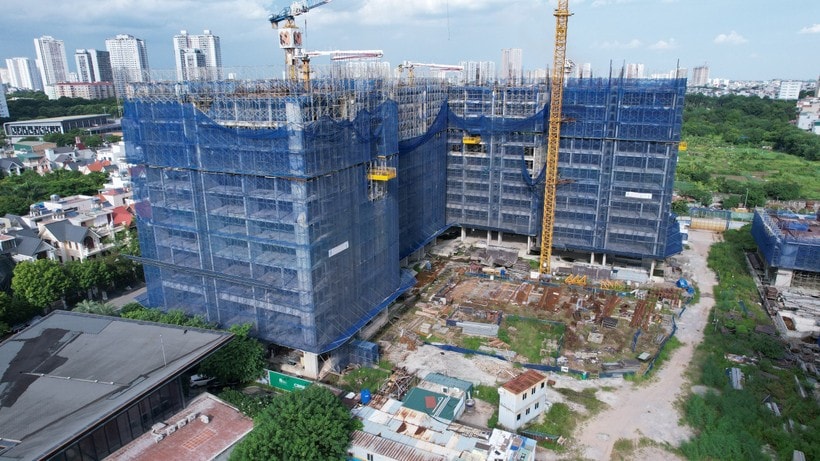
Rising land costs and construction material prices are also posing barriers to real estate M&A.
Home loan interest rates remaining at a high level, combined with an increasing supply, are putting pressure on selling prices and investor sentiment.
High Loan Interest, Incentives Insufficient to Stimulate Demand
To stimulate demand, many developers have implemented financial support programs, such as fixing interest rates at 7% to 8% for the first two years at new projects in Hanoi, Quang Ninh, and Ho Chi Minh City.
However, according to MBS Research, these incentive policies have not yet been enough to give the market a boost, as the majority of investors worry that interest rates will remain high for an extended period. The unit noted that transaction prices at some apartment projects have decreased by about 5% compared to the first quarter. Particularly in Hanoi, the landed property market has also recorded slower transactions, with selling prices adjusting amid the capital's announcement of its 100-year master plan.
Sharing the same viewpoint, OneHousing stated that market liquidity slowed down significantly in the first half of the year. The average absorption rate at primary projects only reached about 50% to 60%, much lower than the rate of over 80% seen in the same period last year.
Mr. Tran Quang Trung – Business Development Director of OneHousing – argued that declining liquidity does not mean cash flow has left the market. According to Mr. Trung, the demand for real estate ownership still exists, but buyers are considering selling prices, financial capacity, and the prospects of each project more carefully before committing their money.
Actual transaction developments show that price levels in many areas that previously surged during the 2023–2025 period have begun to adjust.
A survey by Enterprise Forum (Diễn đàn Doanh nghiệp) recorded that in a mega-urban area in Western Hanoi, a studio apartment with an area of about 28 m² that was once offered for 3.1 billion VND has now dropped to only about 2.4 billion VND. Many neighbouring apartment buildings also saw prices decrease from around 95 million VND/m² down to about 75 million VND/m².
In the Tay Ho Tay (West Lake West) area, the resale market also showed a clear downward price trend. Many apartments previously listed at 145 to 155 million VND/m² have now dropped to around 120 to 135 million VND/m². Quite a few apartments adjusted from a price range of over 11 billion VND down to about 9 to 10 billion VND, equivalent to roughly 100 to 120 million VND/m².
In the Ngoai Giao Doan (Diplomatic Corps) area, apartments in buildings like N01, N03, or Han Jardin, which used to be offered at over 110 to 120 million VND/m², are now commonly priced around 100 million VND/m² if the owners need a quick sale.
The cooling trend has also spread to satellite cities. In Ecopark (Hung Yen), apartment prices are currently about 10% lower than the peak set in 2025. Meanwhile, in a neighboring mega-urban project, many owners have accepted selling below the price stated in their sales contracts, with cutting losses of 300 to 500 million VND per unit being common in order to improve liquidity.
Data from Batdongsan.com.vn also reflects this trend, as the average listing price on the platform currently stands at around 85 million VND/m² and has decreased consecutively for the past three months.
Increasing Pressure of Market Filtering
According to Ms. Nguyen Ly Ly – Market Research Manager at Cushman & Wakefield Vietnam, each segment is facing different liquidity pressures. Particularly for apartments, secondary investors are bearing heavy capital costs while having to compete directly with new projects launched by developers offering attractive price incentives and financial support.

The real estate market enters an adjustment phase as liquidity declines, and many investors accept cutting prices to find buyers.
In addition, the growing new supply and the increasing number of projects preparing for handover are intensifying the pressure on this group of investors to offload their properties. This forces many to adjust their profit expectations in order to find buyers quickly.
From a corporate perspective, Mr. Nguyen Chi Thanh – General Director of West Lake International Building Company – stated that many investors accepting lower profit expectations or selling at a loss is a normal reaction when market liquidity declines. In a context where cash flow is tightened, the priority goal for many is to recover capital quickly rather than continuing to hold onto the asset.
According to Mr. Thanh, investors need to proactively review their financial capacity, calculate capital costs, and build appropriate risk management plans instead of continuing to expect price increases like in the previous period.
Meanwhile, real estate expert Rich Nguyen pointed out that continuing to "hoard goods" in Hanoi with expectations of strong short-term price increases carries many risks. After a period of overheating, profit margins have narrowed significantly while the required capital investment is very large.
For investors with limited capital, continuing to chase markets that have already experienced sharp increases could reduce investment efficiency. According to this expert, instead of focusing all resources on Hanoi, investors should consider areas that are still at a low price floor, where infrastructure is being invested in, and where there is still plenty of room for growth.
In the context of the market entering a filtering phase, the critical puzzle is no longer owning real estate in Hanoi at all costs, but rather selecting areas capable of generating investment efficiency and sustainable cash flow in the medium and long term.
Author: DIEU HOA - TRUONG DANG
RELATED TOPICS
RECOMMENDED TOPICS