VN
VN
 EN
EN
16/07/2026, 10:55
Investment
Lam Dong promotes potential of blue marine economy
Lam Dong province has a coastline of approximately 192 km and a marine area of about 20,288 km². It is one of the country’s three key fishing grounds and therefore boasts abundant marine resources. Drawing on this maritime potential, the first Provincial Party Congress of Lam Dong for the 2025–2030 term set out tasks and solutions to better harness opportunities for the development of the coastal and marine area.
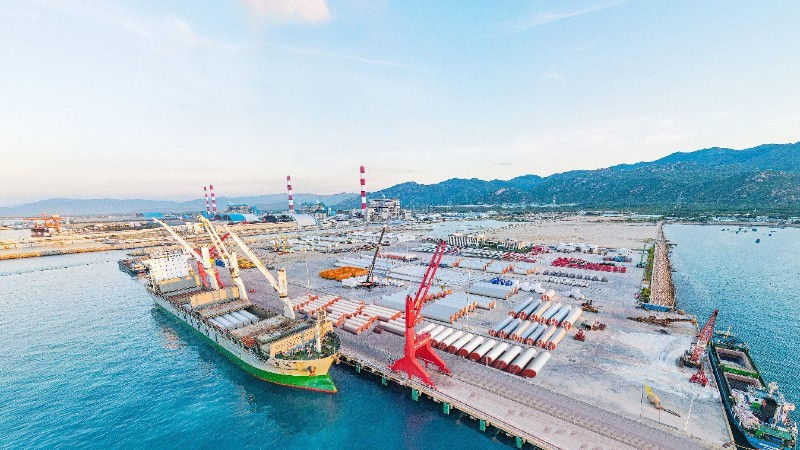
The province places emphasis on the sustainable development of the marine economy, including fishing, aquaculture, seafood farming and “green” tourism. Notably, the sea area features strong winds and a climate that is less affected by storms, creating very favourable conditions for the development of offshore wind power.
Revenue from the sea
Towards the end of the year, seaside tourism in many provinces and cities tends to be sluggish as it enters the low season. By contrast, coastal areas of Lam Dong such as Doi Duong, Mui Ne–Hon Rom, Ham Tien, Tien Thanh, Tan Thuan, Ke Ga and Hon Ba remain lively with visitors sightseeing and swimming. Shops selling local food specialities are also bustling. A restaurant owner on Nguyen Dinh Chieu Street (Mui Ne Ward), Le Anh Vuong, noted that although visitor numbers are lower than in other months, they are still sufficient to maintain operations throughout the fourth quarter.
In recent days, accommodation providers have received encouraging news from the province’s economic development strategy. Nguyen Duc Tien, General Director of Mui Ne Bay Resort (Mui Ne Ward), said that visitors from northern regions and international tourists from Germany, Russia, Finland, the Republic of Korea and Japan are keen to visit the Ham Tien–Mui Ne coast, but transport links have remained inconvenient. The Phan Thiet civil airport (Mui Ne Ward) has recently been approved for operation by the province, promising to attract more domestic and international tourists to the area.
Together with the planning of the Mui Ne National Tourist Area as a leading destination in the Asia–Pacific region, additional state investment in infrastructure, environmental treatment and landscaping will help create favourable conditions to attract investors and visitors.
Ngo Minh Dat said that marine resources are becoming increasingly depleted, so fishermen now only catch fish that meet required weight and size standards. At sea, many vessels also make efforts to protect the environment in order to allow aquatic resources to regenerate.
According to the provincial Department of Agriculture and Environment, in the first 11 months of 2025 total capture fisheries output reached 252,550 tonnes, up 4.79% year on year. There were 3,023 aquaculture cages and 124 shrimp hatcheries, with output of 31,140 tonnes, an increase of 6.7%. More than 8,000 fishing vessels and over ten thousand fishermen are engaged in seafood exploitation. Fisheries account for around 32% of the added value of the agricultural sector.
Recently, offshore wind power has emerged as a major potential area attracting foreign groups. According to the Department of Industry and Trade, with average wind speeds of around 8–14 m/s in the sea area and an average of 5,000–6,000 wind hours per year for power generation, many investors have registered offshore wind power projects with a total capacity of more than 25,000 MW.
Among them, the Thang Long Wind project, with a proposed capacity of 3,400 MW, has been approved in principle by the Prime Minister and the Ministry of Industry and Trade for investor-led research and surveys. Other wind power plant projects under survey include Tan Thuan, with a capacity of 168 MW, annual electricity output of about 529 million kWh and total investment of 5,583 billion VND (212.3 million USD); and Thuan Phuoc, with a capacity of 104 MW, annual output of about 346 million kWh and total investment of 3,801 billion VND (approximately 144.6 million USD).
In addition, investors include Pacifico Energy Viet Nam, Lung Lo Construction Corporation and Thai Binh Duong Group. Offshore, there are three oil and gas fields with output of 80,000 barrels per day, contributing to higher export turnover. Vinh Tan International Seaport (Vinh Hao Commune) comprises one 3,000 DWT berth and two 50,000 DWT berths, with a future development phase adding a 70,000 DWT berth.
A closed-loop chain
Director of the Lam Dong Tourism Promotion Centre Nguyen Linh Vu said that tourism stimulates and supports the development of other industries and trades, helping to create more jobs for local people. Tourist arrivals in coastal areas have increased by an average of nearly 11% per year, with international visitors rising by an average of 12.8% per year. Tourism revenue has grown by around 24% per year on average, while employment has increased by about 12.3% per year.
The fisheries sector contributes around 15% of GRDP, with seafood export turnover reaching 150 million USD. Deputy Director of the provincial Department of Agriculture and Environment Nguyen Van Chien said that shrimp seed production has become a key strength of the province, accounting for more than 25% of national output. Many seafood processing enterprises have applied advanced quality management systems and built value-chain linkages from harvesting to procurement, preliminary processing, processing and product consumption.
Tourism stimulates and supports the development of other industries and trades, helping to create more jobs for local people. Tourist arrivals in coastal areas have increased by an average of nearly 11% per year, with international visitors rising by an average of 12.8% per year. Tourism revenue has grown by around 24% per year on average, while employment has increased by about 12.3% per year.
Director of the Lam Dong Tourism Promotion Centre Nguyen Linh Vu
According to the Provincial People’s Committee, Lam Dong has identified “seafood exploitation, aquaculture and processing” and “renewable energy” as two of six priority marine economic sectors for development, in line with Resolution No. 36-NQ/TW dated October 22, 2018 of the Party Central Committee on the Strategy for the Sustainable Development of Viet Nam’s Marine Economy to 2030, with a vision to 2045.
The province is implementing a project to develop industrial-scale marine aquaculture of high-value species. Fisheries infrastructure is being developed in a synchronised manner, linked with supporting industries and fisheries logistics services to ensure sustainable development. Phu Quy Island is being developed into a regional and national centre for fishing exploitation, logistics services and fisheries trade.
Standing Vice Chairman of the Lam Dong Provincial People’s Committee Le Trong Yen said the province will reduce the number of fishing vessels in line with permitted exploitation capacity, alongside the development of comprehensive management policies to protect aquatic resources. In addition, marine protected areas will be established at Hon Cau and Phu Quy; aquatic resource protection zones at Ham Thuan Nam–La Gi; and time-limited nearshore fishing bans in Phan Ri Bay, Phan Thiet Bay and La Gi. Investment projects will also be implemented to create artificial habitats for marine species, linked with co-management and the development of sustainable livelihoods for fishing communities.
To ensure energy security and economic growth, Le Trong Yen called on relevant agencies to focus on improving the investment and business environment in order to attract enterprises to power generation, green energy and renewable energy projects. Environmental and marine resource protection is always regarded as the foundation of sustainable marine economic development. Accordingly, the province will only approve projects that meet “clean” technology requirements, are energy-efficient and comply with environmental regulations.
In the future, Lam Dong has the opportunity to become a driving centre of a new growth pole from the sea, making an important contribution to the development of a blue marine economy and enhancing Viet Nam’s strategic position in the East Sea/South China Sea.
Author: NDO
RECOMMENDED TOPICS