VN
VN
 EN
EN
10/07/2026, 02:38
Business economics
Low-emission rice farming: benefits and barriers
Three pilot models for low-emission rice farming in the 2026 winter-spring season, implemented in Hung Yen, Ninh Binh, and Hai Phong City, are opening up new directions and laying the foundation for restructuring rice production in the Red River Delta region in a green and sustainable manner.
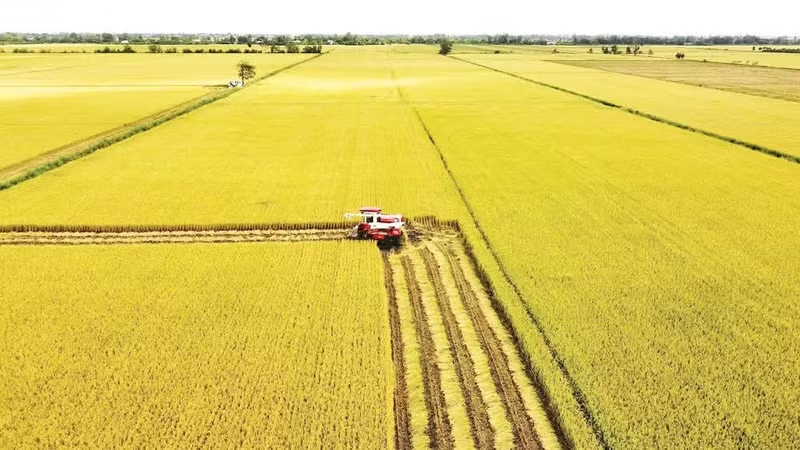
Applying multiple technical solutions in a coordinated manner
Low-emission rice farming models are being implemented within the framework of the Emission Reduction in Crop Production Project for the 2025–2035 period, with a vision to 2050.
This also serves as the basis for building a measurement, reporting, and assessment system for emissions, one of the important foundations if Viet Nam wants to participate more deeply in the carbon credit market in agriculture.
A special feature of these models is the synchronised application of multiple technical solutions, instead of changing individual stages of production.
At Huu Chung Cooperative (Hai Phong City), the model is implemented on an area of 2 hectares, using the VNR20 rice variety with a reduced seed rate of about 45 kg/ha, significantly lower than the traditional method.
The farming process focuses on several key solutions: mechanized row sowing combined with burying fertiliser, helping to control crop density and increase nutrient efficiency; applying the “4 correct principles” in fertilisation, limiting losses and reducing input costs; managing water using the alternating wet-dry method, saving water and reducing methane emissions; and practicing integrated pest management, reducing reliance on pesticides.
According to Associate Professor Dr. Nguyen Van Hung, Senior Expert at the International Rice Research Institute, this synergy is the decisive factor in the model’s success. Applying each solution individually would limit effectiveness and make it difficult to create fundamental changes in production methods.
Multidimensional benefits
In reality, the biggest initial barrier in various localities is the farmers’ reluctance to change. In Tan An Commune (Hai Phong City), Nguyen Duc Manh, one of the households participating in the model, said: “Initially, we worried that sowing sparsely would affect yield.
But after one season, seeing that the rice grew evenly, had fewer pests and diseases, and reduced labour and costs, the farmers began to have more confidence.”
Initial results show that the low-emission rice model brings clear benefits in many aspects. Economically, input costs are significantly reduced thanks to savings in seeds, fertilisers, water, and labour, while yield remains stable.
Environmentally, proper water and nutrient management helps reduce greenhouse gas emissions and limit soil and water pollution.
Socially, the model contributes to changing production mindsets, guiding farmers towards more sustainable practices.
However, the implementation process also reveals many challenges. Traditional farming practices remain a major barrier, requiring time and public awareness campaigns to bring about change.
Uneven mechanisation conditions across localities make it difficult to replicate the model. Furthermore, differences in soil and climate require technical procedures to be flexibly adjusted to each region.
“From these pilot plots, the agricultural sector is gradually building a foundation for low-emission rice production: perfecting technical procedures, establishing an MRV system, and creating a basis for participating in the carbon credit market. This will be a crucial advantage helping Vietnamese rice enhance its value and position in the international market,” said Nguyen Quoc Manh, Deputy Director of the Department of Crop Production and Plant Protection under the Ministry of Agriculture and Environment.
Author: NDO
RECOMMENDED TOPICS