VN
VN
 EN
EN
09/07/2026, 11:15
Investment
Major opportunity to develop the wind power supply chain
Energy demand to support the economy’s high growth trajectory is rising sharply, with wind power expected to play an important role.
Viet Nam possesses significant potential and an emerging ecosystem for wind power development. Experts emphasized at a press briefing for the Asia-Pacific Wind Energy Summit 2026, scheduled for mid-June, that the wind power industry could generate substantial economic benefits for the country.
Mr. Bùi Vĩnh Thắng, Country Manager in Viet Nam for the Global Wind Energy Council, said the world is increasingly shifting toward sustainable development by reducing dependence on conventional energy sources and expanding renewable energy, including solar and wind power. Viet Nam is following the same trend.

Mr. Bùi Vĩnh Thắng, Country Manager in Viet Nam for the Global Wind Energy Council.
The revised Power Development Plan VIII places strong priority on renewable energy development. Under the plan, renewable energy sources excluding hydropower are expected to account for around 28-36% of the power mix by 2030. By 2050, the share is projected to rise to 74-75%.
By 2030, onshore and nearshore wind power capacity is expected to reach between 26,066 MW and 38,029 MW. Offshore wind power is projected at 6,000-17,032 MW, expected to become operational during 2030-2035. Solar power capacity is targeted at 46,459-73,416 MW. Compared with the original Power Development Plan VIII, these figures represent a significant upward revision, particularly for offshore wind.
From an investor’s perspective, Mr. Alessandro Antonioli, Country Manager in Viet Nam for Copenhagen Infrastructure Partners, said Viet Nam holds strong competitive advantages in wind energy thanks to favorable natural conditions, including high wind speeds, stable wind quality, and an extensive coastline.
At the same time, the country’s rapidly expanding economy requires reliable, affordable, and sustainable energy supplies. The ongoing shift of global manufacturing supply chains into Viet Nam is also increasing demand for green energy. According to Antonioli, this presents both a challenge and an opportunity if Viet Nam can establish supportive policies, a clear regulatory framework, and stronger local supply chains.
Mr. Bùi Vĩnh Thắng added that rising geopolitical tensions are pushing many countries to reconsider their energy security strategies and place greater emphasis on renewable energy. Wind power not only strengthens energy security but also supports the development of supporting industries. Countries across the Asia-Pacific region are pursuing similar strategies.
Mr. Nguyễn Tuấn, Head of Commercial at Petrovietnam Technical Services Corporation, highlighted the economic and commercial benefits of offshore wind power. Offshore projects can generate large-scale capacity and maintain higher operating hours than onshore wind farms.
More importantly, wind power development is closely tied to industrial supply chains. The wind power industry can generate major economic gains for the country. According to Tuấn, countries developing wind energy are all pursuing high levels of localization to build domestic wind power industries.
He cited a contract in which PTSC served as contractor for around 6 GW of offshore wind power projects. The company manufactured foundations and 10 offshore substations, generating export revenues worth hundreds of millions of US dollars, creating jobs for around 3,000 workers, and involving nearly 100 domestic enterprises.
The project demonstrated that Vietnamese companies are capable of domestic production and can reduce dependence on foreign supply chains while supporting offshore wind development targets of 6,000-17,032 MW.
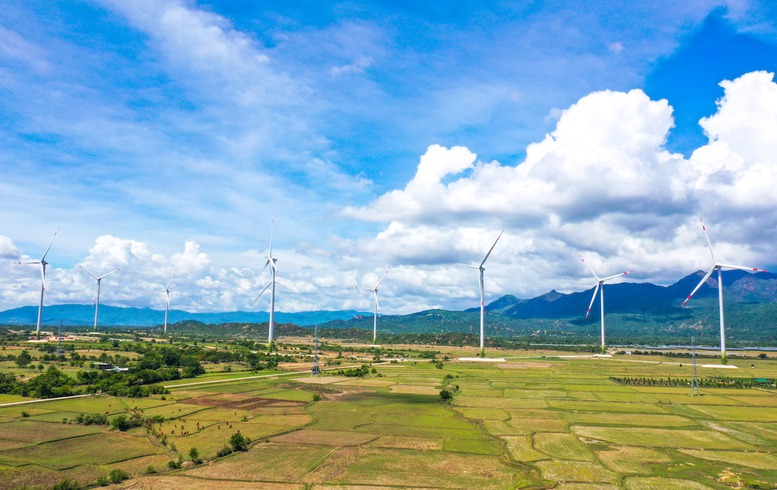
The Ninh Thuan Wind Power Plant No. 5 contributes to bringing Ninh Thuan closer to its goal of becoming the country's renewable energy hub.
Notably, domestic firms are already participating across most segments of the wind power industrial supply chain, which is seen as having enormous long-term potential.
However, Viet Nam’s wind power industry, particularly offshore wind, remains in its early stages. Businesses say stronger government support and incentive policies are needed to help enterprises expand. Most importantly, companies are seeking a stable project pipeline and a clear long-term development roadmap to justify investment in infrastructure.
Describing Viet Nam as one of the most promising wind energy markets in the Asia-Pacific region, Mr. Bùi Vĩnh Thắng said the fourth edition of the Asia-Pacific Wind Energy Summit 2026 will take place in Hanoi from June 9-11, 2026.
The conference is expected to provide a platform for policymakers, businesses, and organizations to discuss key issues shaping the future of the regional wind energy industry while strengthening energy security and economic resilience.
Author: HANH LE
RELATED TOPICS
RECOMMENDED TOPICS