VN
VN
 EN
EN
06/07/2026, 02:00
Business economics
Opportunities for Ha Noi’s satellite towns
According to the Viet Nam Association of Realtors (VARS), Ha Noi is entering an unprecedented phase of large-scale land clearance and infrastructure investment aimed at removing long-standing urban bottlenecks and gradually realising the development vision set out in the Capital Master Plan.
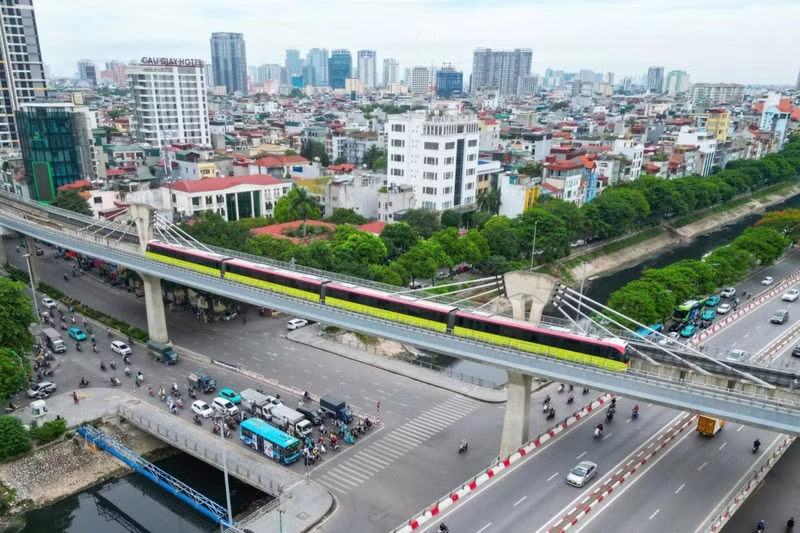
This process represents not only an expansion of urban space but also a comprehensive restructuring of urban space, the urban economic structure and the property market, with a strong shift towards satellite towns.
Since late 2025, Ha Noi has made significant progress in its land clearance efforts. Numerous long-delayed projects have been accelerated, particularly strategic infrastructure works such as Ring Road 4, the Hoang Cau-Voi Phuc section of Ring Road 1, Ring Road 2.5 and 3.5, as well as a series of bridges spanning the Red River, including Tu Lien, Tran Hung Dao, Thuong Cat, Hong Ha and Ngoc Hoi.
At the same time, Ha Noi’s public investment disbursement rate has been considerably higher than the national average. As of April 23, the city had disbursed approximately 31 trillion VND (1.17 billion USD), equivalent to 25.7% of the target set by the Prime Minister, while the national average disbursement rate stood at around 12.6%, according to the Ministry of Finance.
The simultaneous implementation of numerous major projects demonstrates that Ha Noi has entered a distinctly strategic and concentrated phase of infrastructure development, moving from the expansion of a monocentric urban model towards a comprehensive restructuring of its development framework.
If the period from 1990 to 2015 was characterised by administrative expansion and suburban urbanisation, the current phase is marked by a fundamental restructuring of Ha Noi’s urban development model.
In this new context, Ha Noi can no longer rely on land availability or low costs to attract investment. Instead, it must compete through connectivity, infrastructure quality, its ability to attract high-value investment and the efficiency of urban management. This has compelled the city to enter a far more comprehensive restructuring process.
Restructuring urban space and functions
According to VARS, the current restructuring process is not merely about replacing old buildings but about transforming land-use patterns and urban functions.
Old apartment complexes provide the clearest example. These urban structures emerged during the post-subsidy period and are characterised by low land-use efficiency, deteriorating infrastructure and an inability to meet the demands of a modern urban population.
Consequently, the renovation of ageing apartment blocks is not simply a housing issue but also a process of restructuring the value of inner-city land.
At the same time, many factories, warehouses and production facilities within the urban core are gradually being relocated away from central areas. Similar trends have occurred in Seoul, Shanghai and Singapore as urban land values increased and economic structures shifted towards services, finance and technology.
For decades, Ha Noi’s growth was driven largely by the expansion of a monocentric urban area, rapid population growth through migration and the strong development of the inner-city housing market.
The self-built tube house model came to define much of the urban landscape, with densely packed housing lining narrow alleys and limited land allocated for transport infrastructure and green space.
This structure may have been suitable during a period of rapid urbanisation, low development costs and a relatively undiversified economy.
However, as population density and the size of the city have exceeded the capacity of existing infrastructure, the limitations of this model have become increasingly apparent. Traffic congestion, rising logistics costs, overloaded infrastructure and fragmented land ownership have steadily reduced the scope for further development under the old model.
Areas that were once considered peripheral are gradually emerging as new centres for logistics, high-tech industry, urban services and large-scale housing developments.
Whereas under the old urban model, Hoan Kiem Lake and the capital’s central core were regarded as the undisputed centres of locational value, in a polycentric model, travel time to airports, logistics hubs and major transport corridors is becoming an increasingly important determinant of value. This reflects a pattern previously observed in Seoul, Dubai and Singapore as their urban economies shifted towards services, logistics and international trade.
Metro and public transport will reshape the market
VARS notes that over the long term, the metro system could become the single most influential factor shaping Ha Noi’s urban structure. If operated effectively, it will not only change travel behaviour but also reshape population distribution, urban functions and property prices.
In major cities, inner-city industrial land is often redeveloped into mixed-use complexes incorporating housing, retail, office and service functions. Ha Noi is currently following the same path.
Today’s infrastructure projects serve not only to improve transport connectivity but also to redistribute development opportunities across the wider metropolitan region.
Ring Road 4 is perhaps the clearest example. The route is not merely an inter-regional transport project but a key piece of infrastructure for restructuring the development geography of the entire capital region.
As ring roads and other major infrastructure projects are completed, connectivity between different areas improves, triggering shifts in investment flows and land values.
Satellite areas with direct access to metro lines, ring roads or major transport corridors will enjoy significant advantages in attracting residents and investment capital.
Conversely, areas whose price growth is driven solely by infrastructure expectations, without corresponding population growth or genuine economic activity, may face long-term liquidity risks.
This phenomenon has been observed in many major cities worldwide, including Seoul during its urban renewal period, Shanghai during the development of Pudong New Area, Singapore during the expansion of its MRT network, and Tokyo throughout successive railway-led urbanisation cycles.
As infrastructure changes, capital, employment and population patterns shift accordingly, resulting in substantial revaluations of real estate assets.
As Ha Noi enters a period of intensive restructuring, the inherent limitations of housing located in narrow alleyways are becoming increasingly evident, including traffic congestion, insufficient parking, restricted living space, a lack of green areas, fire safety concerns and limited access to modern urban infrastructure.
By contrast, market demand is increasingly shifting towards well-planned developments, including apartment complexes, low-rise housing within new urban areas and integrated satellite megacities supported by coordinated infrastructure.
These projects benefit from modern living environments, comprehensive amenities, superior connectivity and greater planning stability.
Author: NDO
RECOMMENDED TOPICS