VN
VN
 EN
EN
26/07/2026, 02:38
Business economics
Expectations from new salary policy
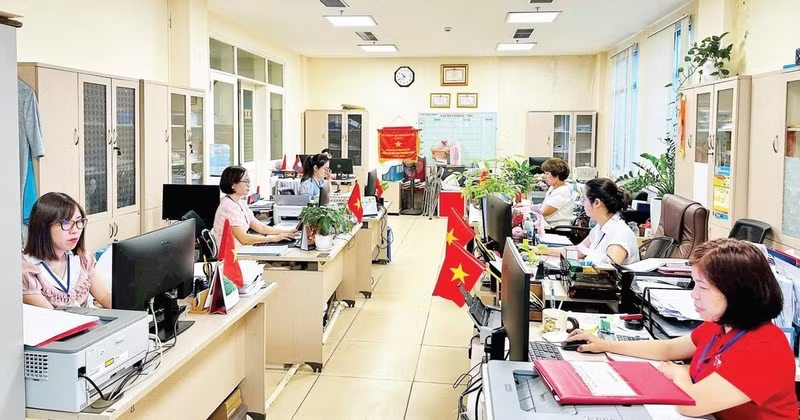
Salary policy has been always most directly affecting the quality of human resources in the public sector. As the administrative system is being streamlined to become leaner and more efficient, the Government's decision to raise the statutory base salary to 2.53 million VND per month from July 1 is expected to provide fresh motivation for public officials, civil servants, employees and members of the armed forces, while laying the groundwork for more far-reaching reforms in the years ahead.
Greater confidence
Having devoted nearly three decades to teaching, Ho Bach Phuong, a teacher at Thang Long Secondary School in Ha Noi, said she was delighted by the announcement of the increase in the statutory base salary. "This decision demonstrates the Party's and the State's genuine concern for public officials and employees, including teachers. Raising incomes at this time is particularly meaningful as living costs continue to rise and professional pressures become increasingly demanding. The salary increase will help improve my family's quality of life to some extent and ease the burden of everyday expenses. Ensuring a decent standard of living for teachers will, in turn, contribute to improving the quality of teaching and learning," she said.
Similarly, Nguyen Trang Thu, an official at the People's Committee of Ngoc Ha Ward in Ha Noi, believes that every adjustment to the salary policy provides significant encouragement for those working at the grassroots level.
After 15 years in public administration, she has witnessed first-hand the growing demands of the job. The volume of administrative work and public service responsibilities has increased, alongside the requirements of administrative reform, digital transformation and new methods of governance.
"Raising the statutory base salary is both necessary and timely. Although the 8% increase does not fully keep pace with today's workload and living costs, it is nevertheless an important source of encouragement for young public servants to continue improving their professional skills and remain committed to public service," she said.
As a mother raising two school-age children, Thu said that the salary policy should continue to be refined so that it better reflects work performance and local circumstances. In densely populated inner-city wards, where workloads are particularly heavy, she suggested that more appropriate allowance mechanisms should be considered. She also emphasised that social housing, healthcare support, educational benefits for officials' children, and transparent systems for performance evaluation and promotion are equally important in encouraging young officials to dedicate themselves to long-term public service.
Comprehensive roadmap to improve public sector livelihoods
Under Government Decree No. 161/2026/ND-CP, the statutory base salary has been increased from 2.34 million VND to 2.53 million VND per month with effect from July 1, 2026, representing an 8% rise.
According to Pham Truong Giang, Director of the Department of Salary and Social Insurance under the Ministry of Home Affairs, the policy should be viewed within the broader context of ongoing reforms to the salary and allowance system for public officials, civil servants and public employees following the introduction of the two-tier local government model.
He noted that immediately after the administrative restructuring implemented on July 1, 2025, the Ministry of Home Affairs began reviewing salary- and allowance-related policies, particularly those affecting commune-level officials and civil servants. Based on the Ministry's recommendations, the Politburo issued Conclusion No. 206-KL/TW on November 10, 2025, providing an important political basis for further policy reform.
In line with this conclusion, the Government promulgated Decree No. 07/2026/ND-CP on January 10, 2026, revising leadership position allowances for commune-level officials and civil servants to ensure consistency with the new organisational model.
The Ministry of Home Affairs also issued Circular No. 23/2025/TT-BNV, revising regional allowances. For newly merged communes, the highest allowance level previously applied among the merged units continues to be used in order to safeguard the interests of officials and civil servants.
In addition, Circular No.24/2025/TT-BNV provides for special allowances for public officials, civil servants, public employees and members of the armed forces working in areas with particularly difficult conditions.
According to the Ministry’s statistics, 31 of 34 provinces and centrally governed cities, covering 1,585 communes—equivalent to 47.73% of all communes nationwide—currently receive regional allowances. Meanwhile, 158 communes across 20 provinces and cities, accounting for 4.76% of the national total, qualify for special allowances.
"The combined implementation of Decree No. 07/2026/ND-CP, Circular No. 23/2025/TT-BNV, Circular No. 24/2025/TT-BNV, and now Decree No. 161/2026/ND-CP has brought about a noticeable improvement in the incomes of public officials, civil servants, public employees and members of the armed forces, particularly those serving at the commune level, " Giang said.
According to the Department of Salary and Social Insurance, a review of the implementation of Government Decree No. 73/2024/ND-CP showed that the previous statutory base salary of 2.34 million VND represented only around 56.32% of the average minimum wage in the enterprise sector. This indicates that the latest adjustment is an objective necessity to gradually narrow the income gap between the public and private sectors.
Another notable feature of Decree No. 161/2026/ND-CP is the continued maintenance of an annual bonus fund equivalent to 10% of the total salary fund. According to Giang, the mechanism is designed to give heads of agencies and organisations greater discretion in formulating bonus payment regulations, allowing greater flexibility in line with the specific circumstances of each institution.
Commenting on the significance of the salary adjustment, Associate Professor Dr Do Chi Nghia, a full-time member of the National Assembly's Committee for Culture and Society, said the decision comes at an important time as Viet Nam accelerates administrative reform, digital transformation and improvements in national governance.
"A professional, effective and efficient public administration can only be built if due attention is paid to its people. A sound salary policy is essential to attracting, retaining and making the best use of high-quality human resources in the public sector," he said.
According to Associate Professor Dr Nghia, raising salaries is only one component of a broader strategy for developing the public sector workforce. Salary reform should continue so that wages genuinely become employees' primary source of income. Remuneration should be linked to job positions, competence, responsibilities and performance, thereby creating stronger incentives to improve the quality of public personnel.
At the same time, higher incomes should go hand in hand with institutional reform, workforce streamlining, digital transformation and more effective public governance.
The increase in the statutory base salary to 2.53 million VND per month, together with ongoing improvements to the allowance, bonus and welfare system, marks an important step towards enhancing the living standards of those paid from the state budget. It is expected to provide stronger motivation for public officials, civil servants, public employees and members of the armed forces to continue contributing to the country's development in the new era.
Author: NDO
RECOMMENDED TOPICS