VN
VN
 EN
EN
26/07/2026, 02:38
Business economics
Economy posts strong growth in first half of the year
Gross domestic product (GDP) growth in the first six months of the year underscores the resilience of the Vietnamese economy and the initial effectiveness of policies designed to stimulate investment, streamlining administrative procedures, decentralising governance, improving the business environment, and maintaining macroeconomic stability.
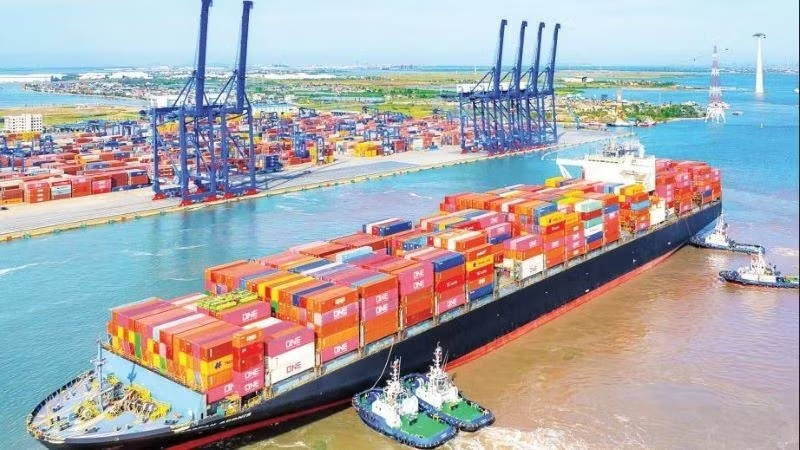
At a press conference on July 3 to announce the socio-economic performance for the second quarter and the first half of 2026, Nguyen Thi Huong, Director General of the Statistics Office, noted that despite lingering uncertainties in both the domestic and global economy, Viet Nam had secured steady economic growth across most sectors and industries.
Bright spots among growth drivers
According to official statistics, GDP surged by 8.39% year-on-year in the second quarter of 2026, 0.25 percentage points higher than in the same period last year. Overall, GDP climbed by 8.18% in the first half of the year, compared with 7.63% in the corresponding period of 2025.
In terms of economic structure, agriculture, forestry, and fisheries accounted for 10.61% of GDP, industry and construction 37.66%, services 43.52%, and product taxes less subsidies on products 8.21%.
Industry and construction continued to serve as a key engine of economic growth, with manufacturing maintaining its role as the leading growth driver. The sector expanded by 10.23%, making the largest contribution to overall GDP growth. The robust performance reflected a recovery in export orders and production capacity, particularly in the country's key manufacturing industries.
According to Nguyen Thi Huong, the robust GDP growth recorded in both the second quarter and the first six months represented the strongest performance in many years, driven by a broad-based recovery across all major sectors of the economy and the combined impact of multiple growth engines. Unlike the same period last year, the economy's traditional growth pillars — investment, exports, and consumption — continued to fuel expansion. Public investment, in particular, emerged as the principal growth driver in the second quarter, propelled by accelerated disbursement, especially for large-scale infrastructure projects with significant spillover effects.
Production and exports continued to affirm their role as the pillars of the economy, demonstrating its resilience and adaptability despite the slow recovery in global demand and persistent external risks. Meanwhile, household final consumption exhibited signs of improvement, helping to stabilise aggregate demand and strengthen the economy's capacity to withstand external shocks. Notably, new growth drivers, including the digital economy, science and technology, and innovation, have been promoted more vigorously and are gradually gaining traction in high-tech manufacturing and service industries, providing additional support for economic growth.
The consumer price index (CPI) fell by 0.39% in June 2026 compared with the previous month, mainly due to lower domestic fuel prices following declines in global oil prices. However, it remained 4.69% higher than a year earlier and 3.21% above the level recorded in December 2025. On average, CPI increased by 4.38% in the first six months of the year, while core inflation rose by 4.12%. These figures suggest that inflation remains under control, although policy room has narrowed as the Government seeks to keep annual CPI growth at around 4.5%.
Ngo Tri Long, an economic expert at the Viet Nam Association of Financial Consultants, said that GDP growth of 8.18% in the first half of the year lays a crucial foundation for achieving the annual growth target, particularly as the country is pursuing faster, higher-quality, and more substantive economic expansion. However, he cautioned that stronger growth would inevitably bring greater inflationary pressures. The consumer price index (CPI) dipped by 0.39% in June 2026 compared with the previous month, mainly due to lower domestic fuel prices following declines in global oil prices. However, it remained 4.69% higher than a year earlier and 3.21% above the level recorded in December 2025. On average, CPI increased by 4.38% in the first six months of the year, while core inflation rose by 4.12%. These figures suggest that inflation remains under control, although policy room has narrowed as the Government seeks to keep annual CPI growth at around 4.5%.
Towards a “dual objective”
Looking ahead to the second half of the year, Nguyen Thi Mai Hanh, Head of the National Accounts Department under the Statistics Office, forecast that the economic recovery would continue to strengthen, supported by macroeconomic stability, sustained growth in industrial production and services, accelerated public investment, and a steadily improving investment climate.
Nevertheless, significant challenges remain. Growth and inflationary pressures are expected to escalate amid lingering global uncertainty, particularly rising trade protectionism, geopolitical tensions, monetary policy adjustments by major economies, and the uneven recovery of global demand. Domestically, the resilience of the business sector remains limited, some traditional growth drivers are displaying signs of fatigue, while emerging drivers have yet to generate a significant breakthrough. Against this backdrop, economic management must pursue the “dual objective” of fostering growth while safeguarding macroeconomic stability.
The Statistics Office also pinpointed several bottlenecks hampering economic growth. Although domestic demand has improved, it remains fragile as consumer spending and business activity continue to be dampened by income constraints and cautious market sentiment. Meanwhile, businesses continue to confront formidable challenges, reflected in the more than 150,000 enterprises that exited the market during the first six months of the year.
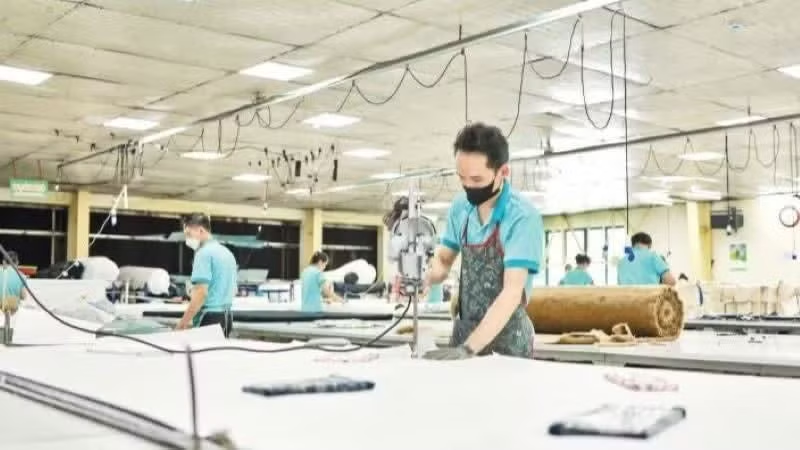
In addition, the implementation of investment projects — particularly public investment — has advanced unevenly across localities. Although exports have continued to grow, they remain heavily concentrated in a limited number of markets and key product groups, leaving them susceptible to changes in international trade policies and other external shocks.
The Statistics Office noted that achieving double-digit economic growth will be a formidable undertaking. To remain committed to this objective, the Government should continue to maintain macroeconomic stability, safeguard major economic balances, keep prices and markets under control, strengthen price management, and regularly update growth and inflation scenarios.
To sustain production momentum, policymakers should focus on driving industrial development by enhancing competitiveness, proactively managing supply chain risks, diversifying sources of supply, and controlling logistics costs. To strengthen consumption as a growth driver, authorities should implement demand-stimulation programmes, promotional campaigns, and supply-demand matching initiatives to boost domestic spending, while accelerating the development of e-commerce and expanding modern distribution networks.
In addition, further efforts are needed to improve the investment and business environment, accelerate administrative reform, reduce regulatory compliance costs, dismantle obstacles confronting businesses, and attract high-quality investment projects with priority given to high technology, innovation, green transformation, and digital transformation.
Author: NDO
RECOMMENDED TOPICS